
Single Dose vs Hopper Grinders: Which Workflow Is Better?
Explore the pros and cons of single dose grinders versus hopper grinders to find the best fit for your coffee brewing workflow and preferences.
COFFEE GRINDERSESPRESSO
The Coffee Tech Buzz Editorial Team - Led by AJ “Buzz” Eichman
4/30/20264 min read
In the world of home coffee brewing, the grinder often plays a decisive role far beyond just size and grind quality. It is a linchpin in the entire coffee preparation system, shaping both the workflow and the consistency of the final cup.
To properly understand how grinder workflow fits into your setup, it helps to anchor it within the broader ecosystem of Coffee Grinders, especially when refining espresso-specific performance through the Complete Espresso Grinder Guide.
Choosing between single dose grinders and hopper grinders is not merely about the grinder’s type or capacity, but about how these choices integrate with your brewing habits, maintenance routines, and your overall system’s efficiency.
Quick Verdict
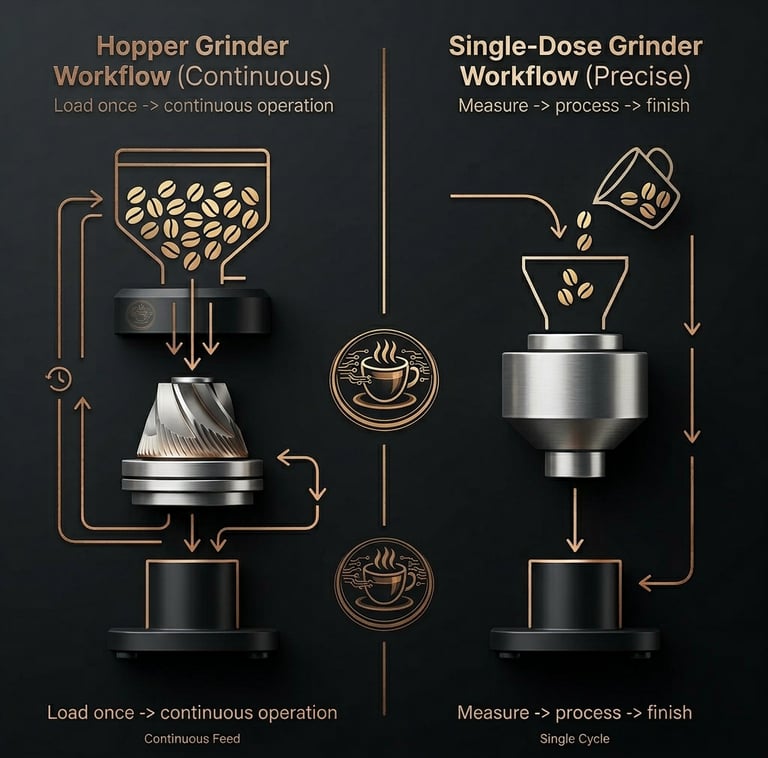
Single dose grinders enhance freshness and dosing precision by requiring manual bean loading for each brew
Hopper grinders excel at speed and capacity with continuous bean feeding
Single dose setups require more cleaning and calibration
Hopper grinders require attention to bean freshness in the hopper
The best choice depends on your workflow, not just grinder specs
Overview of Single Dose Grinders: How They Work
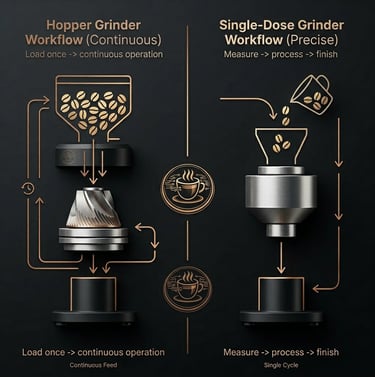
Single dose grinders operate on a simple principle: you load the exact amount of beans needed for a single brew cycle each time you grind.
This eliminates long-term bean exposure and gives you tight control over dosing—something especially important when dialing in espresso variables. If you're still exploring entry-level setups, options in Best Espresso Grinders for Beginners often highlight single-dose-friendly workflows.
However, this manual approach introduces more steps. Measuring beans, loading each dose, and cleaning become part of the process. That added effort pays off in freshness and control but requires consistency in routine.
Overview of Hopper Grinders: How They Work
Hopper grinders store a bulk supply of beans in a built-in container, feeding them continuously into the burrs during grinding.
This system prioritizes convenience and speed, making it ideal for multi-cup brewing or busy routines. It’s also common in more budget-conscious setups, where models featured in Best Espresso Grinders Under $300 often lean toward hopper-based designs for ease of use.
The trade-off is freshness. Beans sitting in the hopper are exposed to air, which can degrade flavor over time if not managed properly.
Comparing Workflow Efficiency: Speed vs Precision
The real difference between these two grinder styles comes down to workflow.
Single dose grinders slow things down intentionally. You measure, grind, adjust, and repeat. This supports precision, especially when dialing in espresso shots. If you're trying to refine extraction, pairing this approach with troubleshooting guides like Why Your Espresso Shot Is Too Fast or Too Slow helps tighten results significantly.
Hopper grinders, on the other hand, are built for speed. Beans are always ready, and grinding multiple doses becomes quick and seamless.
Neither workflow is inherently better—it depends on whether you prioritize control or efficiency.
Maintenance and Cleaning Considerations
Maintenance plays a major role in how each workflow performs over time.
Single dose grinders require more frequent cleaning since oils and fine particles build up quickly with fresh dosing. Hopper grinders, while needing less frequent burr cleaning, require attention to bean turnover to avoid stale coffee sitting in the hopper.
If you're trying to evaluate long-term usability, understanding the fundamentals in What to Look for in an Espresso Grinder helps connect maintenance to real-world performance.
Impact on Coffee Freshness and Consistency
Freshness is one of the biggest advantages of single dose grinders. By grinding only what you need, you minimize exposure to air and preserve flavor integrity.
Hopper grinders introduce variability here. While convenient, beans stored in the hopper can lose freshness over time, especially in lower-use setups.
Consistency also ties into grinder design and burr behavior—something that becomes clearer when comparing grinder builds directly, like in Turin DF54 vs Baratza Encore ESP, where workflow and grind retention differences are more noticeable.
Buyer Considerations: Use Case and Experience Level
Choosing between these workflows depends heavily on how you actually make coffee day to day.
Single dose grinders are ideal for low-volume, precision-focused brewing
Hopper grinders are better for high-volume, convenience-driven routines
If you’re moving into more refined setups, stepping up to higher-performing grinders—like those found in Best Espresso Grinders Under $600—can help close the gap between convenience and precision regardless of workflow.
Common Mistakes and How to Avoid Them
Not cleaning single dose grinders frequently enough
Letting beans sit too long in hopper grinders
Choosing a workflow that doesn’t match your daily habits
Overestimating how much control or speed you actually need
A mismatch between grinder type and routine is one of the fastest ways to create inconsistency.
Frequently Asked Questions
What is the main difference between single dose and hopper grinders?
Single dose grinders require manual bean loading per use, while hopper grinders store beans and feed them automatically.
Which grinder type offers better grind consistency?
Both can be consistent, but single dose grinders allow more precise adjustments per brew.
How often should I clean each type?
Single dose grinders typically need more frequent cleaning, while hopper grinders require monitoring of bean freshness and periodic cleaning.
Is a single dose grinder slower?
Yes, but the added steps can be streamlined with a consistent workflow.
Can hopper grinders cause stale coffee?
Yes, if beans are left sitting in the hopper for extended periods.
Which is better for home use?
It depends—single dose for precision, hopper for convenience and volume.
Practical Conclusion
Choosing between single dose and hopper grinders comes down to how you want your coffee workflow to function.
Single dosing rewards precision and freshness but requires more effort and maintenance. Hopper systems simplify the process and increase speed but demand attention to bean freshness.
The best choice is the one that fits your routine and allows you to stay consistent over time.
Contact@TheBuzzHQ.com
© 2026 Coffee Tech Buzz. All rights reserved.
Coffee Tech Buzz
Smarter brewing through better gear, clearer insights, and real-world performance testing.
Built for home users who want consistency without guesswork.
We focus on how machines actually perform — not just what they claim.
Home
Coffee Equipment Guide
Coffee Makers & Machines
Coffee Grinders
Espresso Gear & Guides
Coffee Beans & Roasts
Coffee Accessories & Tools
For educational purposes only.
We may earn commissions from qualifying purchases.
General Inquiries: