
How Manual and Electric Espresso Grinders Work
Discover the pros and cons of a manual espresso grinder versus electric models to find the perfect grinder for your espresso routine.
ESPRESSOCOFFEE GRINDERS
The Coffee Tech Buzz Editorial Team - Led by AJ “Buzz” Eichman
4/30/20266 min read
If you’re serious about making espresso at home, the grinder you choose can make a bigger difference than many realize. Between manual espresso grinders and electric espresso grinders, there’s plenty to consider beyond just speed and price. From how much effort you want to put in each morning to the consistency you expect in your shot, this choice shapes your routine more than most gear decisions. Having worked through both options over the years, I’ve found that the best grinder isn’t necessarily the fanciest or the fastest—it’s the one that fits your rhythm without friction. Let’s unpack how manual and electric grinders measure up so you can pick the one that actually works day after day.
To better understand how grinder type fits into your overall setup, start with Coffee Grinders and refine your workflow through the Complete Espresso Grinder Guide.
Quick Verdict
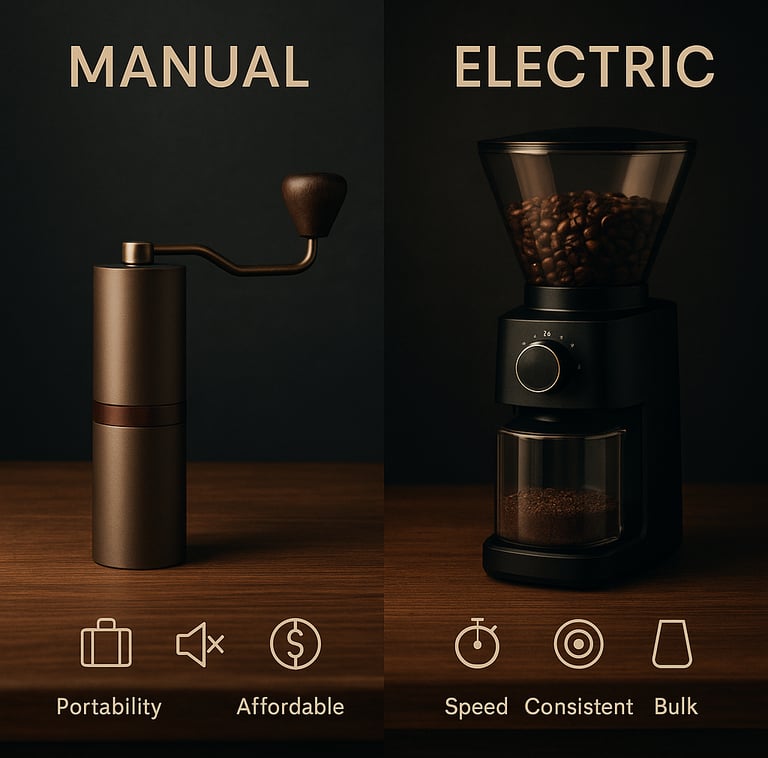
Manual Grinders
Great for portability and low-volume use
Affordable and easy to maintain
Quieter, but takes practice and time
Electric Grinders
Offers speed and consistency for daily espresso makers
Adjustable settings streamline repeatable shots
Bulkier and noisier but saves effort
Overview of Manual and Electric Espresso Grinders
At their core, manual and electric grinders serve the same purpose: breaking coffee beans down to the right size for espresso extraction. Manual grinders rely on hand power—usually a crank attached to conical burrs that you turn yourself. They’re typically small, simple, and quite affordable.
Electric grinders use a motor to spin burrs (conical or flat) for you. With more powerful burrs and motor control, they consistently deliver grinds faster and with less effort on your part. But they’re generally bigger, noisier, and cost more.
How Each Grinder Works: Mechanisms and Materials
Manual grinders generally feature conical burrs that are smaller than what you’d find in electric grinders. You turn the handle to crush beans, with the grind size adjusted by changing the burr position. This hands-on approach offers close control, but consistency depends heavily on steady speed and calibration.
Electric grinders ramp up the process with a motor spinning larger burrs at uniform speeds. Many models let you adjust grind size and dose via dials or digital controls for precise, repeatable grinding. The larger burrs also handle more coffee at once, which speeds up your workflow.
Performance: Grind Consistency and Quality Comparison
For espresso, grind consistency isn’t just a luxury—it impacts how evenly water extracts your coffee, influencing taste and crema. Electric grinders typically produce a steadier particle size distribution out of the box due to controlled motor speeds and larger burrs.
That said, manual grinders can hold their own if calibrated and operated carefully. The key is getting a consistent crank rhythm and fine-tuning the burrs. You can get good espresso shots this way, but it requires patience and practice. Most people don’t have the extra time in busy mornings to fuss with a manual grinder’s quirks.
For a deeper breakdown of how burr type impacts grind consistency, see Flat Burr vs Conical Burr Grinders for Espresso.
Usability and Convenience in Daily Espresso Making
Here’s where the difference between manual and electric becomes practical. An electric grinder is a no-brainer if you’re grinding daily and want to skip the extra step of turning a handle. It’s especially useful if you pull multiple shots a day or have a household that drinks espresso regularly.
Manual grinders shine in more specific situations: if you enjoy the tactile process of grinding by hand, travel often, or have a compact kitchen where counter space is tight. They’re quieter too, which some people appreciate during early mornings.
Workflow differences like these are explored further in Single Dose vs Hopper Grinders.
Pros and Cons of Manual vs Electric Grinders
Manual grinders are straightforward, portable, and quiet. They usually come in lower price brackets and don’t need power sources, making them ideal for occasional use, travel, or minimalist setups. But they demand physical effort and time, which can slow you down during a rushed morning.
Electric grinders offer speed and repeatability that most daily espresso drinkers rely on. Adjustable grind settings and dosing options reduce guesswork and help ensure each shot starts with a consistent grind size. On the downside, they take up more space, make noise, and represent a higher investment.
Buyer Considerations: Budget, Space, and Coffee Habits
Your espresso habits and kitchen setup are key. If you make espresso once or twice a week or want to bring your grinder camping or on trips, a manual espresso grinder will fit nicely. It won’t hog counter space or noise budgets.
If espresso is a daily ritual for you—especially multiple shots—and your kitchen can handle an appliance, an electric grinder will save time and keep your routine consistent. Budget matters too: entry-level electrics start higher than most manual options but include features that help dial in your coffee.
If you're comparing price-to-performance options, check out Best Espresso Grinders for Beginners and Best Espresso Grinders Under $600.
Also consider maintenance: manual grinders are simpler to clean and maintain, with fewer parts to worry about. Electric grinders require more attention to burr cleaning, especially since oils and fine particles can build up faster under motorized operation.
Common Mistakes and How to Avoid Them
One common mistake is assuming manual grinders will always produce inferior espresso. That’s not true if you take the time to calibrate and practice. However, it’s a fair point that manual grinding isn’t as quick or convenient for daily use.
Another pitfall is choosing an electric grinder just because it’s fast. Speed only matters if the grind consistency matches your espresso needs, which means paying attention to burr quality and size.
Ignoring maintenance is another frequent misstep with both types. Burrs clogged with old coffee residue lead to inconsistent grinding and faster wear. Keeping burrs clean pays off in the long run.
Some also overlook noise and space, which, for small kitchens or shared apartments, can be deal-breakers. Manual grinders may seem slow but offer a quieter footprint, while the electric models usually require a dedicated spot.
FAQ
How do manual espresso grinders compare in grind consistency to electric ones?
Electric grinders generally produce more uniform grinds thanks to motorized speed control and larger burr sizes. Manual grinders can approach this level with careful calibration and consistent hand speed, but it takes practice and patience.
Which type of grinder is easier to maintain and clean?
Manual grinders tend to be simpler to maintain. They have fewer moving parts and no electrical components, making burr cleaning straightforward. Electric grinders often require more frequent burr maintenance due to faster, higher-volume grinding.
Are manual grinders suitable for daily espresso preparation?
They can be, especially if you enjoy the hands-on aspect and don’t mind the extra time. For busy mornings or multiple shots, an electric grinder is generally more practical.
Do electric grinders offer better value for home espresso users?
For regular espresso drinkers, yes. The convenience, speed, and repeatability often justify the higher cost. For occasional use or travel, a manual grinder can deliver good value without the fuss.
How important is grind size adjustment in espresso grinding?
It’s crucial. Espresso needs a very specific grind size range for proper extraction. Both manual and electric grinders offer adjustment, but electric models often provide more precise and repeatable settings.
What are common errors when using a manual grinder?
Rushing the process can cause inconsistent grind size. Inconsistent crank speed and improper calibration also lead to problems. Taking the time to dial it in and maintain steady technique pays dividends.
Can I achieve professional-quality espresso with a manual grinder?
You can, but it’s less common outside of skilled or patient users. Consistency is key, and electric grinders simply make hitting those targets more reliable for most home users.
How does grinder noise impact home use?
Manual grinders are much quieter, which helps in shared living spaces or early mornings. Electric grinders can be quite loud, which some find disruptive.
Conclusion: Which Grinder Type Fits Your Needs?
At the end of the day, the grinder you pick should slot smoothly into your routine. If consistency, speed, and ease from the first shot to the last are your top priorities, an electric grinder will likely be your best partner. They deliver quick, steady results with little hassle, helping you keep espresso prep simple and reliable.
If you prefer a quieter machine, aren’t in a rush, or want a grinder you can take on the road, a manual espresso grinder is a solid choice that won’t break the bank. It demands more involvement, but that’s part of what makes it satisfying for certain users.
Over time, simpler setups tend to win. For most home espresso drinkers, the electric grinder’s convenience outweighs the extra complexity. But if you find yourself captivated by the hands-on ritual or pressed for budget and space, don’t overlook the manual option.
Contact@TheBuzzHQ.com
© 2026 Coffee Tech Buzz. All rights reserved.
Coffee Tech Buzz
Smarter brewing through better gear, clearer insights, and real-world performance testing.
Built for home users who want consistency without guesswork.
We focus on how machines actually perform — not just what they claim.
Home
Coffee Equipment Guide
Coffee Makers & Machines
Coffee Grinders
Espresso Gear & Guides
Coffee Beans & Roasts
Coffee Accessories & Tools
For educational purposes only.
We may earn commissions from qualifying purchases.
General Inquiries: