

Flat Burr vs Conical Burr Grinders for Espresso: Which Is Better?
Discover how a flat burr grinder compares to conical burrs for espresso, focusing on grind consistency, heat control, and maintenance.
COFFEE GRINDERSESPRESSO
The Coffee Tech Buzz Editorial Team - Led by AJ “Buzz” Eichman
4/30/20265 min read
Making espresso with precision depends heavily on consistency and control, and the choice of grinder plays a pivotal role in achieving those outcomes. Among the many variables that influence espresso grind quality, the burr type—specifically, flat burr versus conical burr grinders—often prompts considerable discussion.
To fully understand where burr type fits into your setup, it helps to anchor it within the broader context of Coffee Grinders, especially when dialing in espresso-specific performance through the Complete Espresso Grinder Guide.
This comparison explores the functional and performance differences between these two popular burr styles, emphasizing their impact on espresso extraction.
Quick Verdict
Flat burr grinders generally provide more consistent particle size distribution crucial for predictable espresso extractions but tend to produce a higher proportion of fines.
Conical burr grinders operate at slower speeds, generating less heat and static, which better preserves coffee freshness during grinding.
Espresso grind quality hinges on more than burr type, including build precision, grind adjustment control, and regular maintenance.
Flat burr grinders are preferred in professional settings where repeatability and precision trump user convenience.
Conical burr grinders offer quieter operation, simpler maintenance, and are often more suitable for everyday home espresso routines.
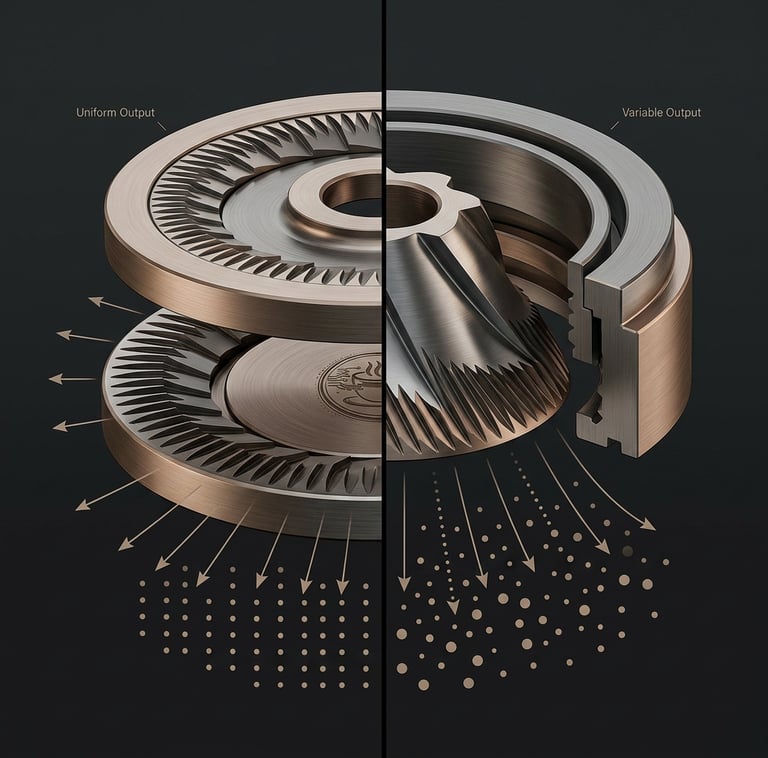
Overview of Burr Grinder Types
Burr grinders have become the standard for quality espresso preparation because they crush coffee beans uniformly without overheating or degrading the aromatic compounds.
If you're still narrowing down options, exploring real-world picks like Best Espresso Grinders for Beginners or value-focused options like Best Espresso Grinders Under $300 can help connect burr type to actual performance.
The flat burr grinder uses two parallel, flat discs that rotate in opposite directions, drawing beans between them and fracturing them with a cutting motion. This system centers on consistent particle size, crucial for even extraction during espresso brewing.
In contrast, the conical burr grinder features a cone-shaped burr nested inside a ring burr. Coffee beans fall between these burrs and are crushed through a combination of crushing and shearing, typically at slower speeds.
How Flat Burr Grinders Work
Flat burr grinders subject coffee beans to a rapid, horizontal shearing action between flat disc burrs. This design tends to produce particles within a narrow size distribution, offering predictability favored by espresso professionals.
That level of consistency is what separates higher-end grinder builds—something you’ll notice in breakdowns like TIMEMORE Sculptor 064S vs Fellow Ode Gen 2, where particle uniformity directly impacts shot repeatability.
However, this style frequently increases the volume of fines. Fines are very small coffee particles that can over-extract and contribute to bitterness if not managed carefully.
Flat burr grinders often run at higher rotational speeds, which can generate more heat, impacting bean integrity if the grinding process is prolonged or inefficient.
How Conical Burr Grinders Work
Conical burr grinders utilize a slower revolving, tapered cone burr that fits inside a fixed outer ring burr. Beans feed vertically through the burr set, which crushes and shears them at a reduced speed compared to flat burrs.
This slower speed limits heat buildup, preserving delicate coffee oils and aromatic compounds often vulnerable to excessive heat during grinding.
Another advantage of conical burr designs is that the shape naturally reduces static electricity. This minimizes grind retention and mess, resulting in cleaner dosing.
Grind Size Consistency and Espresso Quality
Espresso extraction demands a consistent grind; even slight variations in particle size have immediate effects on flavor balance and texture.
Flat burr grinders usually provide tighter particle size distribution, which directly correlates with a stable flow rate and extraction time. This is why many professionals prefer them when precision matters most.
If you're noticing inconsistencies in your shots, issues often trace back to grind behavior—something explored deeper in Why Your Espresso Shot Is Too Fast or Too Slow.
Conical burr grinders, on the other hand, produce fewer fines but a slightly wider particle distribution. For many home users, this trade-off is manageable and often pairs well with workflow approaches like those discussed in Single Dose vs Hopper Grinders.
Heat and Static Considerations in Grinding
Heat generation during grinding is a subtle but crucial variable influencing coffee flavor and extraction consistency.
Flat burr grinders, with their typically higher RPM, are more prone to heat buildup. Conical burr grinders operate at slower speeds, reducing friction and preserving coffee integrity.
Static is another factor—conical burr grinders generally produce less static, leading to cleaner dosing and more consistent shot prep.
Maintenance and Usability Differences
Grinder maintenance directly influences consistency and flavor clarity. Both burr types require periodic cleaning to remove coffee buildup, oils, and fines.
Flat burr grinders often demand more diligent upkeep due to tighter tolerances and increased fines retention. Conical burr grinders are typically easier to maintain and more forgiving over time.
If you're evaluating long-term usability, the key factors are covered in What to Look for in an Espresso Grinder, where maintenance and adjustment control play a major role.
Buyer Considerations: Budget, Use Case, and Experience
Choosing between flat and conical burr grinders depends on your workflow, budget, and tolerance for maintenance.
Flat burr grinders suit users focused on precision and repeatability, while conical burr grinders offer convenience and consistency with less ongoing effort.
For most setups, selecting the right grinder matters more than burr type alone—especially when balancing real-world performance against daily usability.
Which Grinder Type is Best for You?
Deciding on the optimal burr grinder type involves balancing priorities:
Choose flat burr grinders for precision, repeatability, and professional-level control
Choose conical burr grinders for ease of use, quieter operation, and consistent home performance
Ultimately, the grinder you can maintain and dial in consistently will outperform one that sits mis-calibrated.
Common Mistakes in Choosing and Using Burr Grinders
Ignoring maintenance and calibration
Assuming burr type alone determines espresso quality
Overlooking heat and grind retention
Choosing beyond your actual usage needs
Frequently Asked Questions
What are the main differences between flat burr and conical burr grinders?
Flat burr grinders use parallel discs for uniform grinding, while conical burr grinders use a cone-and-ring system that operates slower with less heat and static.
Which grinder type produces a more consistent espresso grind?
Flat burr grinders typically produce more consistent particle sizes, improving extraction predictability.
Do conical burr grinders produce less heat than flat burr grinders?
Yes, due to lower RPM and reduced friction, conical burr grinders generate less heat.
Are flat burr grinders better for professional espresso brewing?
Often yes, because they provide tighter control and repeatability when properly calibrated.
What are common issues when grinding espresso?
Inconsistent grind size, excessive fines, heat buildup, and poor maintenance are the most common problems.
How often should I clean my burr grinder?
Ideally weekly, depending on usage, to prevent oil buildup and maintain consistency.
Practical Conclusion
Choosing between flat burr and conical burr grinders comes down to control, maintenance, and workflow.
Flat burr grinders deliver tighter particle consistency but require more upkeep. Conical burr grinders offer a more forgiving, user-friendly experience while still producing excellent espresso for most users.
The best grinder is the one you can consistently dial in and maintain over time.
Contact@TheBuzzHQ.com
© 2026 Coffee Tech Buzz. All rights reserved.
Coffee Tech Buzz
Smarter brewing through better gear, clearer insights, and real-world performance testing.
Built for home users who want consistency without guesswork.
We focus on how machines actually perform — not just what they claim.
Home
Coffee Equipment Guide
Coffee Makers & Machines
Coffee Grinders
Espresso Gear & Guides
Coffee Beans & Roasts
Coffee Accessories & Tools
For educational purposes only.
We may earn commissions from qualifying purchases.
General Inquiries: