

Types of Coffee Makers Explained
Explore the essential types of coffee makers and how they impact your brew, focusing on manual vs automatic methods for the best coffee makers experience.
COFFEE MAKERS
The Coffee Tech Buzz Editorial Team - Led by AJ “Buzz” Eichman
3/30/20266 min read
Coffee makers form the backbone of any home coffee system, yet they are often misunderstood in isolation rather than as interconnected components of an evolving workflow.
Achieving an ideal brew is less about picking a single product with flashy features and more about understanding how brewing methods, equipment, grind consistency, water quality, and user routine coalesce into a balanced coffee setup.
This comprehensive guide explores the types of coffee makers, contrasting manual versus automatic approaches, highlighting their roles within broader home brewing systems, and examining the subtle interplay of variables that drive performance and consistency—especially when viewed through the lens of Coffee Makers & Machines.
Quick Verdict
Automatic coffee makers offer convenience and steady parameters but trade off some control and customization in the brewing process.
Manual coffee makers empower precision and flavor experimentation, requiring more active participation and attention to technique.
Matching grind size, water temperature, and brew time to the coffee maker is essential for avoiding under-extraction or over-extraction issues.
The decision should be guided by how the coffee maker fits your daily workflow, maintenance habits, flavor preferences, and space constraints.
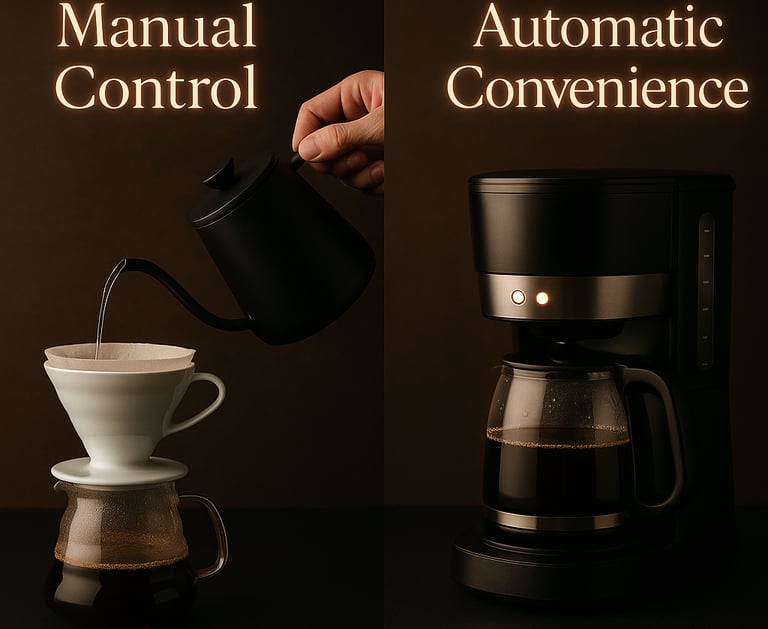
Overview of Coffee Makers: Manual vs. Automatic
A coffee maker’s fundamental purpose is to extract desirable compounds from coffee grounds using hot water. However, the mechanics behind achieving this are diverse, falling broadly into manual and automatic categories, each defined by how much they control the process versus how much control rests with the brewer.
Automatic coffee makers streamline multiple steps, often handling water heating, timing, and flow rate within set parameters. Their appeal lies in consistency and ease, particularly for daily routines demanding minimal hassle.
However, this system-centric advantage can also introduce rigidity; an automatic drip coffee maker, for instance, may not accommodate subtle adjustments in brew time or temperature that manual methods allow—something worth considering when deciding Are Expensive Coffee Makers Worth It.
Manual coffee makers, on the other hand, emphasize user engagement and technique. Devices such as pour-over drippers, French presses, and AeroPresses place brewing variables—pour rate, immersion time, agitation—in the brewer’s hands.
In practice, these dichotomies merge. A manual brewer might rely on an automatic grinder to ensure consistent particle size, or an automatic machine may include programmable features to adapt to different beans or preferences.
Popular Manual Brewing Methods and Their Characteristics
Manual coffee makers shine in their adaptability and direct feedback loop with the user. Their operation reveals the intricate relationship between grind size, water temperature, and brew duration.
The pour-over method, exemplified by devices like the Hario V60 or Kalita Wave, requires pouring hot water over grounds in a controlled manner.
The French press offers a contrasting approach with immersion brewing, delivering a fuller-bodied cup with distinct texture.
Other manual methods like the AeroPress combine immersion and pressure principles, allowing rapid brewing with precise control over variables.
Each of these methods reinforces the importance of aligning technique with system variables—a concept that becomes clearer when exploring How Coffee Makers Work in greater depth.
Common Automatic Coffee Maker Types and Features
Automatic coffee makers range from simple drip machines designed for straightforward brewing to complex espresso machines boasting temperature control, pressure profiling, and programmability.
Drip coffee makers constitute most automatic machines in home kitchens. They automate water delivery over a paper-filtered basket of medium-ground coffee, generally emphasizing convenience and repeatability.
Single-serve pod machines, another automatic variant, excel in portion control and speed but limit freshness and customization.
For espresso, automatic machines utilize pumps generating 9 bars of pressure and boilers or thermoblocks to sustain temperature during short, intense extractions.
Crucially, automatic coffee makers do not exist in isolation. Upgrading one component—like moving to a higher-end machine—should be paired with the right system choices, especially when selecting from Best Coffee Makers for Home Use.
Key Brewing Variables: Grind Size, Water Temperature, Brew Time
Across all coffee makers, the triad of grind size, water temperature, and brew time shapes extraction quality profoundly.
Grind size affects surface area exposure and extraction rate. Using the wrong grind size for your coffee maker systematically unbalances extraction, forcing another part of the system to compensate.
Water temperature finely tunes extraction kinetics, with the ideal range falling between approximately 195°F and 205°F.
Brew time influences how long coffee grounds remain in contact with water.
Each brewing variable’s effect depends on the others—improving one without harmonizing the rest often yields marginal gains, which is why dialing in your setup is just as important as understanding What Coffee Maker Makes the Best Coffee.
Performance and Consistency Considerations in Coffee Makers
The ultimate goal of selecting and using a coffee maker is delivering a consistent, satisfying cup that fits the user’s lifestyle and taste goals.
Materials and build quality impact thermal stability and durability. Glass carafes allow monitoring, while stainless steel retains heat better.
User workflow plays a decisive role. An intuitive automatic machine that fits effortlessly within a morning routine promotes consistency more than a complicated manual brewer.
Every coffee maker requires cleaning and maintenance. Neglecting this step degrades both taste and equipment longevity.
Cleaning and Maintenance Best Practices
Cleaning is often overlooked but functions as the connective tissue ensuring all components perform optimally.
Manual coffee makers call for thorough rinsing and periodic deep cleaning.
Automatic machines necessitate routine descaling to clear mineral deposits, especially in hard water areas.
An optimized coffee system incorporates cleaning into the daily and weekly workflow, minimizing friction and maintaining quality continuity—something often overlooked when evaluating Are Budget Coffee Makers Worth It.
Buyer Considerations: Usability, Budget, and Coffee Style
Deciding on a coffee maker must begin with assessing how the equipment integrates into your coffee system and daily habits.
Daily routines dictate whether convenience or control takes precedence.
Space availability, budget constraints, and cleaning tolerance also influence suitability.
Finally, coffee preferences set the parameters for technical requirements like pressure control and brew capacity.
If you’re working within tighter constraints, exploring Best Coffee Makers Under $100 or compact-friendly options like Best Coffee Makers for Small Kitchens can help align your setup without sacrificing performance.
Upgrading and Accessorizing Your Coffee Setup
When upgrading your coffee system, it is crucial to consider how each new component changes system dynamics.
Adding a high-quality grinder can markedly improve extraction consistency, but pairing it with a subpar coffee maker will limit gains.
Investments in accessories should support workflow efficiency and enhance control without introducing unnecessary complexity.
Upgrades should be approached as iterative refinements to an integrated system.
Common Mistakes in Coffee Maker Usage
Many issues experienced with coffee makers stem not from inherent flaws in the machines but from misaligned system variables or lapses in routine.
One prevalent error is using the wrong grind size for the coffee maker type.
Neglecting cleaning precipitates stale or off-tasting coffee and mechanical troubles.
Another frequent misunderstanding is assuming all automatic coffee makers perform equally.
Overlooking water quality and temperature control further complicates consistency.
Finally, choosing a coffee maker without considering your workflow and space can lead to unnecessary frustration—especially in smaller living setups where Best Coffee Makers for Apartments become more relevant.
Frequently Asked Questions
What are the main differences between manual and automatic coffee makers?
Manual coffee makers require active involvement in controlling brew variables, offering flexibility but demanding technique. Automatic machines handle these steps for consistency and convenience.
How does grind size affect different types of coffee makers?
Grind size determines extraction rate and flow. Coarse grounds suit immersion methods, medium for drip and pour-over, and fine for espresso.
Which coffee makers are best for home use versus occasional brewing?
Automatic machines suit daily use, while manual brewers are ideal for occasional or enthusiast brewing.
What maintenance is required for various coffee maker types?
Manual brewers require regular washing, while automatic machines need descaling and periodic maintenance.
Can the type of coffee maker affect the flavor and strength?
Yes, brewing method directly impacts extraction, body, and flavor intensity.
What common brewing errors should I avoid?
Avoid incorrect grind size, inconsistent temperature, and neglecting cleaning routines.
Are manual coffee makers harder to use for beginners?
They can be, but structured practice improves results over time.
How does water temperature influence brewing in different machines?
Temperature affects extraction balance—too low leads to sourness, too high leads to bitterness.
Practical Conclusion
Understanding the types of coffee makers entails stepping beyond individual products to comprehend their roles and relationships within the broader coffee system.
Both manual and automatic machines have strengths and limitations that suit different routines and preferences.
Success comes from harmonizing key variables—grind size, water temperature, and brew time—with workflow and maintenance.
The best coffee setup is not a fixed acquisition but an evolving system where each component supports the others.
By thinking of coffee making as an interconnected system, you move closer to consistently brewing coffee that satisfies both technical standards and personal enjoyment.
Contact@TheBuzzHQ.com
© 2026 Coffee Tech Buzz. All rights reserved.
Coffee Tech Buzz
Smarter brewing through better gear, clearer insights, and real-world performance testing.
Built for home users who want consistency without guesswork.
We focus on how machines actually perform — not just what they claim.
Home
Coffee Equipment Guide
Coffee Makers & Machines
Coffee Grinders
Espresso Gear & Guides
Coffee Beans & Roasts
Coffee Accessories & Tools
For educational purposes only.
We may earn commissions from qualifying purchases.
General Inquiries: