

Why Portafilter Size Changes Espresso Extraction
Explore how portafilter size impacts espresso shot quality and consistency, and why adjusting brewing variables is crucial when switching sizes.
ESPRESSO
The Coffee Tech Buzz Editorial Team - Led by AJ “Buzz” Eichman
5/7/20267 min read
Portafilter size is a variable that deserves more precise attention than it typically receives within home espresso brewing discussions. Its influence on espresso extraction extends beyond mere aesthetics or convenience, touching on fundamental physical parameters such as pressure distribution, puck stability, and dose volume. These factors collectively shape shot quality and consistency—two pillars of repeatable, performance-driven espresso brewing. Understanding how portafilter size directly affects extraction allows home baristas to make deliberate adjustments rather than guessing outcomes when switching between sizes. A broader understanding of Espresso Gear & Guides helps tie these extraction variables together instead of treating them as isolated espresso problems.
This article unpacks the technical aspects of portafilter size variations and their practical implications on espresso brewing dynamics. If you want a deeper breakdown of basket sizing, machine compatibility, and workflow considerations, the Espresso Portafilter Guide explains how these systems interact across different espresso setups.
Quick Verdict
Increasing portafilter diameter generally improves pressure stability and puck uniformity, enhancing extraction consistency.
Smaller portafilters demand greater precision in grind size, tamp, and dose calibration to avoid channeling and uneven extraction.
Switching portafilter size requires systematic adjustment of grind size and brew time to maintain target extraction parameters.
Basket depth and shape differences, beyond diameter alone, can influence puck compression and flow resistance, impacting shot quality.
What is a Portafilter and Why Size Matters
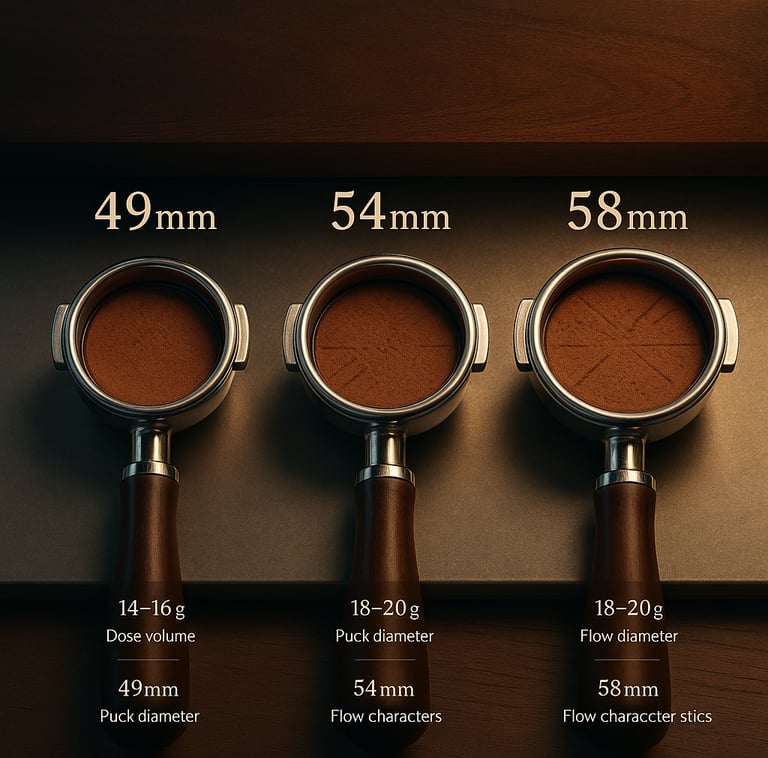
The portafilter acts as the brewing vessel securing coffee grounds in espresso machines. Its size—most notably its basket diameter—governs the volume of coffee grounds used and the spatial configuration through which brewing water passes. Typical home and commercial portafilter sizes range from 49mm on more compact machines to a standard 58mm diameter favored by many commercial setups.
Portafilter size is not a superficial specification; it alters the flow path, affects puck resistance, and dictates extraction surface area. These interconnected factors influence the core physics of espresso extraction, determining how evenly water saturates coffee and how pressure is transmitted through the coffee bed.
Common Portafilter Sizes and Their Characteristics
While 58mm remains the commercial standard due to its optimal balance of capacity and pressure dynamics, home espresso machines often feature smaller sizes such as 49mm or 54mm. The smaller sizes accommodate compact machine designs and single-shot variations but come at the cost of reduced dose capacity and potentially less even pressure distribution.
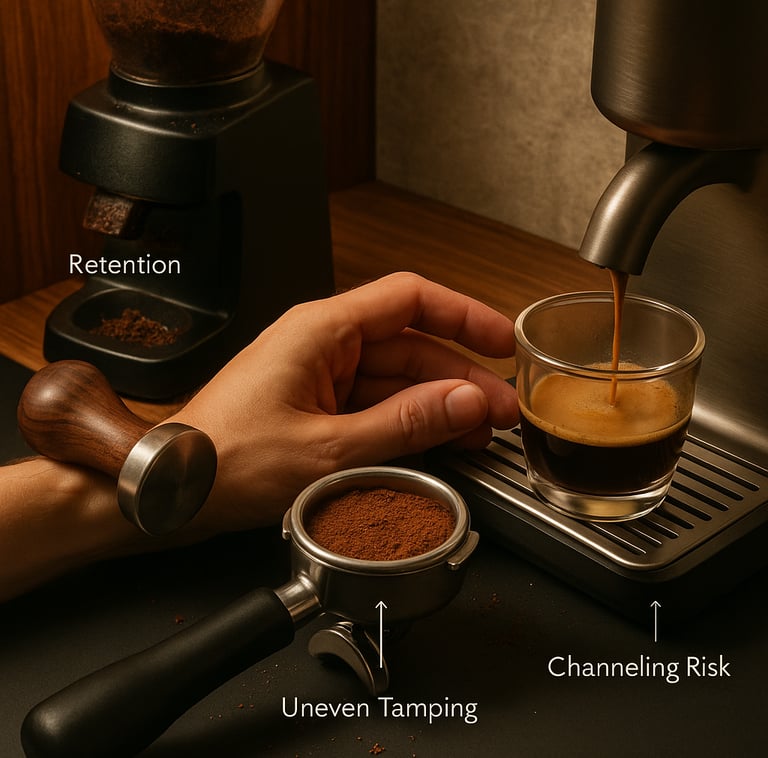
Larger portafilters allow for a higher coffee dose, which can stabilize puck structure, increasing resistance in a controlled way that supports even extraction. Conversely, smaller portafilters condense coffee grounds into a smaller puck, which increases the risk of channeling since small inconsistencies in tamp or grind become more pronounced.
Home users comparing these standards often end up weighing the workflow and extraction differences discussed in 54mm vs 58mm Portafilters before deciding which machine ecosystem fits their brewing style best.
How Portafilter Size Affects Espresso Extraction Physics
At a fundamental level, portafilter size governs the puck’s geometry relative to the extraction pressure profile. Larger diameters distribute water flow over a wider area, which generally reduces localized pressure spikes and promotes uniform extraction. The puck, when adequately compressed and dosed, presents consistent resistance, making pressure fluctuations less impactful on the final extraction yield.
Smaller portafilters compress coffee into reduced puck footprints, elevating flow velocity through narrower channels. This accelerates the emergence of under-extracted zones if tamping or grind uniformity is even slightly off. Pressure stability itself becomes more challenging, as the water's path of least resistance may exploit any irregularity sooner than in larger baskets. In essence, surface area and puck volume correlate with pressure stability and extraction predictability.
The basket itself also plays a major role here, particularly when comparing puck geometry differences covered in 54mm vs 58mm Espresso Baskets Explained where depth and extraction resistance can change dramatically between systems.
Impact on Espresso Shot Quality and Consistency
Differences in portafilter size manifest in flavor balance, crema quality, and shot body. Larger portafilters facilitate more stable flow and reduced channeling, typically resulting in smoother flavor extraction, well-developed crema, and fuller-bodied shots. The margin for error widens slightly, which supports consistent results over multiple brews.
In contrast, smaller portafilters require home baristas to focus heavily on precise grind calibration and uniform tamping. The reduced puck volume and surface area accentuate minor deviations, causing quicker swings in shot quality from one brew to the next. Flavor inconsistencies due to uneven extraction are more common, resulting often in sour or thin shots if parameters are not carefully adjusted.
Adjusting Grind, Dose, and Pressure for Different Sizes
A shift in portafilter size necessitates deliberate recalibration of grind size and dose. Increasing basket diameter typically means increasing dose volume, which alters puck thickness and water flow resistance. To compensate, grind size usually needs slight adjustment—often coarser—to maintain optimum flow rate and extraction time. Conversely, downsizing the portafilter demands finer grind and more precise tamping to elevate resistance appropriately without creating over-extraction risks.
Brew time will also vary; larger portafilters require longer extraction windows due to greater puck volume, whereas smaller ones need reduced time to avoid excessive bitterness. Pressure calibration remains key in any case—machines must consistently maintain around nine bars during extraction, but smaller baskets can challenge this stability more acutely.
If your machine uses smaller basket systems, accessories from the Best 54mm Portafilters category can help improve puck preparation consistency and workflow efficiency.
Common Mistakes When Changing Portafilter Size
It is a common error for home baristas to overlook recalibration after swapping portafilter sizes, assuming that dose, grind, and tamp settings translate directly between sizes. This neglect frequently causes over- or under-extracted shots that undermine any benefit gained from size adjustment.
Another frequent oversight is ignoring variations in basket depth and shape, which profoundly influence puck compression and flow dynamics independently of diameter.
Users also may unintentionally accept uneven tamping or dose distribution because the smaller portafilter’s constraints mask slight inconsistencies until after extraction. Failing to regularly monitor pressure stability when using non-standard sizes compounds these inconsistencies. Finally, shifting portafilter size without testing changes to workflow—such as dosing technique and tamp pressure—risks overall shot quality rather than improving it.
Many extraction issues blamed on grind quality are actually related to poorly matched baskets or low-quality accessories, which is why Why Cheap Espresso Portafilters Often Cause Bad Extraction becomes surprisingly relevant once users begin troubleshooting inconsistencies.
Choosing the Right Portafilter Size for Your Home Setup
Selecting portafilter size should align with your machine’s specifications, your desired shot volume, and your level of experience controlling espresso variables. Larger portafilters (58mm) generally favor home baristas aiming for consistent double shots with greater tolerance for minor procedure variations. If your espresso machine supports it, this size often harmonizes well with commercial-standard accessories, making future upgrades or replacements more straightforward.
Smaller portafilters (49mm or 54mm) might appeal to users focusing on single shots, coffee savings, or space constraints. However, they demand tighter control over grind, dose, and tamping precision. Consider whether your grinder and machine enable fine adjustments before committing to smaller sizes. Budget and availability of compatible accessories also factor significantly—standard 58mm portafilters often provide better options overall.
Users building around commercial-standard systems frequently explore the Best 58mm Portafilters because of the wider accessory compatibility and upgrade flexibility available at that size.
Troubleshooting Extraction Issues Related to Portafilter Size
If you experience channeling, uneven extraction, or shots that fluctuate widely, reevaluate your portafilter size relative to dose and grind settings. Start by verifying that grind size is calibrated specifically to your basket dimensions and dose volume. Small changes here, such as adjusting grind by one or two settings finer or coarser, can significantly improve puck integrity.
Check tamping pressure and tamp distribution carefully; smaller portafilters leave less room for error. Use a consistent tamp pressure and ensure even compression across the puck surface to avoid preferential pathways. Monitoring brew pressure for stability during extraction rounds out the assessment—unstable pressures often link back to puck resistance irregularities caused by incorrect dosing or grind mismatch for the given portafilter size.
For persistent inconsistencies, experiment with different basket depths or non-standard baskets designed to optimize puck geometry for your chosen portafilter size. These subtle equipment changes can restore balance to the extraction process.
Frequently Asked Questions
How does portafilter size affect espresso shot extraction?
Portafilter size alters puck volume, extraction surface area, and pressure distribution. Larger sizes tend to improve pressure stability and promote even extraction, while smaller sizes increase flow velocity and require greater precision to avoid channeling and extraction inconsistencies.
What is the most common portafilter size for home espresso machines?
While home machines vary, 58mm portafilters are widely regarded as the standard, particularly because they align with commercial specifications and offer solid control over shot consistency. Some compact or entry-level home machines feature smaller sizes like 49mm or 54mm.
Do I need to adjust my grind size if I change portafilter size?
Yes. Grind size must be recalibrated to match the dose volume and puck thickness associated with the new portafilter size. Larger baskets generally require a coarser grind and longer brew times, while smaller baskets need a finer grind and shorter extraction windows.
Can a smaller portafilter size produce the same espresso quality as a larger one?
It is possible but demands more precise control over grinding, dosing, and tamping variables. Smaller portafilters have less tolerance for error and may present challenges maintaining pressure stability and puck integrity.
Why does espresso taste different after switching portafilter sizes?
Taste variations stem from altered extraction dynamics: differences in puck thickness, water flow rate, and pressure distribution. These factors impact compound solubility and flavor balance, requiring adjustments in brewing variables to restore desired taste profiles.
Is pressure stability affected by portafilter dimensions?
Yes. Larger portafilters usually provide more consistent pressure distribution across the puck, while smaller baskets can lead to pressure fluctuations and uneven flow, affecting extraction quality.
What portafilter size is best for single vs double shots?
Smaller portafilters (49mm to 54mm) are often used for single shots due to smaller dose capacity, while 58mm baskets are common for double shots offering greater dose volume and pressure control. The choice depends on brewing goals and equipment compatibility.
Are there compatibility issues when changing portafilter sizes?
Because portafilters must fit the group head precisely, changing sizes may require machine-specific baskets or conversion kits. It’s essential to verify your machine supports the desired portafilter diameter to avoid mechanical or flow issues.
Practical Conclusion
Portafilter size should be regarded as a foundational brewing variable that directly influences espresso extraction mechanics and, by extension, shot consistency and quality. Larger portafilters offer more forgiving pressure distribution and puck stability, facilitating consistent results over repeated brews. Smaller portafilters demand tighter control of grind, dose, and tamp to avoid rapid quality degradation due to extraction irregularities.
Any change in portafilter size mandates deliberate recalibration of brewing variables—in particular grind size and brew time—to maintain target extraction parameters. For home baristas seeking predictability in espresso brewing, understanding and controlling portafilter size effects is essential. Selecting the right size aligned with machine compatibility, workflow expectations, and experience level fosters more repeatable espresso, not just in theory, but in every shot pulled at the counter.

Contact@TheBuzzHQ.com
© 2026 Coffee Tech Buzz. All rights reserved.
Coffee Tech Buzz
Smarter brewing through better gear, clearer insights, and real-world performance testing.
Built for home users who want consistency without guesswork.
We focus on how machines actually perform — not just what they claim.
Home
Coffee Equipment Guide
Coffee Makers & Machines
Coffee Grinders
Espresso Gear & Guides
Coffee Beans & Roasts
Coffee Accessories & Tools
For educational purposes only.
We may earn commissions from qualifying purchases.
General Inquiries: