

54mm vs 58mm Espresso Baskets Explained
Explore the key differences between 54mm espresso baskets and 58mm baskets, focusing on extraction consistency, dose capacity, and machine compatibility.
ESPRESSO
The Coffee Tech Buzz Editorial Team - Led by AJ “Buzz” Eichman
5/7/20269 min read
Espresso basket size is a fundamental variable in the pursuit of consistent espresso extraction, yet it often remains overlooked until compatibility or performance issues arise. Among the range of espresso basket dimensions, the 54mm and 58mm sizes stand as two of the most common, each with distinct implications for dose capacity, extraction dynamics, and machine compatibility. Understanding these differences is crucial for anyone aiming to move beyond one-off good shots and achieve predictability in espresso brewing through better equipment selection within Espresso Gear & Guides.
This article offers a detailed comparison of 54mm and 58mm espresso baskets, focusing on how their dimensions influence espresso extraction and brewing consistency while also considering the practical aspects of machine fit and user routine. Whether you are considering the upgrade path covered in Espresso Portafilter Guide or trying to improve shot consistency on your current machine, understanding basket geometry is one of the fastest ways to improve espresso repeatability.
Quick Verdict
58mm baskets are the industry standard for commercial and prosumer machines, offering larger dose capacity and typically more stable extraction.
54mm baskets are common in compact or home machines, requiring tighter control over grind size and dose to maintain consistency.
Basket size affects how water flows through coffee grounds, impacting channeling tendencies and flavor balance.
Selecting the right basket size should align with machine compatibility, routine preferences, and desired dose volume.
What Is an Espresso Basket and Why Size Matters
At its core, an espresso basket is a metal filter that holds coffee grounds within the portafilter during extraction. It defines how much coffee can be dosed and influences water flow through the puck, thereby affecting both extraction efficiency and flavor profile. The diameter and depth of the basket set the physical limits on dose volume and surface area exposed to water. This directly impacts the resistance the water encounters, which in turn shapes extraction time and consistency.
The importance of basket size stems from this relationship between geometry and extraction physics. A larger diameter generally means more surface area for water to interact with, which can supply a more even flow and reduce the risk of channeling. Conversely, smaller baskets concentrate the dose in a tighter space, demanding precise grind and tamp to avoid uneven water paths. Inconsistent dosing or grind adjustments can more quickly lead to extraction irregularities with smaller baskets. This distinction is especially relevant as you scale from home setups to commercial environments.
Many home brewers begin researching basket sizing after running into issues covered in Are Espresso Portafilters Universal?, especially when attempting to swap accessories between machines.
54mm vs 58mm: Key Dimensional Differences
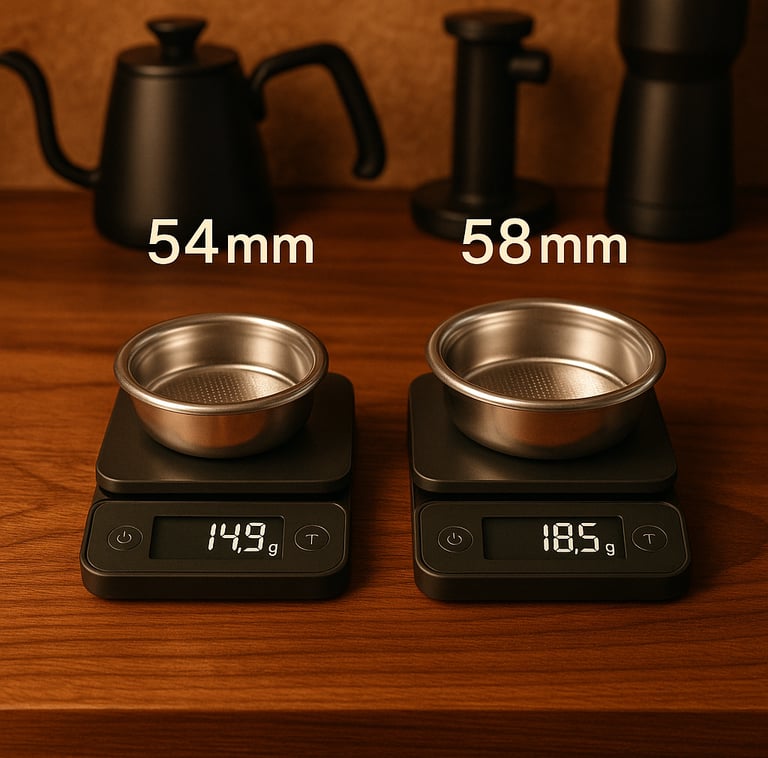
The most apparent difference between 54mm and 58mm espresso baskets is the diameter. The 58mm basket, measuring 58 millimeters across, is widely recognized as the standard size used by the majority of commercial machines and many high-end prosumer models. It supports dose sizes typically ranging from 18 to 22 grams or more, depending on basket depth.
The 54mm basket, by comparison, is smaller in diameter and found primarily in home or compact machines that prioritize size reduction over maximum dose capacity. Dose capacity for 54mm baskets generally falls between 14 and 16 grams. Though diameter is the primary differentiator, basket depth can vary within each diameter size, which also influences how much coffee fits and the resulting extraction volume.
Beyond simple measurements, these differences translate into distinct effects on water dispersion and pressure stability. For instance, the greater surface area of a 58mm basket allows water to spread more evenly across the puck, promoting uniform extraction if grind and tamp are controlled properly. The 54mm basket’s smaller surface area means resistance changes more rapidly with dosage fluctuations or tamp inconsistencies, making repeatability more sensitive to small technique shifts.
These dimensional tradeoffs become even clearer when comparing extraction behavior side-by-side in 54mm vs 58mm Portafilters, particularly when evaluating dose flexibility, tamping forgiveness, and puck stability under pressure.
Impact of Basket Size on Espresso Extraction and Flavor
Extraction depends on the interaction of several variables, including grind size, dose, tamp pressure, and water temperature. Basket size interleaves with all of these by setting physical boundaries that determine how these variables are balanced. For example, a finer grind in a 58mm basket creates more resistance but the larger surface can help distribute flow evenly, reducing channeling risk. On the other hand, a similar grind adjustment in a 54mm basket can produce disproportionately high resistance, possibly causing under-extraction unless dose or tamp is also recalibrated.
A larger basket allows for a higher coffee dose, which often supports better extraction stability. More coffee in the basket spreads water pressure over a wider area, encouraging uniform saturation. This can result in espresso flavors that display greater clarity and complexity over repeated extractions. However, this assumes all other variables remain consistent—a key point where many brewers falter. Basket size alone is not a guarantee but a factor that interacts with technique.
Smaller baskets require precision in grind and dosing to offset their narrower surface area. Even minor variations in dose weight or tamp pressure tend to have amplified effects, leading to more frequent extraction inconsistencies. This does not render the 54mm basket inferior but means that consistency often demands more deliberate control and steady routine.
This relationship between basket geometry and extraction stability closely overlaps with the principles explained in Why Portafilter Size Changes Espresso Extraction and the pressure behavior covered in Pressurized vs Non-Pressurized Portafilters Explained.
Machine Compatibility: How Basket Size Affects Your Setup
Machine compatibility is not just about fitting the basket into the portafilter. The entire flow path through the group head is engineered around a specific basket size to maintain pressure stability and water distribution. Attempting to fit a 58mm basket into a machine designed for 54mm baskets usually results in improper sealing and poor water dispersion. This mismatch compromises extraction quality immediately—an outcome easily avoided by matching basket size to machine specification.
Upgrading from 54mm to 58mm baskets involves more than swapping components. Since 58mm baskets require a portafilter designed for that size, users often need to change the entire portafilter assembly and verify that the group head supports this dimension. Additionally, the different channeling dynamics and dose capacities mean brewing parameters must be adapted accordingly.
For home users, space limitations often dictate basket size choice. Many compact espresso makers rely on 54mm baskets because the smaller diameter fits better in constrained machine designs. Commercial machines and prosumer models typically embrace 58mm baskets to enable larger doses and more consistent extractions. Recognizing these physical and practical constraints early simplifies setup decisions and prevents performance frustration.
Users troubleshooting spray patterns or uneven extractions during upgrades often discover that the issue is not the grinder but the portafilter system itself, especially when using setups discussed in Bottomless Portafilters Explained and Why Your Espresso Shot Sprays Everywhere with a Bottomless Portafilter.
How Brewing Variables Change with Basket Size
Adjusting brewing variables when switching between 54mm and 58mm baskets is rarely straightforward. This is where an understanding of cause and effect can significantly enhance predictability.
Starting with grind size, it has a direct influence on puck resistance and extraction flow rate. The larger 58mm basket allows slightly coarser grinds for a given dose to maintain extraction time, because its broader surface distributes water more evenly. Conversely, the 54mm basket typically requires finer grind to compensate for reduced surface area and maintain resistance, but the margin for error narrows.
Dose weight interacts closely with basket size. A 58mm basket accommodates heavier doses, which can stabilize channeling by filling the basket more completely. With 54mm baskets, the tendency is to work within a narrower dose range where tamp pressure and grind adjustments become pivotal for consistent puck integrity.
Tamp pressure, while less discussed, gains importance in the smaller baskets. Slight inconsistencies in tamp can be magnified, altering flow paths and extraction yield. With 58mm baskets, tamp variations tend to play out over larger puck surfaces, sometimes mitigating extreme impact.
Extraction time depends on the interplay of all these factors. Expect changes in timing when shifting basket sizes, but the key point is that no one variable adjusts alone. Basket size sets the framework; consistent espresso demands calibrated adjustments to all parameters in concert. Ignoring this will create unpredictable outcomes, usually manifesting as under- or over-extraction.
Brewers exploring deeper extraction consistency often pair these adjustments with lessons from How Portafilter Basket Depth Affects Espresso Shots and the thermal retention discussion inside Does Portafilter Material Affect Espresso Flavor or Heat Retention?.
Common Mistakes When Choosing or Using Different Basket Sizes
One of the most frequent errors is assuming that switching to a larger basket size automatically improves espresso quality. While 58mm baskets offer better theoretical extraction stability due to size and dose capacity, without adjusting grind, dose, and tamp, this potential remains unrealized.
Another mistake involves incompatibility. Using a 58mm basket in a machine designed solely for 54mm components compromises water distribution and pressure seal. This often leads to channeling and bitter or thin extraction profiles. Confirming portafilter and group head size before purchasing baskets avoids this pitfall.
Failure to recalibrate technique when changing basket size is another source of inconsistency. A move from 54mm to 58mm should prompt systematic testing of grind size, dose, and tamp pressure. Neglecting these adjustments is where results begin to drift without the user noticing why.
Overlooking basket depth differences can also be problematic. Depth influences dose capacity independently of diameter. Expect different extraction dynamics if basket depth varies significantly, regardless of diameter being the same.
Finally, confusing portafilter diameter with basket diameter can lead to incorrect purchases. Baskets must match portafilter size exactly to ensure proper fit and consistent extraction pressure.
Buying Guide: Which Basket Size Is Right for You?
Choosing between 54mm and 58mm espresso baskets centers on balancing machine compatibility, dose preferences, and your tolerance for routine precision. For home espresso machines with limited internal space, the 54mm basket is typically the default choice. Its smaller dose range suits occasional usage and simpler routines, provided you are willing to control grind size tightly.
Users with commercial-style or prosumer machines generally benefit from the 58mm standard. Larger baskets allow for greater dose control and more forgiving water distribution, translating into steadier extraction when properly dialed in. The 58mm size also grants access to a wider range of aftermarket accessories and replacement parts.
If you expect to upgrade or switch machines in the future, 58mm baskets offer better long-term versatility. Many serious home baristas and coffee shops standardize on 58mm precisely for this predictability and availability advantage.
Ultimately, the best choice is a function of your machine’s design and your commitment to controlling brewing variables. Neither size guarantees success without a process-oriented approach that prioritizes repeatable technique.
How to Upgrade from 54mm to 58mm Baskets
Transitioning from a 54mm to a 58mm basket is more involved than simply purchasing a new filter. First, verify that your machine’s group head and portafilter accommodate 58mm components. Most 54mm machines won’t accept 58mm portafilters due to physical clearance constraints. If the machine supports 58mm, you will likely need to replace the entire portafilter assembly to match.
Once installed, recalibrate all brewing variables. Expect dose increases and the necessity to adjust grind size coarser compared to the 54mm setup. Observe extraction time closely and test tamp pressure for even puck compaction. Pay particular attention to puck behavior after brewing—any signs of uneven flow or channeling indicate adjustments are still needed.
Be aware that changing basket size alters the feel of your routine. It may initially require more precise dosing or tamping changes before stability is achieved. Over time, however, many find the standardization and consistency gains justify the upgrade.
For users evaluating upgrade paths, comparing premium options from Best 58mm Portafilters against entry-level recommendations from Best 54mm Portafilters can help narrow down the best route based on workflow and machine compatibility.
Frequently Asked Questions
What are the main differences between 54mm and 58mm espresso baskets?
The primary difference lies in diameter; 58mm baskets are larger, allowing higher dose capacity and generally more even water flow. Depth variations also influence dose capacity but diameter affects compatibility and extraction stability more significantly.
How does basket size affect espresso extraction and flavor?
Larger baskets promote more uniform water distribution and reduce channeling risk, which can enhance flavor clarity and extraction consistency. Smaller baskets are more sensitive to grind and tamp variations, sometimes leading to inconsistent flavor profiles unless carefully dialed in.
Can I use a 58mm basket in a machine designed for 54mm baskets?
Generally not. Machines designed for 54mm baskets and portafilters usually do not physically or functionally support 58mm baskets. Attempting to use mismatched parts results in poor seals and extraction problems.
Does basket size influence grind size or dose amount?
Yes. Larger baskets usually call for higher doses and slightly coarser grinds to maintain balanced extraction times, while smaller baskets require lower doses and finer grinds for sufficient resistance.
Which basket size is better for home espresso machines?
Most compact home machines use 54mm baskets due to space constraints. However, if your home machine supports 58mm baskets, they often provide greater extraction consistency when paired with precise brewing control.
Are there differences in basket depth or volume between the sizes?
Basket depth varies independently of diameter and affects total dose capacity and puck thickness. Both 54mm and 58mm baskets come in various depths, so depth should also be considered alongside diameter.
How do I know if my espresso machine supports 58mm baskets?
Check your machine’s specifications regarding portafilter and group head diameter. Manufacturer documentation or support can clarify compatible basket sizes. Physical measurement or comparison with known components also helps.
Does a larger basket size mean easier espresso brewing?
Not necessarily easier, but often more forgiving of minor technique variations due to more even water flow. Brewing variables still require control and adjustment for consistent results regardless of basket size.
Conclusion
Espresso basket size is a critical factor in controlling extraction consistency and machine compatibility. Both 54mm and 58mm baskets present pros and cons tied to their physical dimensions that influence dose volumes, flow dynamics, and required precision in brewing variables. For those aiming to elevate the predictability of their espresso, understanding these nuances is essential.
The 58mm basket stands as the industry standard for good reason, allowing for higher doses, greater extraction stability, and compatibility with a wide range of machines and accessories. Meanwhile, 54mm baskets offer compactness and simpler integration with home machines but demand more disciplined control due to tighter tolerances in grind and dosing.
Assessing your current or desired espresso setup against these parameters will guide you toward a choice that supports your brewing goals without introducing unintended inconsistency. Precision in espresso brewing begins with knowing how your materials and tools behave—in this case, how the simple dimension of your espresso basket sets the stage for your final cup.
Contact@TheBuzzHQ.com
© 2026 Coffee Tech Buzz. All rights reserved.
Coffee Tech Buzz
Smarter brewing through better gear, clearer insights, and real-world performance testing.
Built for home users who want consistency without guesswork.
We focus on how machines actually perform — not just what they claim.
Home
Coffee Equipment Guide
Coffee Makers & Machines
Coffee Grinders
Espresso Gear & Guides
Coffee Beans & Roasts
Coffee Accessories & Tools
For educational purposes only.
We may earn commissions from qualifying purchases.
General Inquiries: