
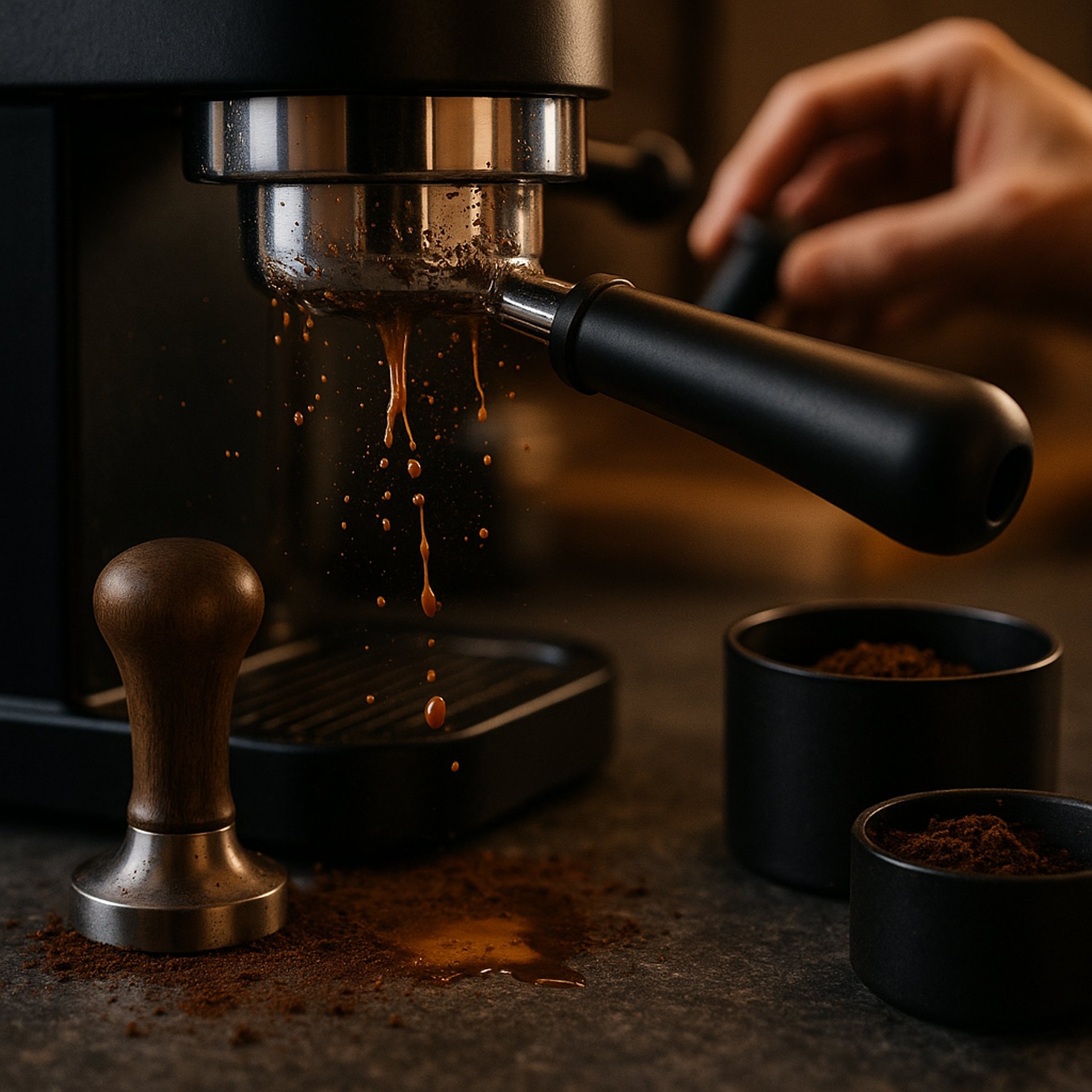
Why Your Espresso Shot Sprays Everywhere with a Bottomless Portafilter
Explore how a bottomless portafilter reveals espresso extraction flaws causing shot spray and learn how to control tamping, grind size, and maintenance for quality.
ESPRESSO
The Coffee Tech Buzz Editorial Team - Led by AJ “Buzz” Eichman
5/7/20268 min read
A bottomless portafilter, sometimes called a naked portafilter, offers an unfiltered view of the espresso extraction process by removing the spout and exposing the basket’s underside. This design reveals the flow of espresso directly as it passes through the coffee puck, making any imperfections in technique or grind immediately visible. While this transparency is invaluable for diagnosing extraction issues, it also means that common faults such as uneven tamping, channeling, or inappropriate grind size manifest as espresso spraying out irregularly from the portafilter edges. Understanding broader Espresso Gear & Guides helps explain why these extraction variables compound so quickly in bottomless setups.
Understanding why your espresso shot sprays everywhere when using a bottomless portafilter requires a methodical analysis of the variables that influence extraction quality. It is not a matter of chance but rather control over grind size, distribution, tamp pressure, and machine parameters. For a deeper overview of sizing, basket standards, and compatibility issues that affect extraction behavior, the Espresso Portafilter Guide provides a more complete systems-level breakdown.
Quick Verdict
Espresso shot spraying with a bottomless portafilter usually indicates uneven extraction caused by channeling or puck inconsistencies.
Precise grind size adjustments and consistent tamping pressure minimize water flow irregularities that produce spray.
Even coffee distribution and surface integrity improve puck resistance, reducing the chance of water bypassing weak spots.
Regular cleaning of portafilter baskets and mindful maintenance sustain consistent extraction performance.
What Is a Bottomless Portafilter?
A bottomless portafilter is a basket holder without the typical spout, designed to showcase the espresso as it emerges. Unlike traditional spouted portafilters, where espresso flows through a controlled channel, the bottomless variant exposes the bottom of the coffee puck directly, so water flow patterns and pressure distribution are visible without obstruction. This makes it an ideal tool for baristas and enthusiasts striving for consistency, as it instantly displays flaws that otherwise go unnoticed. However, the trade-off is that any instability in puck preparation or grind quality results in uneven flow and espresso spraying laterally rather than a neat stream.
Because the bottomless design lacks a spout to guide the espresso, it demands precision in brewing technique. Minor imperfections that remain hidden in spouted extraction become more pronounced, making the bottomless portafilter a diagnostic tool as much as a brewing accessory. Understanding these subtle force dynamics is essential to controlling results reliably.
If you’re newer to naked extraction setups, Bottomless Portafilters Explained covers the broader mechanics and workflow benefits behind why these tools expose puck preparation flaws so aggressively.
Why Does Espresso Spray When Using a Bottomless Portafilter?
Spraying espresso from a bottomless portafilter indicates that water is taking the path of least resistance, often through cracks or less compacted sections of the coffee puck. This uneven water distribution is known as channeling. When water channels form, pressure results in high-velocity streams erupting unexpectedly from the basket edges, disturbing the extraction and creating a mess.
The absence of a spout means that any irregular flow directly translates into spray rather than a focused stream. Uneven tamping, inconsistent grind particle size, poor distribution of coffee grounds, and insufficient puck integrity all contribute to this phenomenon. These flaws cause localized zones where water passes too quickly, undersaturating coffee in some areas while overextracting others. The visual of espresso spraying everywhere is not only distracting but also an indicator that shot quality is compromised.
The Role of Grind Size in Preventing Spray
Grind size dictates the flow rate of water through the coffee puck and directly influences pressure dynamics during extraction. If the grind is too coarse, resistance decreases, allowing water to flow rapidly and inconsistently, which can provoke spraying in a bottomless setup. Conversely, an overly fine grind creates excessive resistance, potentially choking the flow and causing pressure buildup that leads to channeling or machine strain.
Achieving the correct grind size is a balance. You want sufficient resistance to slow water flow and encourage even extraction while avoiding choking the espresso machine. Moreover, grind uniformity is equally vital—a consistent particle size ensures water encounters uniform resistance across the puck. Minor fluctuations in grind size cause pressure inconsistencies that translate into erratic spray patterns.
Because bottomless portafilters expose flow irregularities explicitly, the impact of grind adjustments is more visible here than with spouted portafilters. Small changes in grind size tend to reveal themselves clearly in how cleanly the espresso flows from the basket’s underside.
Extraction resistance and pressure behavior also change noticeably depending on basket geometry, especially in setups discussed in Why Portafilter Size Changes Espresso Extraction.
Proper Tamping Technique to Reduce Channeling
Tamping applies pressure to compact coffee grounds into a puck, creating resistance and an even surface for water dispersion. Inconsistent or uneven tamping is a primary cause of espresso spraying from bottomless portafilters. If the pressure is applied unevenly, it leads to cracks or weak zones in the puck, allowing water to channel through these low-resistance areas rather than spreading evenly.
A tamp pressure of approximately 30 pounds, applied evenly with a level, flat base, is the broadly accepted standard. Deviating from this can create density gradients within the puck, facilitating channel formation. Additionally, a poorly leveled tamp will encourage espresso to break through the thinner, less compacted side, resulting in spray.
While tamping firmness matters, uniformity is often more critical. Maintaining consistent pressure with each shot reduces variability and makes spray behavior predictable. Many seasoned brewers adjust their tamping to fine-tune espresso quality rather than guessing or over-correcting.
Common Espresso Extraction Issues Leading to Spray
Besides grind size and tamping, several factors contribute to spraying when using a bottomless portafilter. Coffee distribution before tamping plays an important role. If grounds are unevenly distributed, the coffee puck density varies, creating irregular resistance zones. Techniques like proper dosing and distribution tools help minimize this problem.
Dose amount affects puck thickness and thus water flow. An insufficient dose results in a thin puck with a higher chance of channeling, whereas a dose that is too large can cause overpressure and disrupt the flow.
Portafilter basket condition also impacts shot quality. Old coffee oils or residual grounds clog small holes, forcing water to reroute and produce spray. Regular cleaning maintains optimal water dispersion characteristics.
Finally, machine pressure and water temperature influence extraction dynamics. Inconsistent pressure or temperature fluctuations can exacerbate channel formation and irregular spray patterns.
Lower-quality baskets and inconsistent manufacturing tolerances can amplify these problems dramatically, which is why many home users eventually research Why Cheap Espresso Portafilters Often Cause Bad Extraction after repeated troubleshooting frustrations.
Troubleshooting and Fixes for Espresso Spraying
Addressing espresso shot spraying starts with discipline in controlling variables systematically. Begin by examining your grind size. If spray appears as fast, forceful bursts, coarsen the grind slightly to increase resistance. Conversely, if the flow is sluggish or puck swelling is excessive, a finer grind may be necessary.
Next, test your tamping. Focus on applying the correct pressure evenly and maintaining a level surface. Use calibrated tampers or tools with guidance markers if needed. Re-distributing grounds with a consistent technique prior to tamping reduces spots of uneven density.
Visual inspection of the bottomless portafilter basket is critical. Clean it thoroughly, removing oils and stuck grounds regularly to ensure unrestricted water flow.
Monitoring dose amounts and adjusting to recommended guidelines based on your basket size and machine specifications ensures an optimal puck thickness.
Also, review machine settings to ensure pressure is stable and temperature consistent. Irregular settings tend to amplify spray symptoms.
If problems persist, observing the spray pattern during extraction helps diagnose specific faults. A steady, symmetrical stream indicates balanced pressure and puck integrity. Erratic bursts or lateral spatters often point to uneven tamping or channeling through inconsistent grind zones.
Users running compact home systems often improve consistency by upgrading to accessories found in the Best 54mm Portafilters category where basket quality and fitment are more tightly controlled.
Impact of Maintenance and Cleaning on Shot Quality
Maintenance is a frequently underestimated factor affecting espresso performance with bottomless portafilters. Residues and coffee oils accumulate inside the basket and grouphead, influencing water flow paths and creating microscopic obstructions that encourage channeling and spray.
Daily backflushing and periodic deep cleaning prevent buildup that can distort extraction uniformity. Neglecting this results in variable pressure distribution, unpredictable spray, and deteriorating shot quality over time.
Additionally, worn or damaged baskets contribute to uneven water dispersion. Inspect baskets for deformities or blockages and replace them when necessary to maintain consistent flow.
Choosing the Right Equipment and Accessories
A bottomless portafilter demands precise technique but can also benefit from equipment choices that enhance control. Calibrated tampers with flat bases help maintain consistent pressure and level tamping.
Distribution tools designed to evenly spread grounds before tamping reduce density variation in the puck. These devices, when used methodically, make a tangible impact on spray reduction and shot consistency.
Grinders with adjustable, stable grind size settings and minimal particle size variation are foundational. Precision grinders offering stepless adjustment help dial in flow rates that work best with bottomless extraction.
When selecting a bottomless portafilter, consider basket size and machine compatibility. Larger baskets require different dosing techniques and may respond differently to tamp pressure.
Ultimately, investing in accessories that promote repeatability rather than trial-and-error experimentation aligns with controlled extraction principles.
Common Mistakes That Lead to Espresso Spray
Many home baristas unknowingly introduce variables that cause spraying, especially when switching to bottomless portafilters. The most frequent mistakes include applying uneven tamp pressure that creates cracks in the puck, using a grind size that is too coarse or inconsistent, and neglecting proper distribution leading to weak spots.
Ignoring maintenance by not cleaning portafilter baskets allows residue buildup, causing erratic water flow. Overdosing or underdosing coffee disrupts puck thickness and resistance, further encouraging channeling. Lastly, expecting immediate proficiency with a bottomless portafilter without technique adaptation leads to frustration and misdiagnosed spray problems.
Avoiding these pitfalls requires deliberate control of each brewing step with focus on repeatability.
Frequently Asked Questions
Why does espresso spray more from a bottomless portafilter than a spouted one?
Because the spout channels espresso into controlled streams, it conceals flow irregularities. A bottomless portafilter exposes the puck’s underside directly, so uneven water paths lead to visible spray rather than a contained flow.
How to tamp properly to avoid espresso spraying?
Apply roughly 30 pounds of pressure evenly using a flat, level tamper base. Ensure the puck surface is smooth and consistent without tilting or gaps. Maintain consistency across shots to reduce variability.
What grind size is ideal for use with a bottomless portafilter?
A grind size fine enough to create appropriate resistance but not so fine as to choke the flow works best. Uniform particle size is critical. Adjust based on spray behavior—too coarse typically causes spray from rapid flow.
How does channeling cause espresso to spray?
Channeling occurs when water finds less dense or cracked areas in the puck, bypassing uniform resistance. This causes high-pressure streams to burst erratically, leading to the spray observed with bottomless portafilters.
Is spraying an indicator of poor espresso shot quality?
Yes. Spray indicates uneven extraction due to puck inconsistencies. This typically results in an imbalanced shot with undesirable flavor characteristics.
Can bottomless portafilters damage my espresso machine?
When used correctly, no. However, improper grind size or tamping causing excessive backpressure can stress the machine. Maintaining parameters within machine specifications avoids damage.
How to troubleshoot spraying issues step-by-step?
Start with grind size adjustment, then verify tamp pressure and levelness, confirm even distribution, clean the basket thoroughly, and check dose. Observe spray changes after each adjustment to isolate causes.
Does water pressure affect spraying with a bottomless portafilter?
Yes. Pressure fluctuations can exacerbate channeling by forcing water through weak spots in the puck. Stable machine pressure contributes to consistent flow and reduces spraying.
Conclusion
Spraying espresso shots from a bottomless portafilter is less an unpredictable nuisance and more a clear diagnostic signal of inconsistencies in brewing technique and preparation. Because this tool exposes the raw dynamics of espresso flow, it demands precision and repeatability in every step: proper grind size, even and sufficient tamping pressure, uniform distribution, adequate dose, and routine maintenance. Small adjustments in these variables—made calmly and methodically—tend to produce noticeable improvements in the flow pattern, yielding cleaner extraction and eliminating spray.
For those serious about refining espresso extraction, a bottomless portafilter offers unmatched feedback and learning opportunities. It reveals what was always there beneath the surface, enabling brewers to control their process rather than chase fleeting trends or guesswork. With disciplined technique and attention to detail, espresso shots can become predictable, clean, and precisely executed without spray, even through this most revealing of portafilters.

Contact@TheBuzzHQ.com
© 2026 Coffee Tech Buzz. All rights reserved.
Coffee Tech Buzz
Smarter brewing through better gear, clearer insights, and real-world performance testing.
Built for home users who want consistency without guesswork.
We focus on how machines actually perform — not just what they claim.
Home
Coffee Equipment Guide
Coffee Makers & Machines
Coffee Grinders
Espresso Gear & Guides
Coffee Beans & Roasts
Coffee Accessories & Tools
For educational purposes only.
We may earn commissions from qualifying purchases.
General Inquiries: