

Why Cheap Espresso Portafilters Often Cause Bad Extraction
Explore why cheap espresso portafilters lead to inconsistent extraction and how quality portafilters enhance shot consistency and flavor.
ESPRESSO
The Coffee Tech Buzz Editorial Team - Led by AJ “Buzz” Eichman
5/7/20268 min read
The espresso portafilter is often overlooked as a mere accessory in an espresso machine setup, yet it plays a fundamental role in directing water evenly through the coffee grounds during extraction. Precision in espresso brewing hinges on the portafilter's ability to maintain stable pressure, consistent temperature, and uniform water flow—qualities that inexpensive portafilters frequently fail to deliver. Understanding why cheap espresso portafilters lead to inconsistent shots clarifies why investing in quality components improves your espresso’s predictability far more than chasing flashy machine features or altering brew variables at random inside Espresso Gear & Guides.
For home baristas trying to stabilize espresso quality, understanding portafilter construction is often more valuable than endlessly changing grind settings or brew ratios. Many of the upgrade paths covered in Espresso Portafilter Guide exist specifically because poor machining, unstable thermal behavior, and weak seals quietly undermine extraction consistency long before users realize the portafilter itself is the problem.
Quick Verdict
Cheap portafilters often use low-grade materials and loose manufacturing tolerances, causing pressure leaks and uneven extraction.
Poor build quality results in inconsistent water distribution, encouraging channeling and under-extraction.
Materials with higher thermal stability, like brass or stainless steel, help maintain temperature consistency during brewing.
Weight and balance of the portafilter influence tamping consistency, affecting extraction repeatability.
Upgrading to a precision-made espresso portafilter improves shot consistency without needing radical changes elsewhere.
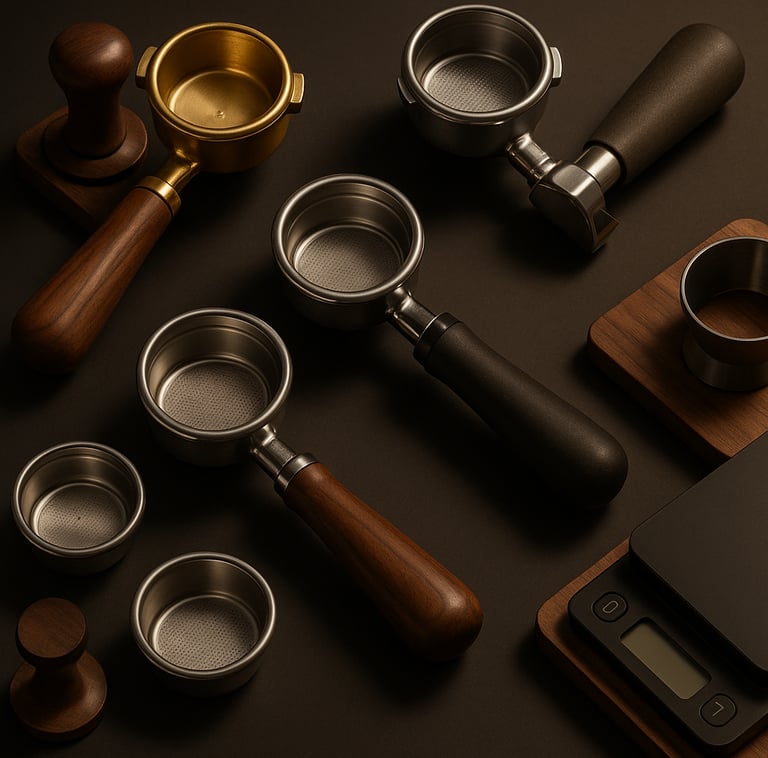
What is an Espresso Portafilter and How It Works
The espresso portafilter serves as the interface that holds your tamped coffee grounds tightly and channels pressurized water through the coffee puck during brewing. It typically consists of a handle attached to a metal basket and a spout or double spout for delivering espresso to the cup(s). Its design must ensure a tight seal against the machine’s group head gasket, maintain pressure integrity, and conduct heat efficiently without allowing excessive heat loss.
Water flows from the machine’s group head into the portafilter basket, saturates the coffee puck, and extracts solubles that constitute the espresso shot. Uniform water distribution requires precise manufacturing tolerances that prevent leaks and channeling pathways. If the portafilter fails to hold the coffee puck firmly or if its metal surface loses temperature rapidly, these variables quickly introduce inconsistencies in shot quality.
The extraction stability differences become especially noticeable when comparing systems featured in Best 54mm Portafilters and Best 58mm Portafilters, where machining tolerances, material thickness, and basket quality often separate budget hardware from premium espresso setups.
Why Cheap Portafilters Cause Extraction Issues
Cheap espresso portafilters often exhibit substandard build quality that impacts core aspects of extraction. First, inferior materials like low-grade alloys conduct heat poorly and lack the mass necessary to stabilize brewing temperature. This results in rapid heat fluctuations during successive shots, which can push flavors toward sourness or bitterness unpredictably.
Manufacturing tolerances tend to be looser with cheap portafilters, causing uneven or incomplete seals against the group head gasket. This allows water to escape pressure paths, reducing effective brewing pressure and causing uneven water distribution through the coffee puck. Such leaks promote channeling, where water carves low-resistance pathways, over-extracting some grounds and under-extracting others. The result is espresso that tastes hollow, uneven, or burnt.
Additionally, lightweight and poorly balanced portafilters make consistent tamping more difficult. Since tamping pressure strongly influences how water flows through the puck, an unbalanced portafilter makes maintaining a predictable resistance difficult. This unpredictability compounds extraction inconsistency shot after shot.
These extraction failures closely overlap with the thermal and pressure consistency issues discussed in What Makes a Heavy Portafilter Better for Espresso? where added mass improves stability throughout the brewing cycle.
Materials and Build Quality Differences
The choice of material influences both thermal retention and structural integrity. Premium portafilters are usually machined from brass or stainless steel, metals with higher thermal mass and better heat retention. These qualities help maintain a stable temperature throughout each shot and across successive brews. In contrast, cheaper portafilters made from cast zinc or lower-quality alloys lose heat quickly, introducing temperature fluctuations that disrupt extraction parameters.
Build quality also governs the portafilter’s fit and seal quality. Precision-machined portafilters exhibit tight dimensional tolerances, ensuring a secure interface with the group head gasket and minimizing pressure loss. Cheap portafilters may feature rough edges or irregular basket holders that prevent even tamping and consistent puck compression. These small inconsistencies are often the invisible factors behind poor espresso extraction.
The impact of machining also extends to the spout design. Well-crafted spouts direct espresso flow evenly to minimize sprays and disruption in the cup, whereas budget portafilters sometimes have uneven or misaligned spouts, which can affect flow rate and crema consistency.
Impact of Portafilter Design on Extraction Consistency
Extraction consistency depends heavily on maintaining steady pressure and temperature over the duration of the shot. Portafilter design affects these by influencing how well the coffee puck is sealed, how heat is retained, and how even the water disperses. A well-made portafilter ensures a snug gasket seal that prevents leaks, promotes stable water pressure, and allows the barista to maintain predictable flow dynamics.
Weight and ergonomics also contribute indirectly. Heavier portafilters convey a sense of solidity that helps the barista apply consistent tamping force—crucial since tamp pressure affects resistance and flow rate during extraction. Lighter models may tip or shift during tamping, subtly changing density in the coffee puck and thus altering shot parameters unpredictably.
Many of these flow inconsistencies become more obvious when comparing extraction behavior in Pressurized vs Non-Pressurized Portafilters Explained and the basket geometry changes covered in 54mm vs 58mm Espresso Baskets Explained.
Common Espresso Brewing Problems Linked to Portafilter Quality
Many espresso brewing difficulties encountered at home or in low-end commercial setups trace back to the portafilter’s shortcomings. Channeling is one clear symptom, where water finds easier paths around the coffee, resulting in both rapid over-extraction of some areas and under-extraction of others. Temperature instability means flavors fluctuate between shots, making it impossible to dial in a consistent profile.
Under-extracted shots, marked by sourness or thin mouthfeel, often result from pressure leaks caused by worn or poorly fitting gaskets in cheap portafilters. Such leaks reduce effective pressure, causing insufficient solubles to dissolve from the coffee puck.
Misfit baskets or irregular basket edges can harbor grounds unevenly, making consistent dosing and tamping more difficult. This adds variability to shot volume and extraction time. Users might repeatedly adjust other variables, like grind size or dose, not realizing that the portafilter itself is the limiting factor.
How to Choose a Quality Portafilter for Better Shots
Selecting a quality espresso portafilter involves matching machine compatibility, material choice, and build quality. First, confirm your machine’s group head diameter and basket size to ensure proper fit. Interchangeability is not universal, and forcing incompatible parts will compromise extraction consistency.
Next, prioritize brass or stainless steel materials for their thermal conductivity and longevity. These metals absorb and radiate heat evenly, smoothing temperature swings during consecutive shots. Look for precision machining in the spout and basket attachments to guarantee tight fits and even water distribution.
Weight and ergonomics should not be overlooked. A well-balanced portafilter facilitates steady tamping pressure, contributing to reproducible puck density. If you regularly prepare multiple shots, consider ergonomics that reduce fatigue and promote control.
Finally, consider baskets. Non-pressurized baskets made of high-quality stainless steel tend to offer cleaner extraction and greater control but require more attention to grind size and tamping. Pressurized baskets simplify the process at the expense of some flavor nuance.
Maintenance and Care Tips for Espresso Portafilters
Even a quality portafilter can degrade in performance without regular maintenance. Gaskets wear out and lose their sealing ability, creating leaks that reduce pressure integrity. Regular inspection and timely replacement of gaskets are essential for maintaining consistent extraction.
Cleaning is equally important. Coffee oils and residues accumulate on basket holes and within the spout, altering water flow and sometimes causing channeling. Use appropriate brushes and cleaning solutions periodically to remove buildup without damaging metal surfaces.
Pay attention to the tightness and condition of handle fasteners, which can loosen and cause slight shifts in alignment affecting seal quality. Consistent cleaning and maintenance help preserve thermal and pressure characteristics over time.
When and Why to Upgrade Your Portafilter
Upgrading from a cheap espresso portafilter becomes a logical step when inconsistencies persist despite controlled grind size, dose, and tamping technique. The gains may not lie in visible speed or ease but in predictable behavior from shot to shot. Even small improvements in pressure retention, heat stability, and balance translate to noticeable differences in espresso quality.
For home baristas aiming to elevate café-level consistency, investing in a precision-made portafilter often yields more stable extraction before considering other gear upgrades. Portafilter quality tends to be a baseline control point; once it is established, further adjustments in grind size or machine settings can be more reliably interpreted and optimized.
Common Mistakes
One frequent error is assuming all portafilters fit interchangeably. Compatibility with machine group head diameter and basket size is critical; forcing mismatched parts leads to poor sealing and leaks. Many overlook the impact of material thermal stability on temperature consistency, attributing shot variability solely to grind or dose.
Expecting quality espresso from low-grade portafilter hardware alone also causes frustration. Extraction issues may stem from the portafilter but rarely improve without addressing the full brewing setup.
Another mistake is neglecting regular gasket and basket inspections. Worn components degrade performance over time, causing slow leaks and uneven flow that mimic other extraction problems. Finally, ignoring the need to adapt grind size and dose to a new portafilter’s characteristics slows dialing in repeatability.
FAQ
What materials are best for espresso portafilters?
Brass and stainless steel are preferred for their thermal conductivity, durability, and ability to maintain stable brewing temperature compared to zinc or cheaper alloys.
How does portafilter weight affect espresso extraction?
A heavier, well-balanced portafilter facilitates consistent tamping pressure, which stabilizes puck density and improves shot repeatability. Weight impacts ergonomics and user control during preparation.
Can a cheap portafilter cause channeling and bad shots?
Yes. Poor sealing, loose tolerances, and inadequate temperature retention in cheap portafilters promote pressure leaks and uneven water flow, leading to channeling and bad extraction.
What portafilter features improve extraction consistency?
Precise machining for tight gasket seals, quality metal materials for steady temperature, balanced weight for stable tamping, and well-designed spouts for even espresso flow are key features.
How often should I replace gaskets and baskets?
Gaskets typically need replacing every 6 to 12 months depending on use; baskets require inspection during cleaning routines and replacing if warped or clogged beyond cleaning.
Are there compatible aftermarket portafilters for my espresso machine?
Many machines have compatible aftermarket options, but confirming exact group head diameter and basket type is essential to ensure proper fit and sealing.
Does the type of portafilter basket affect extraction quality?
Yes. Non-pressurized baskets require precise grind and tamp but offer better extraction control. Pressurized baskets simplify brewing at the expense of nuanced flavor and require less precise technique.
How to identify a low-quality portafilter?
Signs include lightweight feel, rough machining, poor fit or looseness at the group head, rapid heat loss during use, and inconsistent espresso flow or pressure leaks.
Conclusion
In espresso brewing, where control and repeatability govern quality, the portafilter is a critical component that often escapes scrutiny. Cheap espresso portafilters, with their inferior materials and loose tolerances, introduce variables that render extraction unpredictable. Small inconsistencies in pressure seal, temperature stability, and balance manifest as uneven shots that frustrate even experienced baristas.
A direct comparison between basket standards in 54mm vs 58mm Portafilters can also help clarify how portafilter diameter influences extraction stability, dose flexibility, and overall espresso consistency across different machine types.
Investing in a precision-made, high-quality portafilter fundamentally stabilizes these variables. By focusing on this often-overlooked element, home baristas can achieve a consistent foundation that allows for reliable espresso extraction without guesswork. Careful maintenance, correct machine compatibility, and material selection amplify these benefits over time. Ultimately, treating the portafilter as a performance-driven tool rather than a disposable accessory aligns extraction with intention, making great espresso less a matter of chance and more of deliberate control.
Contact@TheBuzzHQ.com
© 2026 Coffee Tech Buzz. All rights reserved.
Coffee Tech Buzz
Smarter brewing through better gear, clearer insights, and real-world performance testing.
Built for home users who want consistency without guesswork.
We focus on how machines actually perform — not just what they claim.
Home
Coffee Equipment Guide
Coffee Makers & Machines
Coffee Grinders
Espresso Gear & Guides
Coffee Beans & Roasts
Coffee Accessories & Tools
For educational purposes only.
We may earn commissions from qualifying purchases.
General Inquiries: