
Do Expensive Coffee Grinders Make a Difference?
Explore how expensive coffee grinders impact brew quality with improved grind consistency, material durability, and precision for better coffee results.
COFFEE GRINDERS
The Coffee Tech Buzz Editorial Team - Led by AJ “Buzz” Eichman
4/4/20267 min read
Coffee grinding is often underestimated in the pursuit of that perfect cup, yet it remains one of the most critical variables influencing brew quality. The consistency and precision of your coffee grind size directly govern extraction rates, flavor clarity, and overall balance. This reality places coffee grinders at the intersection between raw beans and brewed coffee, making their performance crucial for predictable results. If you want a full breakdown of how grinders fit into the system, Coffee Grinders covers the complete foundation.
Expensive coffee grinders frequently promise superior build quality, enhanced grind uniformity, and refined control features. The question is whether these claims translate into practical advantages across various brewing methods or if more affordable options suffice with careful use. Understanding how grinder quality affects coffee grind consistency allows home baristas to allocate their budget and effort responsibly toward stable extraction and flavor refinement.
Quick Verdict
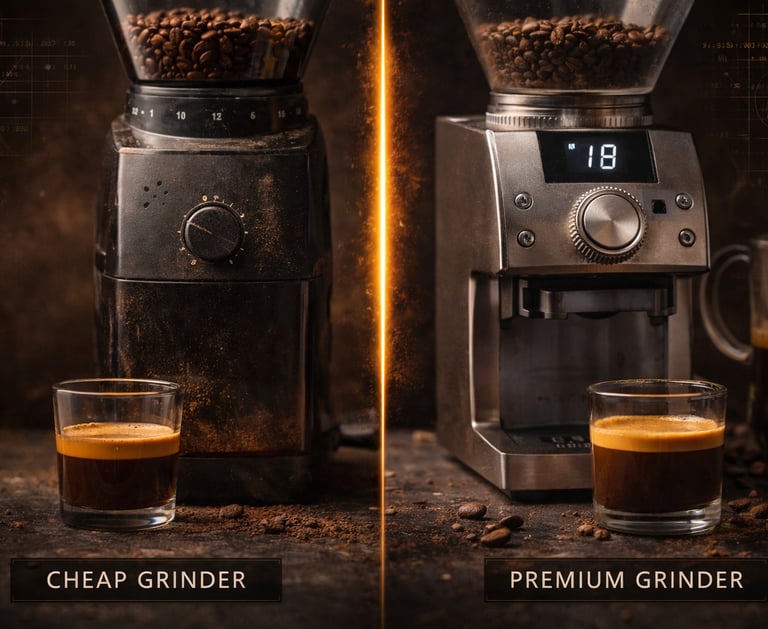
Expensive coffee grinders generally produce more consistent grind size, leading to more uniform extraction and clearer flavor profiles.
Material quality and burr type, such as steel flat burrs versus conical burrs, influence not only durability but also particle uniformity and grind speed.
Precision adjustments and grind stability matter most for espresso and pour-over methods where fine control alters extraction subtly but significantly.
Coarser methods like French press tolerate greater inconsistency, reducing the impact of high-end grinders on brewing results.
Routine maintenance and burr replacement affect grinding performance as much as initial build quality. Neglecting this often masks hardware advantages.
More expensive grinders are not inherently better if their features do not align with the user’s brewing preferences or commitment to consistency.
How Coffee Grinders Affect Brew Quality
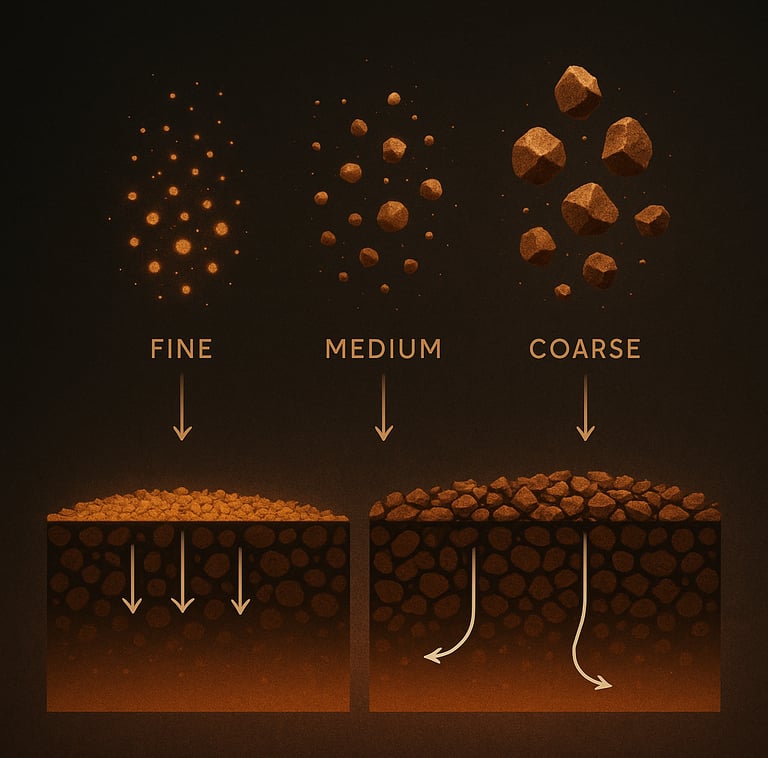
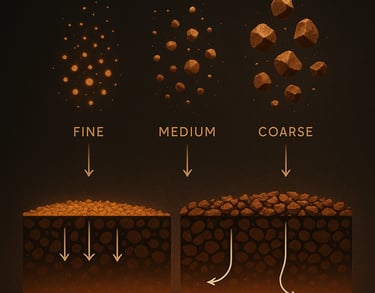
Grind size and uniformity serve as the foundation for extraction control. Finer particles expose more surface area, accelerating extraction, but uneven particle distribution invites a mix of under-extracted fines and over-extracted boulders, producing bitterness, sourness, or muddiness. The fundamental role of a coffee grinder is to minimize variations in particle size within a grind batch, ensuring water flows evenly through the coffee bed.
An inconsistent grind produces unpredictable brew strength and flavor imbalance from shot to shot. If you’ve experienced this directly, Why Grind Size Matters breaks down how these inconsistencies show up in real-world brewing.
Expensive coffee grinders usually leverage advanced burr geometry, tighter manufacturing tolerances, and refined adjustment mechanisms to deliver a narrower particle size distribution. This reduction in fines and oversized fragments dampens extraction variability, leading to more consistent flavor profiles. For instance, dialing in espresso requires micrometer-level precision in grind size to stabilize pressure drop and extraction times. Without this, small fluctuations rapidly manifest as bitter or sour cups.
For pour-over brewing, where immersion time and flow rate fluctuate, a grinder capable of nuanced steps or stepless adjustment improves repeatability. This is where higher-end grinders begin to separate themselves, especially when paired with controlled dialing techniques found in How to Dial in Grind Size.
Conversely, grinders at lower price points often have looser tolerances and coarser adjustment increments, resulting in more pronounced grind size swings.
Materials and Burr Types: What’s Inside Expensive Grinders?
Materials and burr design determine a grinder’s performance longevity and grind quality. Higher-end grinders commonly employ hardened steel burrs manufactured with precision engineering to maintain sharpness and resist wear longer than those in entry-level models. The housing materials, such as zinc or aluminum alloys, contribute to structural stability and noise reduction, indirectly affecting user experience during routine grinding.
Regarding burr types, flat burrs typically produce a more uniform particle size distribution compared to conical burrs. Flat burr designs deliver a narrower grind profile because their geometry slices coffee beans more evenly across their faces, especially at fine grind settings. However, flat burr grinders tend to be noisier and operate slower, which can marginally raise grinding temperature over prolonged use.
Conical burrs offer quieter operation and faster grinding, excelling in coarse to medium grind ranges but potentially creating a wider spread of particle sizes, particularly at fine settings. That said, modern conical burrs with quality machining have narrowed this gap considerably. In practice, the choice between flat and conical burrs should consider brewing method priorities.
If you're comparing grinder performance tiers directly, Cheap vs Premium Coffee Grinders highlights how these differences show up across real use cases.
Grinder motors and their speed also influence grinding quality. High-speed motors increase throughput but risk generating heat that may subtly degrade coffee flavor. Slower-speed grinders may preserve quality better but require longer grinding times. Most premium grinders strike a balance with efficient motor design and cooling.
Grind Consistency and Its Impact on Different Brew Methods
The relationship between grind consistency and brewing method is fundamental when assessing the value of an expensive coffee grinder. Espresso, with its high-pressure extraction and fine grind requirement, demands the tightest control over grind size distribution. Minute changes in particle size affect flow rate and extraction time significantly, which is why many espresso specialists invest in premium grinders with stepless adjustment and calibrated burr sets.
If you're building an espresso-focused setup, Best Coffee Grinders for Espresso is where consistency and precision really start to matter.
Pour-over techniques, such as using a V60 or Chemex, require precise grind size adjustments to manipulate brew time and extraction balance. Although slightly more forgiving than espresso, inconsistent grind size causes uneven water flow channels, leading to under- or over-extraction zones. A grinder capable of incremental adjustments aids in tailoring brews to specific recipes and beans.
Conversely, coarse brew methods like French press or cold brew tolerate greater particle size deviation. The full immersion and longer steep times compensate for grind irregularities, meaning consistent but less precise grinders still produce satisfying results.
Usability Factors: Adjustments, Speed, Noise, and Maintenance
Operational experience should not be overshadowed by grind quality alone. Usability features of premium grinders often justify their cost depending on the user’s brewing routine. Stepless adjustment allows real-time, nuanced control, while stepped adjustments limit settings to predefined intervals.
The ease of dose adjustment, minimal grounds retention, and consistent output also matter. Well-designed grinders reduce static cling and chaff mess, enabling smoother workflow and more precise dosing. Noise level during operation may influence home use, especially in early mornings or shared spaces.
Maintenance considerations affect long-term performance. Expensive grinders tend to allow simpler burr replacement and cleaning access, preserving their grind consistency over years. However, this advantage only manifests with routine maintenance. If cleaning is neglected, performance drops quickly, which is why How Often Should You Clean a Grinder becomes critical for long-term consistency.
Budget vs Premium: When to Upgrade Your Grinder
Determining whether to invest in an expensive coffee grinder hinges on your brewing goals, frequency, and tolerance for inconsistency. If you primarily prepare espresso or pour-over and seek to control variables precisely, upgrading delivers noticeable improvements in grind uniformity and adjustment resolution.
Alternatively, if your brewing leans toward coarser methods or you are early in refining technique, a solid entry-level option can still perform well. Best Coffee Grinders Under $100 highlights options that provide solid consistency without a major investment.
For those wanting a balance between performance and price, Best Coffee Grinders Under $300 offers a strong middle ground where grind quality improves significantly without entering premium pricing territory.
Ultimately, expensive grinders are tools whose value corresponds to how well their features align with your process needs rather than an absolute guarantee of better coffee.
Common Myths About Grinder Performance
One frequent misconception is that all expensive grinders automatically produce better tasting coffee. While they generally offer tighter grind size precision, final cup quality depends on how well you integrate that consistency into the broader brewing process.
Another is that flat burrs are always superior to conical burrs; each burr geometry suits particular contexts best. Similarly, the belief that high grind speed definitively harms flavor oversimplifies the issue. Most quality grinders manage heat effectively under normal use.
Understanding these nuances helps place grinder price and performance in a context where user technique ultimately controls coffee quality.
Tips for Getting the Best Out of Your Grinder
Consistent results depend more on deliberate adjustment than random changes. If you focus on one variable first, start with grind size — it strongly influences extraction time and flavor clarity. Avoid changing multiple settings at once, as this obscures cause-effect relationships.
Perform grinder cleaning regularly to prevent buildup that alters grind size distribution and retention. Replace burrs per manufacturer recommendations or as you notice degradation in grind quality. Pay attention to dosing consistency supported by your grinder’s chute and collection system.
For espresso users, stepping through incremental adjustments with small trial shots reveals how precisely your grinder affects extraction. Pour-over brewers benefit from recording grind settings alongside brew parameters to replicate favored results. Approach your grinder as a calibrated instrument in a process, not a black box.
Frequently Asked Questions About Coffee Grinders
Do expensive coffee grinders produce better coffee taste?
They tend to offer more consistent grind particle size, which leads to more uniform extraction and clarity in flavor. However, improvements in taste depend on integrating that consistency into your overall brewing process.
What grind size consistency do high-end grinders offer compared to budget models?
Premium grinders deliver narrower particle size distributions with fewer fines and oversized particles, improving extraction predictability.
Are flat burrs better than conical burrs?
Flat burrs generally produce more uniform particles, while conical burrs offer quieter operation and faster grinding. Both can perform exceptionally well depending on design and use case.
Is it worth upgrading from an entry-level grinder?
It depends on your brewing goals. Precision-focused brewing benefits more from upgrades than casual brewing.
How often should grinder burrs be replaced?
Typically every 500–1,000 pounds of coffee, depending on usage and burr material.
Does grinder speed affect coffee flavor?
High speeds can generate heat, but most quality grinders balance this effectively during normal use.
Can a grinder improve espresso and pour-over brewing?
Yes. Both methods benefit significantly from precise and consistent grind size control.
What factors affect grind quality beyond price?
Maintenance, burr condition, user adjustments, and brewing consistency all play major roles.
Practical Conclusion
Investing in an expensive coffee grinder can make a demonstrable difference, particularly if your brewing style prioritizes precision and repeatability. The incremental advantages in grind consistency, material durability, and usability features align best with espresso and pour-over methods that demand nuanced control.
Yet, these differences only translate into better coffee when paired with disciplined adjustment, routine maintenance, and mindful brewing. The pursuit of predictability rests on controlling all variables methodically rather than simply acquiring high-end equipment.
Ultimately, the grinder is a tool whose value is defined by how well it integrates into a disciplined process, not its price tag alone.
Contact@TheBuzzHQ.com
© 2026 Coffee Tech Buzz. All rights reserved.
Coffee Tech Buzz
Smarter brewing through better gear, clearer insights, and real-world performance testing.
Built for home users who want consistency without guesswork.
We focus on how machines actually perform — not just what they claim.
Home
Coffee Equipment Guide
Coffee Makers & Machines
Coffee Grinders
Espresso Gear & Guides
Coffee Beans & Roasts
Coffee Accessories & Tools
For educational purposes only.
We may earn commissions from qualifying purchases.
General Inquiries: