

How to Make a Ristretto
Learn how to craft a perfect ristretto shot with precise control over grind size, extraction time, and coffee-to-water ratio for a rich, syrupy espresso.
ESPRESSO
The Coffee Tech Buzz Editorial Team - Led by AJ “Buzz” Eichman
5/17/20268 min read
Quick Verdict
• A ristretto is a highly concentrated espresso shot using the same dose but roughly half the water volume of a standard espresso.
• Achieving consistency depends on finer grind size, shorter extraction time around 15-20 seconds, and precise coffee-to-water ratio control.
• Consistent dosing and tamping pressure, combined with stable temperature control between 90-94°C, are critical to avoid bitterness and maintain syrupy sweetness.
• Small iterative adjustments to grind and yield based on taste feedback ensure predictable, repeatable results over time.
What Is a Ristretto Shot?
A ristretto presents itself as an espresso variant distinguished by its concentrated nature and shorter extraction volume. While the amount of coffee grounds remains the same as a standard espresso — typically 18 to 20 grams — the total water used is about half, extracting around 15 to 20 milliliters of liquid compared to 30 to 40 milliliters in a regular shot. This reduced volume increases the density of dissolved solids, oils, and sugars, producing a richer, fuller body. The process deliberately brings forward sweetness and viscosity, suppressing some of the bitterness that tends to arise in longer extractions.
The defining technical characteristic of a ristretto lies in cutback on extraction time paired with a finer grind size. Finer grounds increase resistance within the portafilter basket, slowing water flow to extend contact time with coffee particles slightly but shorten overall shot time by limiting water volume. This balancing act is what yields the dense, syrupy liquid many associate with the best ristretto shots. Without this equilibrium, the resulting shot risks being either under-extracted and sour or over-extracted and thin.
For coffee enthusiasts exploring concentrated espresso styles, both Espresso Drinks and Italian Espresso Drinks help explain how drinks like ristretto fit into traditional espresso culture.
Essential Equipment and Setup for Ristretto
Control is paramount when preparing ristretto shots. Achieving precision requires a high-quality espresso machine capable of stable pressure at around 9 bars, often considered the standard for espresso extraction. Temperature control between 90°C and 94°C is another non-negotiable. Even subtle temperature fluctuations alter extraction rates and flavor solubility, skewing the balance of sweetness and bitterness, especially noticeable in a ristretto.
Equally important is a burr grinder with consistent particle size distribution and micro-adjustment capabilities. Since the grind size must be finer than standard espresso, the grinder’s precision is essential to avoid channeling or uneven extraction. A quality tamper, used to apply consistent pressure, helps ensure uniform puck density. Consistency in dose weight is necessary; use a scale rather than relying on volume or scoops.
Home baristas struggling with sour or uneven shots often discover the problem comes from grind inconsistency or extraction balance, which is covered further in Why Espresso Tastes Bitter or Sour. Grinder consistency also plays a major role in achieving repeatable ristretto extractions, especially when dialing in finer espresso settings discussed in Best Espresso Grinders for Beginners.
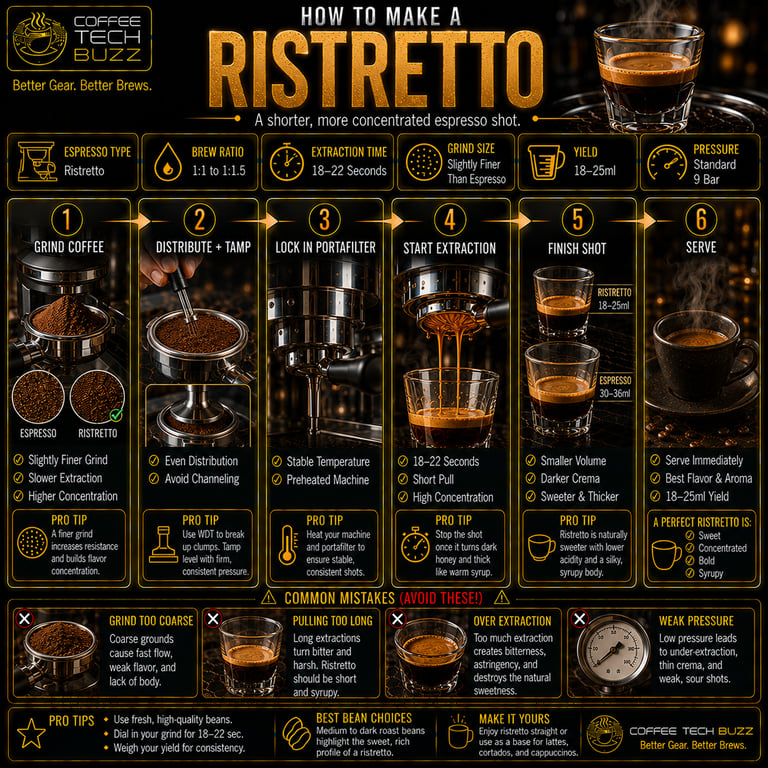
Step-by-Step Ristretto Brewing Guide
Begin by dosing 18 to 20 grams of freshly ground, high-quality coffee beans into the portafilter. Ensure the beans are freshly roasted and properly rested; stale beans will underperform, masking subtle flavor details that distinguish an ideal ristretto.
Grind to a finer setting than your usual espresso, mindful that this increases resistance and slows flow. Aim for a tamp pressure around 30 pounds, maintaining a level bed for uniform extraction.
Lock the portafilter into the espresso machine group head and begin extraction immediately. Target a shot volume of roughly 15 to 20 milliliters to be achieved within 15 to 20 seconds. Use a scale to monitor output precisely, adjusting in small increments.
If the shot pulls too quickly, indicating over-extraction risk, adjust the grind slightly finer. If too slow or overly syrupy with signs of under-extraction, coarsen the grind marginally. Maintaining consistent extraction pressure at 9 bars is also imperative.
Once brewed, examine the ristretto’s body and flavor profile. A good ristretto will have a thick, syrupy texture, with pronounced sweetness and minimal bitterness. Notes may exhibit fruitiness or caramel depending on the bean origin.
For a broader breakdown of extraction theory, dosing, and shot structure, see the Complete Espresso Guide.
Adjusting Grind Size and Dose for Ristretto
The finer grind size for ristretto is not arbitrary; it directly affects flow rate, extraction uniformity, and ultimately flavor intensity. A finer grind increases surface area but also resistance, slowing the water’s path through the puck. This deceleration is necessary because the volume is reduced — water must spend enough time in contact with the grounds to dissolve desired solubles without pulling harsh compounds.
Grind adjustments should be incremental. Even a single notch on a grinder dial can significantly alter shot duration and taste. If extraction time exceeds 20 seconds or the yield surpasses 20 milliliters, consider tightening the grind. Conversely, if flow is too slow, leading to under-extraction or puck blocking, slightly coarsen the grind.
Dose consistency also plays a role, though it is less frequently adjusted for ristretto compared to grind or yield. Maintaining 18 to 20 grams ensures the puck density remains stable, allowing the water pressure and temperature to perform predictably. If you change dose, recalibrate grind and extraction parameters accordingly.
Understanding extraction ratios is one reason many espresso enthusiasts eventually study Espresso Ratio Explained to improve consistency and shot balance.
Extraction Time and Coffee-to-Water Ratios Explained
Extraction time governs the balance between under- and over-extraction, particularly acute for ristretto shots. Extraction that continues beyond the 20-second mark tends to draw out more bitter and astringent compounds, which ristretto strives to avoid. By shortening this window to 15-20 seconds, you emphasize sugars and oils with less bitterness.
The coffee-to-water ratio shifts meaningfully in ristretto preparation. Using the same coffee dose but about half the water volume naturally concentrates dissolved solids. This adjustment is not just volume but also a flavor concentration tool. It’s important that the machine and grinder setup supports this reduced yield — simply pulling a regular espresso shot and stopping early without adjusting grind size often leads to under-extracted, acidic shots.
Consistency in extraction pressure, temperature, and dosing all contribute to managing the coffee-to-water ratio effectively. When these factors drift, the ristretto shot shifts from syrupy and sweet to thin or overly bitter.
Ristretto extraction also differs heavily from longer espresso styles discussed in Lungo vs Espresso Explained, especially regarding flavor concentration and shot volume.
Common Mistakes and How to Avoid Them
One of the most frequent errors is failing to adjust grind size and extraction time compared to a regular espresso. Using the same parameters but cutting shot volume prematurely produces weak, under-extracted flavors. Over-extracting to compensate introduces bitterness and astringency that overshadow the ristretto’s hallmark intensity.
Inconsistent dosing or tamping leads to channeling where water flows unevenly through the puck. This unpredictability manifests immediately in shot variance from one pull to the next, undermining repeatability.
Using low-quality or stale coffee beans masks the nuanced flavor clarity a ristretto demands. Freshness and bean origin are not mere enhancements but foundational. Crema quality can also reveal issues with freshness, grind consistency, and extraction technique, which is explored deeper in Why Crema Matters.
Neglecting machine maintenance—such as cleaning group heads and ensuring stable pressure and temperature control—introduces variability in the brewing environment, eroding reliability.
Finally, diluting ristretto shots with extra water or milk is counterproductive. The point of a ristretto is concentration and syrupy body; adding volume diminishes this, undermining the profile entirely.
Troubleshooting Ristretto Shots
If the ristretto tastes bitter, it usually indicates over-extraction. Confirm that the shot time isn’t exceeding 20 seconds and ensure the grind is not too fine, which can cause resistance and channel clogging. Also, verify that the brewing temperature is not above 94°C; excessive heat accelerates extraction of harsh compounds.
Conversely, a watery or sour ristretto usually signals under-extraction. This can be due to grind size being too coarse, shot time too brief, or insufficient puck density from inconsistent tamping.
In cases of erratic shot flow or taste inconsistency, examine machine pressure stability and group head cleanliness. Regular maintenance of your espresso machine preserves stable brewing conditions necessary for precise ristretto preparation.
Coffee drinkers newer to concentrated espresso styles often start with milk-heavy beverages before moving toward shorter extractions like ristretto, which is one reason Best Espresso Drinks for Beginners can help explain progression through espresso styles.
Ristretto vs. Espresso and Other Short Coffee Shots
Ristretto differs fundamentally from a standard espresso in volume, extraction time, and grind size, resulting in a distinct flavor emphasis. While espresso produces 30–40 milliliters typically extracted in 25–30 seconds with a medium-fine grind, ristretto halves both yield and extraction time but uses a finer grind. This process increases concentration of sugars and oils, producing a sweeter, fuller-bodied shot.
Compared to lungo, which is extracted with the same dose but nearly double the water, ristretto sits on the opposite end of the spectrum in terms of volume and flavor profile. Lungo tends to be thinner, more bitter, and less intense.
Coffee enthusiasts comparing concentrated espresso drinks often also compare ristretto against smaller traditional drinks like the one discussed in What Is a Traditional Macchiato?
Understanding these differences helps home baristas decide which shot suits their preferences and how to adjust variables accordingly in pursuit of repeatable results.
Frequently Asked Questions
What is the ideal coffee-to-water ratio for a ristretto shot?
Aim for about 18-20 grams of coffee to yield 15-20 milliliters of liquid, roughly halving the water volume compared to a regular espresso, to concentrate flavor while avoiding over-extraction.
How does grind size affect ristretto extraction?
Finer grind increases resistance, slowing water flow, which is essential to balance the shortened extraction time and reduced volume to extract sugars and oils without bitterness.
Can I make a ristretto shot with any espresso machine?
Technically yes, but consistent and precise ristretto shots require machines with reliable pressure at 9 bars, stable temperature control around 90-94°C, and compatibility with fine grind settings.
How long should I extract a ristretto shot?
Extraction times between 15 and 20 seconds typically produce balanced, concentrated shots; longer extraction risks bitterness, while shorter can cause under-extraction.
What beans are best for making ristretto?
Use fresh, high-quality beans with flavor profiles emphasizing sweetness and body. Single-origin and specialty coffee with medium to dark roasts often perform well.
How is a ristretto different from a lungo or a regular espresso?
A ristretto uses the same coffee dose with half the water of espresso, focusing on a shorter, more concentrated extraction. Lungo uses the same dose but twice the water, resulting in a longer, more diluted shot.
Why does my ristretto taste bitter or weak?
Bitterness suggests over-extraction, often due to grind being too fine or too long extraction time; weakness can stem from under-extraction caused by coarse grind, short extraction, or inconsistent tamping.
Is a ristretto stronger in caffeine than an espresso?
Because the ristretto uses less water but the same amount of coffee grounds, the caffeine concentration is higher per milliliter, but the total caffeine content per shot is generally slightly less due to shorter extraction time.
Practical Conclusion
Making a perfect ristretto shot is less about chasing the latest gear and more about mastering control over a handful of variables — grind size, extraction time, dose consistency, and temperature stability. The hallmark of a good ristretto lies in predictable, repeatable results, not one-off successes.
By refining these parameters incrementally and purposefully, you establish a process that yields a syrupy, intensely flavorful shot that highlights coffee’s sweeter and more complex attributes. The process demands disciplined adjustments informed by tasting and measurement. Over time, this approach transforms ristretto preparation from guesswork into a reliable, high-performance routine.
For those serious about precision in home espresso brewing, investing in a quality burr grinder and an espresso machine with robust temperature and pressure control forms the essential foundation. Supplement this with rigorous maintenance and methodical technique, and the elusive perfect ristretto becomes an attainable standard rather than a lucky accident.
Within the broader spectrum of coffee brewing methods, the ristretto shot exemplifies how small adjustments and exacting attention to detail can significantly elevate coffee experience. Understanding and controlling these factors puts quality into the realm of certainty rather than chance.
Contact@TheBuzzHQ.com
© 2026 Coffee Tech Buzz. All rights reserved.
Coffee Tech Buzz
Smarter brewing through better gear, clearer insights, and real-world performance testing.
Built for home users who want consistency without guesswork.
We focus on how machines actually perform — not just what they claim.
Home
Coffee Equipment Guide
Coffee Makers & Machines
Coffee Grinders
Espresso Gear & Guides
Coffee Beans & Roasts
Coffee Accessories & Tools
For educational purposes only.
We may earn commissions from qualifying purchases.
General Inquiries: