
Can You Use One Grinder for Espresso and Pour Over?
Explore whether one espresso grinder can effectively serve both espresso and pour over with precise adjustments and disciplined calibration.
COFFEE GRINDERS
The Coffee Tech Buzz Editorial Team - Led by AJ “Buzz” Eichman
5/31/20268 min read
Using a single coffee grinder for both espresso and pour over brewing is a question I encounter frequently, especially from home baristas seeking efficiency without sacrificing control. These two brewing methods demand significantly different grind sizes and particle uniformity to achieve their optimal extraction profiles. Espresso requires a fine, densely packed bed of coffee grounds to resist high-pressure water flow, while pour over depends on a coarser grind that allows a steady drip and balanced extraction. The feasibility of using one grinder hinges on its ability to deliver consistent performance across a broad grind size range and on the brewer’s willingness to recalibrate settings carefully for each method.
For a broader look at grinder performance, brewing consistency, and equipment choices, start with our Coffee Grinders guide.
Understanding how grinder adjustments affect extraction becomes much easier when paired with a proper Complete Espresso Grinder Guide.
Quick Verdict
• One grinder can serve both espresso and pour over if it offers fine gradation and stable grind consistency.
• Stepless or very finely indexed grind adjustments enhance control when switching between methods.
• Regular recalibration and thorough cleaning are critical to prevent extraction inconsistencies.
• While saving counter space and cost, using a single grinder may require workflow compromises compared to dedicated machines.
Understanding Grind Size Differences Between Espresso and Pour Over
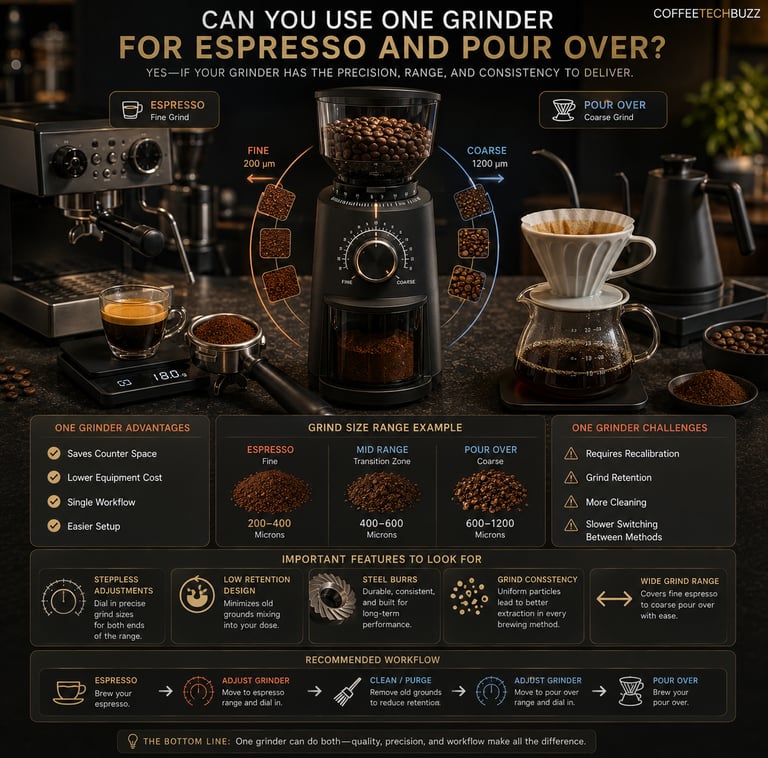
The root of the challenge lies in grind size itself. Espresso usually calls for a grind size between 200 and 400 microns, where the particles are fine enough to provide resistance against water pushed through under 9 bars of pressure. This resistance determines the flow rate and extraction time, two critical factors for balanced flavor. Conversely, pour over methods—such as the V60 or Chemex—gain their clarity and body from a coarser grind that typically ranges from 600 up to 1200 microns. The larger particle size facilitates slower water passage by gravity, enabling uniform saturation over several minutes.
This difference in grind size is not merely a matter of coarse versus fine; it reflects how particle size distribution impacts extraction dynamics. With espresso, a narrow particle size distribution reduces channeling and ensures even extraction, while pour over benefits from a somewhat broader distribution that promotes balanced flow. Using one grinder for both demands that it reproduces these diverse particle size profiles reliably. A grinder failing to maintain consistent size distributions when switched between settings will compromise the quality of either brew method.
Key Grinder Features for Versatility and Consistency
To extract espresso and pour over effectively with one machine, the grinder must provide dedicated features that support both ends of the grind size spectrum. A stepless grinder or one with very fine incremental adjustments allows precise micro-tuning of grind size. This level of control is invaluable because even a slight deviation in espresso grind can alter extraction time dramatically. Slightly coarser or finer adjustments for pour over help optimize flow without guesswork.
Burr type also plays a central role. Flat burrs often deliver uniform particle size but generally demand more fine-tuning from the user to dial in settings across grind ranges. Conical burrs offer a tolerance to grind variations and retention, which can aid switching between coarser and finer settings without significant adjustment drift. Materials matter as well; steel burrs tend to retain sharp edges longer, supporting consistent particle size over time, whereas ceramic burrs may wear or chip more quickly, affecting grind uniformity.
Another crucial feature is low retention design. Grind retention refers to grounds remaining inside the grinder’s chamber, which become problematic when drastically changing grind size between espresso and pour over. Residual fine grounds can contaminate coarser settings, leading to uneven extraction or flavor muddiness. Grinders designed with minimal retention reduce this carryover effect and maintain grind purity when shifting between methods. Understanding Why Retention Matters in a Coffee Grinder helps explain why some grinders handle multi-method brewing better than others.
Adjusting Grinder Settings for Dual Brewing Methods
When employing a single grinder, adjustment becomes the ongoing process that governs extraction quality. Most users underestimate how critical frequent recalibration is when switching from espresso to pour over and back. Even with a precision grinder, you will need to reestablish grind settings every time you change brew styles to maintain repeatable results. This is often where results start to vary without people realizing why—the same grinder setting will never suffice because the particle size and distribution requirements differ so radically.
If you focus on one variable first, begin with grind size. It affects flow rate, extraction timing, and ultimately taste. Document your starting points for both methods and calibrate systematically. For espresso, start finer and make incremental adjustments until shot times align with your target range, usually between 25 and 30 seconds for a double shot. For pour over, begin with a coarser setting that facilitates a 2.5 to 3.5-minute brew time, then adjust based on flow and flavor clarity.
Keep in mind that grind particle size interacts with tamping pressure in espresso and pouring technique in pour over. A small change here tends to show up more than expected in the final cup. Avoid random jumps; instead, work in consistent steps and assess outcomes carefully. Over time, this disciplined approach trains you to predict how setting changes translate into flavor extraction.
Common Challenges and How to Overcome Them
Transitioning between espresso and pour over on one grinder exposes several practical challenges. One of the most frequent issues is inconsistent grind retention, especially when jumping between a very fine espresso grind and a coarse pour over setting. Residual fine grounds from espresso can accumulate in the chute and burrs, causing unexpected finer particles when grinding for pour over, which often results in over-extraction or muddled flavors.
To mitigate this, regular cleaning becomes a non-negotiable part of your routine. Simply brushing out the grinder chute, burrs, and dosing chamber before switching methods limits carryover. Some grinders incorporate features designed to reduce retention, which is a consideration in your selection process.
Static and grind clumping tend to intensify during fine espresso grinding and can influence dosing consistency. Employing strategies to reduce static, such as grounding in a slightly humid environment or using anti-static materials for the catch bin, helps maintain grind predictability.
Another concern is time lost during recalibration. When you dial back and forth repeatedly, it’s tempting to sacrifice refinements in favor of speed. But rushed adjustments introduce variability, the very problem consistent brewing tries to solve. Embrace the recalibration process as part of your brewing ritual.
When to Consider Dedicated Grinders vs One Grinder
While using a single grinder is achievable, there are practical limits. Dedicated grinders remain advantageous for those who brew both methods frequently or in larger volumes, as they streamline workflow and reduce the need for constant adjustment. They also prevent cross-contamination of grounds between brew styles, maintaining purity and precision in each cup.
For users with space or budget restrictions, or those who brew one method predominantly but occasionally switch, a single high-quality grinder with precise adjustment capability is a reasonable compromise. However, expect to invest time initially to establish reliable grind profiles and to maintain your grinder meticulously.
If workflow efficiency and maximum repeatability are priorities—think a morning routine that demands fast transitions or a home barista who values process stability above all else—dedicated grinders reveal their worth more clearly. If you're shopping for a versatile option, our roundup of the Best Coffee Grinders for Espresso is a great place to start.
Real-World Tips for Using One Grinder Effectively
Practically, treat your grinder as a performance instrument that requires care and attention. Log grind settings for both espresso and pour over so you can reset quickly without guessing. This may mean marking your grinder’s adjustment collar or maintaining a digital note.
Minimize retention by cleaning your grinder before each method change. If possible, purge a small amount of grounds into a separate container or use retention-blowing tools that some grinder manufacturers provide.
Invest in a grinder with stepless or fine increment adjustments and burrs known for consistency, ideally in steel. Avoid budget grinders that lack control precision or produce uneven particle sizes; these will amplify the difficulty of managing dual brewing methods.
Slow grinding speed also helps preserve grind consistency and reduces static. Grinding more slowly generates less heat, which can otherwise accelerate flavor degradation in the ground coffee before brewing.
Maintaining Your Grinder for Optimal Brew Performance
The grinder is a precision machine. Burr dullness or misalignment translates immediately into increased fines, inconsistent particle size, and thus unpredictable extractions. Maintain your grinder by regularly inspecting and replacing burrs as recommended by the manufacturer.
Routine cleaning prevents oils and fines buildup that affect flavor clarity and grinder operation. Adopting a cleaning schedule with detergent pellets and brushes, plus a visual check on burr wear, will extend the grinder’s ability to maintain consistent outputs across the full grind size range.
Adequate maintenance is especially critical when one grinder serves two vastly different brewing approaches, as it magnifies the impact of any inconsistency. For a maintenance schedule, see How Often Should You Clean a Grinder? Essential Guide for Coffee Lovers.
Common Mistakes in Using One Grinder for Espresso and Pour Over
One of the most common oversights is assuming that any grinder setting used for espresso will suffice for pour over or vice versa without recalibration. The large gap between fine and coarse grind sizes demands deliberate adjustment each time.
Neglecting the implications of grind retention and static leads to contamination of grind profiles and flavor muddiness. Users often underestimate retention effects, resulting in unexpected shifts in particle size distribution that hurt repeatability.
Choosing low-quality grinders without flat or conical burrs compromises grind uniformity. Such grinders might deliver inconsistent extraction regardless of user effort, making it virtually impossible to master dual-method brewing.
Failure to maintain the grinder over time accelerates burr wear and reduces precision, silently degrading your coffee’s flavor clarity and balance.
FAQ
Can one grinder really produce good espresso and pour over coffee?
Yes, a single grinder with precise, stepless adjustments and consistent burr technology can deliver both espresso and pour over grind profiles effectively. However, it requires regular recalibration and maintenance to ensure that grind size and consistency meet the exacting demands of each method.
What grind size ranges are needed for espresso vs pour over?
Espresso grinds typically range from 200 to 400 microns—fine enough to create resistance for pressurized extraction. Pour over grinds range from approximately 600 to 1200 microns, coarser to support controlled water flow by gravity over multiple minutes.
What grinder features are best for multi-method use?
Look for grinders with stepless or micro-indexed grind adjustments, low retention design, durable steel or ceramic burrs with flat or conical geometry, and a build quality that supports consistent particle size distribution across a wide grind size range.
How do I adjust grinder settings when switching between espresso and pour over?
You should recalibrate the grinder settings each time you switch brew methods. Begin from a known baseline for each method, then make small incremental adjustments based on extraction time and flavor profile. Also, clean the grinder to reduce retention impact before switching.
Is it better to have two grinders for espresso and pour over?
If workspace and budget allow, two grinders can simplify workflow and provide stable, dedicated settings for each method, reducing recalibration time. However, for many home setups, a single, high-quality grinder can suffice with diligent control.
What common problems occur when using one grinder for both?
Common issues include grind retention causing cross-contamination of fine and coarse grounds, inconsistent grind size due to burr wear or poor adjustment mechanisms, and extraction variability caused by infrequent recalibration.
How often should I recalibrate or clean my grinder?
Recalibrate grind settings whenever switching brew methods. Frequent cleaning—ideally before each switch or daily with heavy use—helps maintain consistency and prevents buildup that affects particle uniformity.
Are there budget grinders suitable for both methods?
Budget grinders often struggle to provide the fine tuning and grind consistency required for both espresso and pour over. While some models offer versatile grind ranges, they may sacrifice reliability and control, making them less suitable for baristas prioritizing consistency in dual-method brewing.
Conclusion
Using one grinder for espresso and pour over is a task of precision rather than convenience. It demands a grinder capable of fine-tuned, stable adjustments across a wide grind size range, combined with a disciplined approach to recalibration and maintenance. While it offers practical benefits in terms of space and cost, it inevitably requires more attentiveness from the user to maintain consistency. With the right grinder and technique, it’s possible to control and predict the extraction outcomes for both brewing methods, but it is not a one-click solution. The process-oriented brewer understands that every setting change ripples through the final cup. Accepting this reality enables deliberate control and elevates each brew from chance to certainty.
For those interested in exploring further, reviewing grinder comparisons can help identify models known for their versatility and consistency. Additionally, resources on brewing methods and coffee bean selection provide the context to fully leverage your grinder’s capabilities and achieve refined results whether dialing in espresso or perfecting your pour over.
Contact@TheBuzzHQ.com
© 2026 Coffee Tech Buzz. All rights reserved.
Coffee Tech Buzz
Smarter brewing through better gear, clearer insights, and real-world performance testing.
Built for home users who want consistency without guesswork.
We focus on how machines actually perform — not just what they claim.
Home
Coffee Equipment Guide
Coffee Makers & Machines
Coffee Grinders
Espresso Gear & Guides
Coffee Beans & Roasts
Coffee Accessories & Tools
For educational purposes only.
We may earn commissions from qualifying purchases.
General Inquiries: