
Why Retention Matters in a Coffee Grinder
Explore how coffee grinder retention impacts brew consistency and flavor, and learn key techniques to manage and reduce retained grounds.
COFFEE GRINDERS
The Coffee Tech Buzz Editorial Team - Led by AJ “Buzz” Eichman
5/31/20268 min read
For a broader look at grinder performance, brewing consistency, and equipment choices, start with our Coffee Grinders guide. Understanding how grinder adjustments affect extraction becomes much easier when paired with a proper Coffee Grinder Settings Guide.
Quick Verdict
• Coffee grinder retention, while often overlooked, plays a significant role in grind quality consistency and dose accuracy.
• Retained grounds mix older, stale particles with fresh grinds, causing variation in extraction and flavor profile.
• Different grinder designs influence retention levels; understanding these differences is crucial for performance-driven brewing.
• Regular cleanout practices and retention reduction techniques improve brewing precision, especially in multi-dose scenarios.
What is Coffee Grinder Retention?
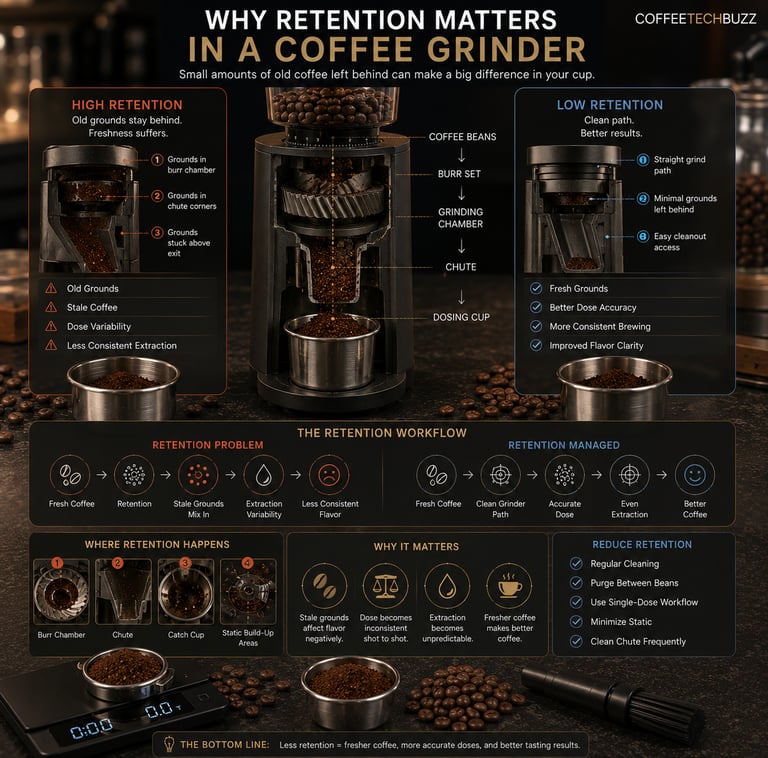
Coffee grinder retention refers to the volume of coffee grounds that remain trapped inside the grinder after the grinding process. These grounds do not reach the brew basket and can linger in the burr chamber, chute, or dosing mechanisms depending on the grinder’s design. While it might seem minor, this retention introduces inconsistency into each dose by carrying over remnants from previous grinds. This residual coffee tends to age and oxidize in place, which affects the freshness and uniformity of subsequent brews. Given that finely ground coffee is highly sensitive to any variation in particle size or freshness, even small amounts of retained grounds have a disproportionate impact on grind quality consistency.
Retention is a variable that most home brewers do not account for consciously. It is often masked by factors such as dose by weight or volume, leading baristas to misinterpret fluctuations in yield or extraction as problems with grind size or brewing technique. Recognizing retention’s role makes it possible to control brew outcomes with greater predictability.
How Retention Affects Coffee Quality and Extraction
The core impact of coffee grinder retention lies in the blending of old and fresh grounds. Coffee that remains in the grinder after a dose gradually loses volatile aromatic compounds and develops stale flavors due to oxidation and potential moisture exposure. When these aged grounds mix with freshly ground coffee, they compromise the overall flavor clarity and balance of the cup. This is particularly apparent when brewing multiple doses in succession, such as in batch brewing or during espresso pulls where precise dose consistency is critical.
Extraction uniformity is also affected. Retained grounds can vary slightly in particle size from freshly ground coffee if, for example, the previous dose was ground at a different setting or if fines settle differently in the retained residue. This inconsistency influences flow rate and extraction yield, creating unwanted variability from cup to cup. Over time, if retention is not managed through regular cleaning or purging, it contributes to a decline in perceived coffee quality that cannot be corrected by grinding or brewing adjustments alone. Understanding Why Freshly Ground Coffee Tastes Better also highlights why stale retained grounds can negatively affect flavor.
Common Causes of Grind Retention
Retention primarily occurs due to a combination of grinder design, burr geometry, and static electricity. Burr grinder designs with dosing chambers or chute paths that hold grounds after grinding show higher retention levels. Doser grinders, for example, typically trap more grounds within their compartment compared to single-dose grinders engineered to minimize leftover residue.
The shape and material of the grinder chute and catch bin influence how grounds adhere and settle. Materials such as plastic chutes tend to exhibit more static cling, attracting fine particles that stick to surfaces instead of falling cleanly into the portafilter or brew basket. Static buildup not only causes retention but also clumps fines together, further disrupting dose consistency.
In addition, burr alignment and clearance settings can affect retention. Worn or misaligned burrs produce uneven grinds that are more prone to getting stuck in narrow passages. Similarly, a grind setting that produces excessive fines or uneven particle distribution increases the likelihood of fines lingering inside the grinder.
How to Measure and Monitor Retention
Understanding your grinder’s retention starts with careful measurement and observation. One practical method involves running a known dose of coffee through the grinder, then performing a thorough cleanout and weighing the grounds collected from the grinder’s interior surfaces. Comparing this residual amount to the initial dose size quantifies retention percentage.
Regular monitoring is essential, especially if you adjust grind settings frequently or switch beans. Variations in bean oil content and roast level can affect how grounds behave inside the grinder. Tracking retention alongside grind quality metrics helps identify when cleaning or maintenance is required to maintain consistency.
Maintaining records of dose weights before and after grinding, combined with routine cleanouts, will reveal retention trends that otherwise go unnoticed. Apps or brewing logs can assist in correlating retention with extraction measurements to refine dosing and grind adjustments for predictable results.
Tips to Reduce Retention and Improve Consistency
Reducing retention is not about eliminating it entirely—this is often impractical—but about managing its impact on each brew. One widely recommended approach is purging: running a small amount of coffee through the grinder before dosing to clear out residual grounds from previous grinds. This “flush” dose is discarded or used for less critical brews, preventing stale grounds from contaminating the intended cup.
Regular grinder cleanout is fundamental. Depending on usage, cleaning every few days to weekly keeps retention stable. This includes brushing out burrs, removing clumps, and wiping static-prone surfaces inside the grinder chute. Special cleaning tools made for grinders can facilitate this process without disassembly.
Selecting a grinder with low-retention design elements delivers more predictable yields. Single-dose grinders with straight-through paths and minimal crevices where grounds can lodge are preferred for precision-focused brewing. Features such as steel chutes and anti-static coatings help decrease the clinging of fines.
Small adjustments to grind size also affect retention. A finer grind increases particle count and may raise retention if the grinder is not optimized for such settings. By contrast, a coarser grind usually reduces fines and clumping, lowering retention impact. Tracking these effects allows brewers to choose consistent settings that balance extraction goals and retention control.
Choosing Low-Retention Grinders for Home Use
When selecting a grinder, retention should be a consideration equal to grind consistency and durability. Burr grinders designed for espresso typically exhibit more retention due to dosing chambers, whereas manual or single-dose grinders minimize this risk. Understanding the way your grinder retains grounds enables easier control of dose weight and flavor profile, especially if you are leveraging manual brew methods or espresso where precision matters.
Among popular home grinders, models with straight burr chutes and minimal dosing compartments tend to score better in retention tests. For example, grinders with single-dosing funnels or those that allow easy removal of residual grounds streamline cleanout, reducing the consistency drift caused by stale residues.
The trade-off sometimes involves convenience, as low-retention grinders may require more frequent dosing or cleaning cycles. However, in a performance-driven home setup, the improved yield reliability and flavor consistency justify these routines. Reviews that focus on grinder comparisons often provide retention data to assist buyers aiming for consistent performance at home. If you're shopping for one, our roundup of the Best Coffee Grinders for Espresso includes several low-retention options.
Routine Maintenance and Cleaning Best Practices
Consistent grinder maintenance prevents retention from escalating into a source of unpredictable variance in your cup. Beyond daily purge routines, deeper cleanings at least once a week remove oils, chaff, and fine grounds that accumulate on burrs and inside the grinder body. This reduces static and physical buildup that traps coffee particles.
Disassembling burrs for thorough cleaning allows access to hidden crevices where stale coffee can hide, directly impacting flavor if neglected. Many grinder manufacturers provide guidelines on safe disassembly and cleaning schedules that maintain burr sharpness and structural integrity while controlling retention.
In addition to brushing and vacuuming, periodic use of cleaning tablets designed for grinders can dissolve oils and residues in hard-to-reach areas. Follow these cleanouts with calibration checks, as burr realignment or recalibration after cleaning ensures grind size remains consistent.
Maintaining a clean grinder chute and using anti-static wipes help reduce adherence of fines inside the feed path. Over time, these routines stabilize your dosing accuracy and ensure grind quality consistency without introducing new variables. For a detailed maintenance routine, see How Often Should You Clean a Grinder? Essential Guide for Coffee Lovers.
Addressing Common Retention-Related Issues
Brewers often misattribute dose variability, extraction inconsistencies, or flavor shifts solely to grind settings or brewing parameters, overlooking retention’s role. This is where results start to drift without immediate awareness. When retention fluctuates, the effective dose changes subtly, causing inconsistent flow rates and extraction yields that confound troubleshooting efforts.
In multi-dose or back-to-back brewing sessions, failure to purge retention leads to cups contaminated with stale coffee residues, softening the vibrancy and clarity. This issue usually manifests as inconsistent acidity or a dull aftertaste. Identifying retention as a variable enables methodical correction rather than guesswork.
Some grinders with high retention require dose adjustment strategies to compensate for leftover grounds. Measuring and calibrating doses frequently counters variability but does not replace cleanout routines. Understanding how retention interacts with other brewing variables reduces unpredictable outcomes in your workflow.
Avoiding common mistakes—like ignoring retention or delaying cleanouts—preserves the integrity of your grind quality and overall workflow consistency, key components to performance-driven brewing.
Common Mistakes Related to Grind Retention
Failing to clean out the grinder regularly is the primary error that leads to accumulation of stale coffee grounds and inconsistent dosing. Over time, this neglect translates directly into unpredictable brew profiles and impaired coffee quality despite other controlled variables.
Another frequent mistake is assuming grind retention has negligible influence on coffee flavor and extraction. This underestimation overlooks the chemical degradation that retained grounds undergo, which impacts cup clarity and balance.
Using high-retention grinders without adjusting dosage or purging routines compounds inconsistency, especially in manual brewing. Users often neglect the impact retention has on yield timing and volume, affecting dose accuracy.
Many brewers do not consider how retention influences repeatability in dose weight measurements. This is critical for manual methods that rely on precise coffee-to-water ratios. Overlooking small changes due to retention is where variability begins.
Finally, a common oversight is ignoring retention’s role across different brewing methods. For example, espresso demands far tighter yield consistency than drip or immersion methods, making retention effects more pronounced and troublesome if not managed carefully.
FAQ
What causes grind retention in coffee grinders?
Retention results primarily from burr geometry, grinder chute design, static electricity, and material surfaces that cause grounds to adhere inside the grinder after grinding.
How does retention affect coffee flavor and extraction?
Retention causes older coffee particles to mix with fresh grounds, leading to stale flavors and inconsistent extraction due to variable particle size distribution and dose weight.
Which types of grinders have the least retention?
Single-dose grinders with straight-through burr paths and minimal dosing chambers typically have the lowest retention compared to doser-equipped or bulk grinders.
How often should I clean out my grinder to reduce retention?
Cleaning frequency depends on usage, but weekly deep cleanings combined with daily purging routines are effective for maintaining low retention and consistent grind quality.
Can grind retention cause inconsistencies in coffee brewing?
Yes, retention leads to dose variability and mixing of stale grounds, which directly impacts extraction uniformity and cup-to-cup flavor consistency.
What are effective techniques to reduce grinder retention?
Techniques include pre-dosing purges, regular cleanouts, choosing grinders with low-retention design features, minimizing static by cleaning and using anti-static tools, and carefully adjusting grind size.
Does retention impact different brewing methods differently?
Retention effects are most critical in espresso and manual brew methods requiring precise dose control, but any brewing method can suffer flavor degradation and extraction inconsistency from unmanaged retention.
Is grind retention more problematic for home or commercial grinders?
Retention can affect both; however, commercial grinders often have more robust cleaning protocols to manage retention. Home brewers may encounter more variability due to irregular cleaning and single-dose setups.
Conclusion
Understanding and managing coffee grinder retention is fundamental to achieving predictable, repeatable brew results in a performance-driven home coffee setup. Retention silently influences grind consistency, dose accuracy, and extraction quality by blending stale and fresh grounds. This subtle factor is often overlooked yet critical for anyone serious about refining flavor precision across repeated brews.
Rather than chasing equipment trends, focusing on controlling retention through proper grinder selection, routine maintenance, and disciplined dosing practices yields measurable improvements. Small changes—whether purging retained grinds before dosing, selecting grinders designed to minimize retention, or adhering to regular cleaning schedules—translate into more consistent cups and fewer mystery variables undermining your process.
For deeper insight into grinder design and maintenance protocols, reference our comprehensive pillar guide on grinders. Additionally, exploring accessories tailored to grinder cleaning and low-retention performance can enhance your routine even further. For those comparing grinder models, our side-by-side reviews include retention analysis to inform your purchase decision with practical accuracy in mind.
Ultimately, retention is not an unsolvable problem but a controllable variable. Treating it as a core part of the brewing process, rather than an afterthought, brings precision and confidence to each cup you brew.
Contact@TheBuzzHQ.com
© 2026 Coffee Tech Buzz. All rights reserved.
Coffee Tech Buzz
Smarter brewing through better gear, clearer insights, and real-world performance testing.
Built for home users who want consistency without guesswork.
We focus on how machines actually perform — not just what they claim.
Home
Coffee Equipment Guide
Coffee Makers & Machines
Coffee Grinders
Espresso Gear & Guides
Coffee Beans & Roasts
Coffee Accessories & Tools
For educational purposes only.
We may earn commissions from qualifying purchases.
General Inquiries: