
Why Freshly Ground Coffee Tastes Better
Explore why freshly ground coffee preserves aroma and flavor better, with consistent grind size ensuring optimal extraction and taste in every brew.
COFFEE GRINDERS
The Coffee Tech Buzz Editorial Team - Led by AJ “Buzz” Eichman
5/31/20266 min read
For a broader look at grinder types, brewing consistency, and equipment choices, start with our Coffee Grinders guide.
Understanding how grind size affects brewing performance becomes much easier when paired with a proper Coffee Grinder Settings Guide.
Quick Verdict
Grinding coffee immediately before brewing preserves critical aromatic oils that begin to dissipate rapidly after grinding.
Consistent grind size plays a decisive role in even coffee extraction, directly influencing the flavor balance.
Pre-ground coffee experiences accelerated oxidation due to prolonged exposure to air, moisture, and light, leading to flavor degradation.
Matching grind size accurately to your brewing method is essential for extracting optimal taste and avoiding unwanted bitterness or sourness.
How Grinding Coffee Works and Affects Flavor
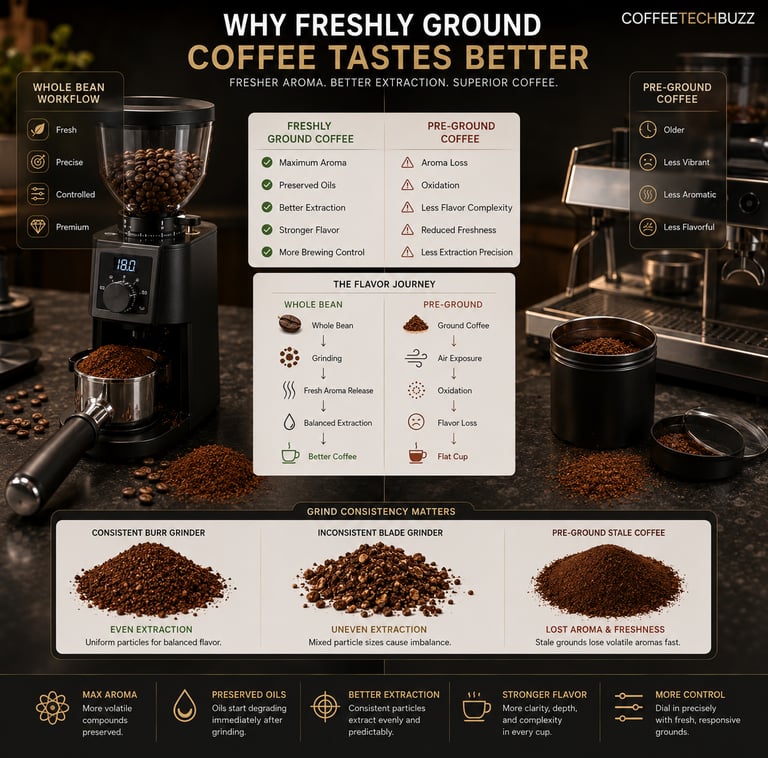
Grinding coffee fundamentally changes the physical state of the beans by converting them from whole beans to particles. This process increases the surface area exposed to water during brewing, which is essential for flavor extraction. However, this increase in surface area also accelerates oxidation—the chemical interaction between coffee compounds and oxygen—which diminishes the volatile oils responsible for coffee’s aroma and flavor. The precision of this grind, both in particle size and uniformity, directly impacts extraction dynamics. Finer grinds increase resistance and slow water flow, extracting soluble compounds more thoroughly, but risk over-extraction if the grind is too fine or uneven. Conversely, coarser grinds reduce resistance and extraction time, potentially under-extracting desirable flavors. This relationship between grind and extraction is why control in grind size is the cornerstone of predictable coffee brewing. To learn more about the science behind extraction, see How Grind Size Affects Extraction in Coffee Brewing.
Why Freshly Ground Coffee Retains Better Aroma and Taste
The critical factor that separates freshly ground coffee from pre-ground alternatives is the preservation of volatile aromatic compounds. Coffee beans contain numerous oils and acids that begin breaking down when exposed to air and moisture. These compounds evaporate or degrade quickly after grinding since the protective bean structure is compromised, exposing them directly to environmental factors. Within minutes, key aroma molecules dissipate, and flavor precursors oxidize. This degradation path leads to a flat, muted cup lacking in complexity and brightness. Freshly ground coffee, by contrast, maintains these delicate oils and aromas up to the point of brewing, ensuring a vivid and authentic flavor profile. This preservation is especially significant for brewing methods sensitive to aroma, such as pour-over or siphon, where the initial fragrance sets expectations and influences perceived taste.
The Impact of Grind Size and Consistency on Extraction
Extraction is an intricately balanced exchange during brewing, where water dissolves soluble compounds from coffee particles. Consistent grind size ensures uniform flow and extraction rates. When particle sizes vary widely, finer fragments over-extract rapidly, releasing bitter compounds, while larger pieces under-extract, contributing sourness or thinness. This imbalance creates a cup peppered with off-flavors and inconsistency between sips.
Matching grind size to brewing method is equally important; espresso demands a fine, almost powdery grind to resist fast pressure-driven water flow, while French press requires a coarse grind to allow full immersion without clogging filters. Each method’s preferred grind size affects the duration and uniformity of extraction, shaping the coffee’s final taste and mouthfeel. Achieving consistent grind size also depends on grinder quality—burr grinders produce more uniform particles compared to blade grinders, which tend to yield uneven and unpredictable results. For a deeper look at grinder design differences, see our Burr vs Blade Grinder comparison.
Common Mistakes When Using Pre-Ground Coffee
One common pitfall is using pre-ground coffee indiscriminately across brewing methods without considering grind size appropriateness. Pre-ground coffee is often milled to a medium grind, which rarely aligns optimally with specific brew techniques. This mismatch usually leads to varied extraction results, reducing control and cup quality.
Another frequent error is grinding coffee too far in advance. Even if stored carefully, ground coffee loses its aromatic oils within hours, noticeably flattening flavor. Storing ground coffee improperly—exposed to oxygen, moisture, or light—only accelerates staleness.
Many underestimate the impact of inconsistent grinders: blade grinders not only produce mixed particle sizes but also generate heat during grinding, which can prematurely degrade aromatic oils. Selecting the right grinder and grinding immediately before brewing minimizes these risks and enhances cup predictability.
Choosing the Right Grinder for Your Brewing Method
Selecting a grinder should be driven by how well it controls grind size consistency and adjustability relative to your brewing style. Burr grinders, both conical and flat, are the preferred choice because they mechanically shear beans evenly, preserving uniformity. These grinders offer incremental adjustments that translate directly to brew variations, allowing you to fine-tune extraction precisely.
For espresso, having a grinder capable of very fine and consistent settings is critical because small deviations create pronounced changes in resistance and flavor. For methods like pour-over or drip, the ability to dial coarser, yet precise, grinds matters just as much to maintain clarity and avoid muddiness.
While budget is a factor, prioritizing consistent particle size and ease of adjustment will yield better results than simply opting for cheaper, less controllable blade grinders. Assessing grinder usability includes considering noise levels, dosing consistency, and ease of cleaning—factors that influence routine precision. If you're shopping for an upgrade, our roundup of the Best Coffee Grinders is a great place to start.
Best Practices for Grinding and Storing Coffee at Home
To preserve coffee freshness and ensure consistent flavor profile, grind coffee immediately prior to brewing. Avoid grinding entire batches far in advance; instead, measure appropriate portions daily to prevent premature deterioration.
Use airtight, opaque containers for coffee storage between uses to minimize oxygen and light exposure, as both accelerate oxidation. Store whole beans in a cool, dry environment and only grind when ready to brew.
If you must store ground coffee, limit the duration to as short a period as possible and always use airtight containers designed to restrict oxygen exchange. Regularly clean your grinder to avoid buildup of old grounds and residual oils that can taint fresh coffee.
Finally, pay close attention to adjusting grind size incrementally with each session—consistent results emerge when only one variable changes between brews, allowing you to identify the precise effect on flavor.
FAQ: Addressing Common Questions About Grinding and Freshness
Why does freshly ground coffee taste better than pre-ground?
Freshly ground coffee preserves volatile aromatic oils that begin dissipating immediately after grinding. This leads to a richer, more complex flavor and aroma profile, while pre-ground coffee suffers from oxidation and moisture exposure, which dulls its taste.
How quickly does coffee lose its flavor after grinding?
Coffee starts losing noticeable aroma and flavor compounds within minutes of grinding, with significant degradation occurring within hours. This is why grinding immediately before brewing is recommended for the best sensory experience.
What grind size is best for different brewing methods?
Grind size varies by brewing technique: espresso requires a fine grind for proper resistance under pressure; pour-over and drip brews use medium to medium-fine grinds for balanced extraction; French press and cold brew favor coarse grinds to avoid over-extraction and sediment in the cup.
How does grind consistency affect coffee extraction?
Inconsistent grind size leads to uneven extraction; finer particles extract quickly and can contribute bitterness, while larger particles under-extract, causing sour or weak flavors. Uniform particles promote balanced extraction and a well-rounded cup.
Can I store ground coffee and maintain flavor?
While advisable to grind fresh, storing ground coffee in completely airtight, opaque containers can slow flavor loss but cannot prevent it indefinitely. Flavor degradation occurs faster in ground coffee compared to whole beans, making immediate consumption preferable.
What are the best grinders for consistent grinding?
Burr grinders outperform blade grinders by delivering more uniform particle sizes and precise grind adjustments. High-quality burr grinders offer incremental settings that support reproducible results across brewing sessions.
How does aroma affect coffee taste perception?
Aroma compounds greatly influence flavor perception, engaging the olfactory system to enhance taste complexity. Loss of aroma due to prolonged exposure reduces the perceived quality of coffee, making the cup seem flat or dull.
Is there a significant taste difference between burr and blade grinders?
Yes, burr grinders produce more consistent particle size, which helps achieve balanced extraction and better flavor clarity. Blade grinders result in uneven grind distribution and often introduce heat that degrades coffee oils, leading to less predictable taste quality.
Practical Conclusion
Consistently good coffee requires understanding and controlling variables central to freshness and extraction. Freshly ground coffee stands as a clear performance advantage because it preserves fragile aromatic and flavor compounds until the moment of brewing. The grind size and consistency directly influence how evenly coffee extracts, affecting balance and clarity. While pre-ground coffee may offer convenience, it sacrifices the chemical integrity essential for nuanced flavor.
Investing in a capable burr grinder that matches your brewing method and developing disciplined grinding and storage habits will significantly improve cup predictability. Over time, these precise adjustments—taking place before water even hits the grounds—define the difference between an ordinary cup and one you can rely on every day.
Understanding Why Grind Size Matters in Coffee Brewing helps connect freshness, grind quality, and extraction into a repeatable brewing process.
For more in-depth guidance on brewing methods and equipment, refer to CoffeeTechBuzz.com’s brewing-methods pillar for insights that complement this process-driven approach. Additional information on grinders and brewing gear comparisons can also assist users ready to upgrade their workflow for maximum control and consistency.
Contact@TheBuzzHQ.com
© 2026 Coffee Tech Buzz. All rights reserved.
Coffee Tech Buzz
Smarter brewing through better gear, clearer insights, and real-world performance testing.
Built for home users who want consistency without guesswork.
We focus on how machines actually perform — not just what they claim.
Home
Coffee Equipment Guide
Coffee Makers & Machines
Coffee Grinders
Espresso Gear & Guides
Coffee Beans & Roasts
Coffee Accessories & Tools
For educational purposes only.
We may earn commissions from qualifying purchases.
General Inquiries: