
How Grind Size Affects Taste: A Guide to Perfect Coffee
Explore how grind size impacts coffee taste, extraction, and brewing consistency to master the perfect cup every time.
COFFEE GRINDERS
The Coffee Tech Buzz Editorial Team - Led by AJ “Buzz” Eichman
4/4/20268 min read
Quick Verdict
Grind size directly influences the coffee extraction process, which in turn shapes the strength and flavor profile of the brew.
Smaller, finer particles increase surface area, speeding up extraction but risking over-extraction and bitterness if not balanced properly.
Coarser particles slow extraction, often producing under-extracted, sour, or weak flavors unless brew time and method are adjusted accordingly.
Consistency in grind size and small, deliberate adjustments are key to predictable, repeatable coffee results.
What is Grind Size and Why It Matters
Grind size refers to the average particle dimension of coffee grounds after milling, and understanding it is fundamental to mastering home coffee brewing. The size of coffee particles governs how water interacts with coffee during extraction—a chemical process in which desirable flavors dissolve into the brew. Grind size essentially controls the rate at which extraction occurs because it dictates the available surface area and resistance water encounters as it passes through the coffee bed.
If you're building a strong foundation, this concept is introduced more broadly in Coffee Grinders, where grind control and equipment selection are broken down from the ground up.
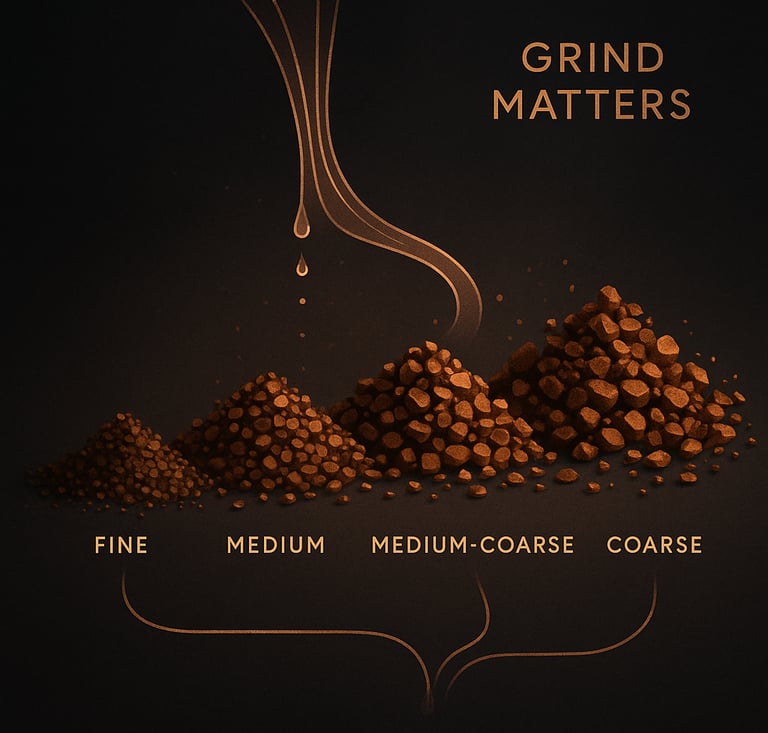
A finer grind exposes more surface area to water, accelerating extraction. Conversely, coarser grinds offer less surface contact, slowing extraction down. This relationship is crucial because every brewing method has an optimal extraction window, both in time and flow rate, in which balanced flavors develop. Deviating from the proper grind size disrupts this balance, pushing results toward under- or over-extraction, both of which negatively impact the coffee taste.
How Grind Size Influences Coffee Extraction
Extraction is the process through which water dissolves soluble compounds from the coffee grounds. These compounds include acids, sugars, and bitter elements, all contributing distinct sensory properties. Grind size directly modulates extraction because the particle size affects factors like contact time and water flow rate through the coffee.
When the grind size is too fine for the brewing method, water passes slowly or even stagnates. This prolonged contact extracts more bitter compounds as well as excessive acidity, leading to a sharp, sometimes harsh flavor — a common indicator of over-extraction. On the other hand, too coarse a grind allows water to flow too quickly, limiting the soluble material extracted. This results in weak, sour, or overly acidic coffee that lacks depth—signs of under-extraction.
This relationship is explored more deeply in How Grind Size Affects Extraction, where extraction dynamics are broken down in more detail.
The balance of extraction is therefore a dynamic interplay between grind size, brew time, temperature, and coffee-to-water ratio. Adjusting grind size modifies the extraction rate and influences how long each flavor component has to dissolve. Since grind size often has the most immediate and tangible effect on extraction dynamics, it serves as the starting point for dialing in any brewing recipe.
Recommended Grind Sizes for Popular Brewing Methods
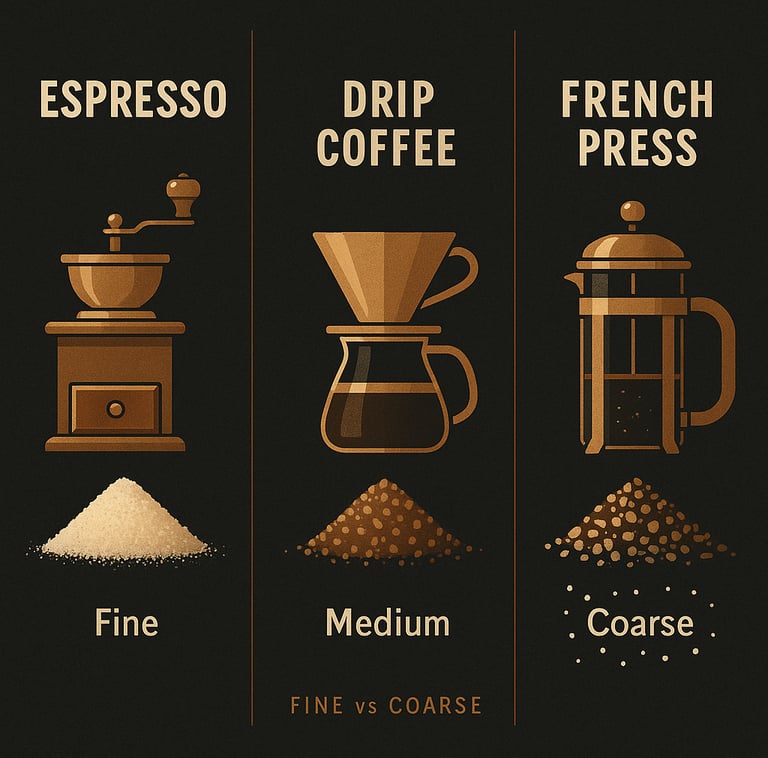
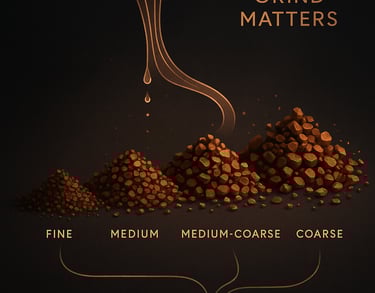
Each brewing method creates different brewing conditions—pressure, water flow, immersion time—that necessitate specific grind sizes for optimal extraction. Espresso machines apply high pressure and very short contact times, which demand very fine grind sizes similar to powdered sugar. This small particle size allows fast extraction under pressure, producing concentrated, flavorful shots without under-extracting. If you're dialing in espresso specifically, Best Grind Size for Espresso (Beginner Guide) helps refine this further.
Drip coffee makers operate with medium flow rates and longer brew times in comparison. Medium grind sizes striking a balance between surface area and resistance provide adequate extraction within the brewing duration typical of these devices. Drip grind size roughly resembles table salt in particle dimension.
French press brewing involves immersion where the coffee grounds steep directly in hot water for multiple minutes. This requires a distinctly coarser grind to reduce fines, prevent excessive sediment, and avoid over-extraction due to extended brew time. Coarse grind particles are usually visibly larger, like coarse sea salt or even peppercorns, slowing extraction suitably for immersion methods.
Using the wrong grind size with any of these methods generally produces disappointing coffee—bitter and hollow from fine grinds where brew times are long, or weak and sharp from coarse grinds in quick extraction methods. For a full breakdown across brewing styles, Best Grind Size for Each Brewing Method maps these relationships clearly.
Common Grind Size Mistakes and How to Avoid Them
The most frequent errors home brewers make regarding grind size are using one grind size for all methods, making large, indiscriminate adjustments, and relying on inconsistent grinders such as simple blade mills. For example, assuming a grind setting that works for drip coffee is acceptable for espresso typically leads to poorly extracted shots. Similarly, changing grind settings drastically instead of incrementally can mask actual causes of flavor deficiencies, making reproducibility difficult.
Another common pitfall is neglecting to recalibrate grind settings when changing coffee beans or swapping roast profiles. Dark roasted beans tend to be more brittle and break down more easily, often requiring a coarser grind to avoid over-extraction. Lighter roasts usually call for a finer grind to fully develop their flavors. Skipping this recalibration can cause fluctuating extraction results, despite keeping other factors constant.
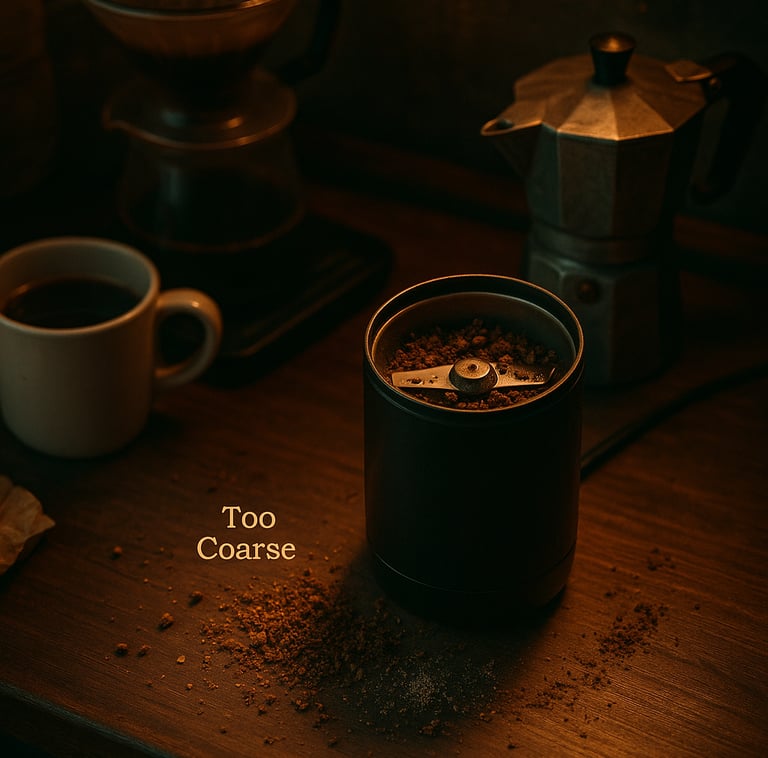
Poor grind consistency, especially from blade grinders or poorly maintained burr grinders, introduces uneven particle sizes, some fine enough to over-extract alongside coarse insufficients that under-extract. This results in a muddled cup that lacks clarity and purpose. If you're experiencing these issues, Why Your Grinder Isn’t Consistent breaks down the root causes.
To remedy these issues, choosing a quality burr grinder capable of precise adjustment and uniform particle size is crucial. Make small, measured changes to the grind setting, ideally no more than one or two increments at a time, and carefully observe resulting flavor shifts. Documenting these adjustments supports repeatability. Above all, recognizing grind size as part of an extraction system, not an isolated variable, prevents oversimplification.
Tips for Achieving Consistent Grind Size at Home
Consistency in grind size iteration can be elusive without proper equipment and process discipline. Starting with a calibrated burr grinder is non-negotiable for home brewers serious about control. Burr grinders produce uniform particle distributions by crushing beans between two abrasive surfaces, as opposed to blade grinders that slice irregularly, causing a mix of fine dust and large fragments.
Regular cleaning and maintenance keep burrs sharp and correctly aligned, preventing drifting grind levels that degrade consistency. If maintenance is being overlooked, How Often Should You Clean a Grinder outlines a practical cleaning schedule.
Weighing coffee doses precisely before grinding assures uniform bed thickness and flow resistance, reinforcing repeatability.
Maintaining a coffee journal captures grinder settings alongside sensory notes, helping to correlate minute grind changes with flavor outcomes. Fine tuning grind size in small increments (around 0.1–0.2 on typical grinder dials) after each brew allows precise control over extraction. Additionally, avoid grinding more coffee than needed for each brew cycle; freshly ground coffee delivers more predictable extraction.
When switching coffee beans or roast profiles, reassess grind size and adjust accordingly rather than assuming a one-size-fits-all setting. Finally, pairing the grind size with other brewing variables—such as water temperature and brew time—ensures every factor is aligned for consistent outcomes.
How to Adjust Grind Size to Improve Coffee Flavor
The relationship between grind size and coffee flavor is largely about balancing extraction rates to highlight desirable compounds while minimizing unwanted bitterness or sourness. If a cup tastes sour, thin, or salty, it usually indicates under-extraction. Correcting this involves using a finer grind to increase surface area, permitting more soluble solids to enter the brew within the same time frame.
Conversely, if the coffee exhibits bitterness, harshness, or astringency, it suggests over-extraction. Increasing grind size in that case slows extraction, reducing the rate at which bitter compounds are pulled out.
If you want to approach this systematically, Coffee Grinder Settings Guide walks through how to make controlled, repeatable adjustments.
These flavor issues, however, rarely resolve through grind size adjustment alone. Concurrent refinements in brew time and temperature help lock in the preferred profile.
It is important to make adjustments gradually and confirm the effect over several brews. Shifts smaller than they appear at the grinder often yield noticeably different cup profiles. Abrupt changes can send flavor results into unpredictable territory, undermining the goal of repeatability.
Understanding the Role of Grinder Types in Particle Size
The grinder type significantly impacts particle size distribution and, therefore, extraction consistency. Burr grinders come in various designs—flat burrs, conical burrs—with both capable of producing precise, reproducible grind sizes necessary for performance-driven brewing.
Flat burrs tend to produce a slightly more uniform grind but can generate more heat due to friction, which might slightly affect delicate flavor notes when grinding large amounts. Conical burrs generally run cooler and quieter, with a broader adjustment range favored by some home brewers for versatility.
Blade grinders, by contrast, are inherently inconsistent because they cut rather than crush beans. The resulting mix of fine powder and large chunks complicates extraction due to uneven brewing rates within the coffee bed. This inconsistency usually leads to unpredictable flavor profiles and increased bitterness or sourness.
For a deeper comparison of these grinder styles and their real-world impact, Cheap vs Premium Coffee Grinders helps clarify what differences actually matter.
Investing in a quality burr grinder that allows incremental, stable adjustments ensures the grind size matches brewing method requirements consistently, supporting focused, repeatable flavor outcomes.

Common Grind Size Mistakes and How to Avoid Them
Revisiting some frequent mistakes helps reinforce good practices. Relying solely on grind size without adjusting other brewing parameters disregards the integrated nature of coffee extraction. Ignoring recommended grind sizes for specific methods often causes unbalanced flavors.
Large, sudden changes create confusion when trying to identify causes of flavor shifts. Using poor or inconsistent grinders frustrates attempts at consistency. Finally, skipping recalibration when changing beans or roast levels leaves brewers chasing flavors rather than controlling them.
Careful calibration, slow adjustment, and equipment investment grounded in control—not hype—are the solid foundation for avoiding these pitfalls.
FAQs About Grind Size and Coffee Taste
How does grind size affect the strength and flavor of coffee?
Grind size controls extraction rate by altering surface area and water flow resistance. Finer grinds extract more quickly, strengthening flavor but risking bitterness if overdone; coarser grinds extract slower, producing milder, sometimes sour coffee if under-extracted.
What grind size is best for espresso vs. French press?
Espresso requires a very fine grind resembling powdered sugar to produce fast, pressure-driven extraction. French press demands a coarse grind similar to cracked peppercorns to suit long immersion times and prevent excessive sediment.
Why does my coffee taste bitter or sour based on grind size?
Bitterness usually signals over-extraction from too fine a grind or too long brew time, while sourness indicates under-extraction from too coarse a grind or insufficient brewing duration.
How often should I adjust my grinder settings?
Adjust grind settings when changing coffee beans, roast level, or brewing method, and fine-tune gradually during routine brewing if flavor drifts. Consistency minimizes adjustments over time.
What is the difference between burr and blade grinders for grind consistency?
Burr grinders crush beans uniformly, creating consistent particle sizes crucial for steady extraction. Blade grinders slice beans unevenly, producing mixed particle sizes that disrupt balanced extraction.
Can I use the same grind size for all brewing methods?
No, brewing methods have distinct extraction requirements; using one grind size usually compromises flavor due to mismatched extraction rates.
How does grind size interact with brewing time and water temperature?
Grind size affects extraction speed; finer grinds require shorter brew times or lower temperatures to avoid over-extraction, whereas coarser grinds benefit from longer brew times or slightly higher temperatures to extract sufficient flavor.
Practical Conclusion
Grind size stands as a cornerstone variable in precise coffee brewing. It governs extraction rate, shaping strength, clarity, and balance in the final cup. Developing an understanding of how grind size interacts with brewing methods and adjusting it deliberately allows brewers to bring consistency to what often seems a variable process.
Prioritizing uniform grind particle size through quality burr grinders and implementing incremental adjustments aligned with specific brewing techniques empowers home brewers to produce coffee predictably. Recognizing that grind size operates within a system that includes time, temperature, and ratio ensures measured control over flavor outcomes rather than chasing fleeting trends or randomness.
For those seeking to convert coffee into a repeatable craft, mastering grind size is not optional—it is fundamental. By methodically tuning this variable, you create a foundation for consistent, balanced, and satisfying coffee every time.
Contact@TheBuzzHQ.com
© 2026 Coffee Tech Buzz. All rights reserved.
Coffee Tech Buzz
Smarter brewing through better gear, clearer insights, and real-world performance testing.
Built for home users who want consistency without guesswork.
We focus on how machines actually perform — not just what they claim.
Home
Coffee Equipment Guide
Coffee Makers & Machines
Coffee Grinders
Espresso Gear & Guides
Coffee Beans & Roasts
Coffee Accessories & Tools
For educational purposes only.
We may earn commissions from qualifying purchases.
General Inquiries: