
Are Coffee Grinder RPMs Important?
Explore how coffee grinder RPM influences grind consistency, heat generation, and flavor extraction, essential for precise and predictable coffee brewing.
COFFEE GRINDERS
The Coffee Tech Buzz Editorial Team - Led by AJ “Buzz” Eichman
5/31/20267 min read
Coffee grinding is often treated as a secondary step in coffee preparation—a process to reduce whole beans into something brewable. Yet, the speed at which your grinder’s burrs rotate, measured in RPM (rotations per minute), plays a crucial role in shaping your grind quality and ultimately the coffee’s flavor profile. Recognizing how grinder RPM affects thermal buildup, particle size uniformity, and extraction dynamics is essential for anyone seeking precise and predictable coffee results. This article examines the impact of grinder RPM on your brew and why it deserves careful consideration beyond typical marketing claims. For a broader look at grinder performance, brewing consistency, and equipment choices, start with our Coffee Grinders guide. Understanding how grinder adjustments affect extraction becomes much easier when paired with a proper Coffee Grinder Settings Guide.
Quick Verdict
Slower coffee grinder RPMs generally produce more consistent particle sizes with reduced heat generation, supporting even extraction and flavor clarity.
High-speed grinders may deliver faster throughput but risk overheating beans and causing greater grind size variability.
RPM is one factor among many—including burr sharpness and design—that affects grind consistency and flavor outcome.
Matching grinder speed to your brewing method and consumption volume helps balance workflow efficiency and control.
What is Coffee Grinder RPM?
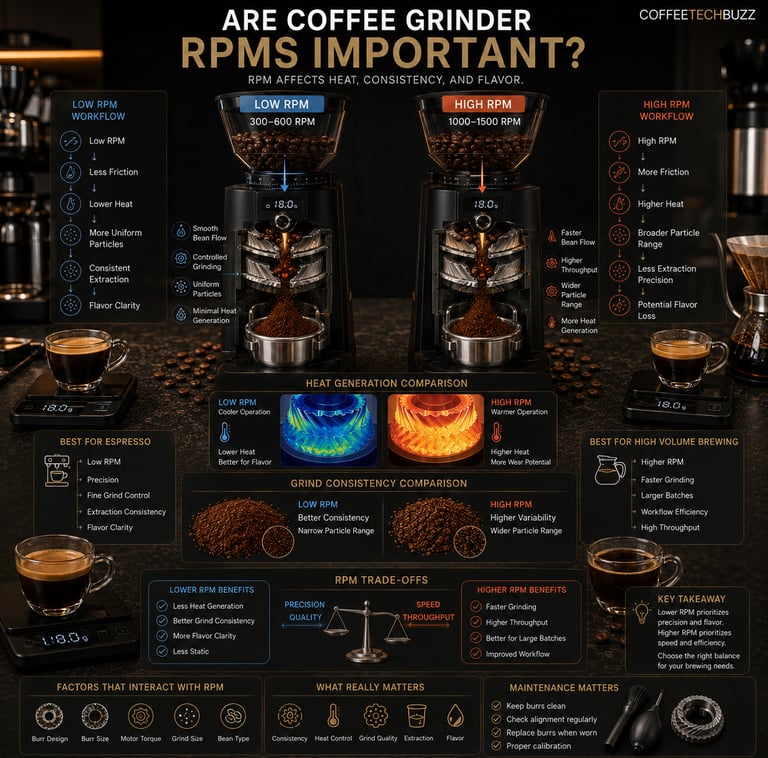
At its core, coffee grinder RPM measures how many full rotations the grinder’s burrs complete in one minute. While this seems straightforward, the practical implications are more nuanced. Home grinders typically operate between approximately 300 and 1500 RPM. This range is influenced by motor design, power, and gearing mechanisms.
Low-speed grinders often incorporate gear reduction motors, which maintain torque while spinning burrs more slowly. This controlled rotation allows for finer abrasion of coffee beans with less friction-induced heat. Conversely, high-speed grinders leverage powerful motors capable of rapid burr rotations, increasing throughput but also thermal transfer to the coffee grounds.
Understanding this variable is the first step toward appreciating its downstream effects. RPM affects raw grinding behavior, but that influence cascades onto grind particle size distribution, temperature during grinding, and ultimately how the coffee extracts in the cup.
How Grinder Speed Affects Grind Consistency
Grind consistency is a fundamental variable for predictable extraction. Uneven particle sizes create channels during brewing water flow, leading to over- or under-extracted flavors surfacing unpredictably. Grinder RPM is one of the controlling forces behind this consistency.
Lower RPM grinding tends to produce more uniform particle sizes for several reasons. Slower burr rotations increase the time beans spend between the burr surfaces, facilitating more controlled shearing and crushing actions rather than impact-driven fracturing. Reduced centrifugal force limits the scattering of finer particles, preserving a tighter size distribution.
On the other hand, high RPM grinding relies more on rapid impact forces to fragment beans. This often increases fines and larger particle fragments, broadening the grind size spectrum. Over repeated brews, this inconsistency manifests as noticeable variability in clarity, body, and extraction balance.
While burr sharpness and burr gap uniformity have central roles in determining grind consistency, grinder speed cannot be overlooked. Even the sharpest burrs spun too fast may create uneven grounds due to accelerated bean breakdown and particle movement. Understanding Why Your Grinder Isn’t Consistent can help connect grinder speed to real-world brewing problems.
The Impact of Heat from Grinder RPM on Coffee Flavor
Another direct consequence of grinder RPM is heat generation during grinding. Excess heat accelerates volatile aromatic oil loss and can cause premature degassing and flavor degradation. The coffee bean does not respond well to elevated temperatures during processing stages after roasting.
Slower grinders typically operate with less frictional heat due to lower burr speeds and torque-controlled mechanisms. This conserves delicate coffee oils and acids, maintaining the roast profile integrity seen in the brewed cup.
Conversely, high RPM grinders often run warmer, especially under continuous use or when grinding larger doses. This elevated temperature can cause a slight scorching effect on the grounds or promote early oxidation of aromatic compounds. While heat differences may seem subtle, their cumulative impact shows up in less distinct flavor notes or duller profiles.
For consumers prioritizing flavor fidelity and repeatability, controlling heat via grinder speed is a subtle but effective lever. Awareness of this variable helps contextualize why some grinders marketed for speed may not deliver superior taste.
Comparing Low vs. High RPM Grinder Performance
The trade-offs between low and high RPM grinders revolve around balance between speed, consistency, and thermal management. Low RPM grinders offer precise control over grind size, more consistent particles, and cooler operation. These attributes suit espresso enthusiasts or manual brew method users who focus on repeatability and fine adjustments.
In contrast, high RPM grinders are optimized for throughput, appealing in commercial settings or busy households needing faster batch preparation. This speed, however, can come at the cost of grind uniformity and increased heat exposure. This is usually where results start to vary without people realizing why, especially when stepping away from rigorous tamping or extraction protocols.
Ultimately, this is not a question of categorically better or worse. Instead, it is about aligning grinder RPM with your brewing goals and workflow. Those who value smaller batch brewing and subtle profile control benefit more readily from low RPM grinders or at least stepless speed adjustments. Users prioritizing convenience or high volume might accept the minor inconsistency trade-off for speed.
Choosing the Right Grinder RPM for Your Brewing Method
Different brewing methods impose unique grind consistency and flavor extraction demands, influencing ideal grinder RPM. Espresso, for example, requires tightly controlled particle sizes to extract equally under high pressure and short brew times. Lower RPM grinders excel here by producing fine and consistent grounds while minimizing heat, preserving extraction uniformity.
Conversely, methods like French press or cold brew tolerate coarser grinds and broader particle spreads. For these applications, slightly higher RPM grinders may be acceptable if their speed benefits outweigh minor consistency variations.
Additionally, total daily volume affects choice. Those grinding multiple espresso shots or several pour overs per day may prefer gradual grinder RPM adjustments for workflow management. Some advanced grinders even allow variable RPM control, enabling users to fine-tune speed as needed without sacrificing burr quality.
In all cases, understanding that grinder motor speed interacts with burr design, alignment, and dosing mechanisms underscores the importance of a holistic approach to grinder selection. RPM informs performance but cannot be isolated from the broader grinding system. If you're shopping for a grinder designed around espresso precision, our roundup of the Best Espresso Grinders Under $600 includes several low-RPM options.
Common Misconceptions about Grinder RPM
One of the most frequent misunderstandings is equating higher grinder RPM with better or faster grinding without considering flavor trade-offs. Speed may reduce grind time but tends to increase heat buildup and inconsistencies, ultimately undermining cup quality.
Another common mistake is ignoring the effect of burr quality and alignment. Even at lower RPMs, dull or misaligned burrs produce uneven particle sizes. Conversely, high-quality burrs can sometimes compensate partially for the downsides of higher RPMs but do not eliminate heat-generated flavor degradation.
Some users also mistakenly conflate grinder RPM with dosing accuracy or granularity of grind adjustment. RPM affects how grounds are produced but does not replace the need for precise grind size settings, particularly variable steps or stepless adjustments.
Finally, many underestimate the significance of heat generated during grinding. While not always obvious, heat-induced changes in coffee chemical composition translate directly into cup stability and aroma longevity.
Practical Tips for Using Your Grinder to Maximize Consistency
If you focus on one variable first, start with grind size, as it directly affects resistance and extraction speed. Adjust grind size methodically while observing brew results before changing grinder RPM settings.
When using a high-speed grinder, consider grinding in shorter bursts rather than continuous runs to minimize heat buildup. Allow the grinder to cool if multiple doses are required.
Keep burrs well-maintained and replaced when dull. Burr sharpness supports cleaner particle breakdown at any speed. For maintenance schedules and cleaning routines, see How Often Should You Clean a Grinder? Essential Guide for Coffee Lovers.
If your grinder offers variable RPM or stepless speed controls, experiment by making incremental adjustments and noting impacts on particle size distribution using sieves or brew tasting.
Match your grinder RPM and burr configuration to your preferred brewing method and volume needs. For espresso, lean toward lower RPM and high-precision burrs. For manual brews at home, a balanced speed paired with configurable grind size control suffices.
Throughout, document your settings and extraction parameters. Repeatability depends on consistent approach rather than seeking constant change.
Frequently Asked Questions
What is a good RPM range for a home coffee grinder?
Typically, home grinders operate between 300 and 1500 RPM. Slower grinders often cluster around 300 to 600 RPM for better consistency and heat control, while faster models push above 1000 RPM for throughput.
How does grinder speed affect coffee flavor?
Grinder speed impacts heat generated during grinding and the uniformity of particle sizes. High speed can cause heat buildup that deteriorates aromatic oils and increased grind variance, leading to uneven extraction and muted flavors.
Are low RPM grinders better for espresso?
Usually, yes. Lower RPM grinders produce finer, more consistent grind sizes with minimal heat increase, supporting precise espresso extraction and balanced flavor profiles essential for quality shots.
Does high RPM cause overheating of coffee grounds?
High RPM grinders can generate more heat, especially with prolonged operation or large doses. This heat may accelerate coffee oil oxidation and volatile compound loss, subtly changing flavor characteristics.
How does RPM relate to grind size consistency?
Lower RPM grinders produce more uniform particles because slower rotation allows controlled shearing rather than impact fracturing dominant in faster grinding.
Can grinder motor speed impact dose consistency?
Not directly. Dose consistency depends more on grinder design, hopper flow, and dosing mechanisms. However, extreme speeds may affect grind retention and distribution, indirectly influencing dosing.
Is grinder RPM more important than burr type?
No. Burr sharpness and configuration are primary determinants of grind quality. RPM influences these results but cannot replace the fundamental importance of burr condition and alignment.
What grinder RPM is ideal for different brewing methods?
Espresso benefits from 300–600 RPM for precision, while manual methods may tolerate higher speeds around 700–1000 RPM depending on grind size and batch volume needs.
Conclusion
Understanding coffee grinder RPM extends beyond simple marketing jargon. It is a measurable variable with tangible effects on your grind consistency, thermal exposure, and ultimately coffee extraction quality. Slower RPM grinders generally offer enhanced control, producing uniform grounds and preserving delicate coffee flavors by limiting heat buildup. Although speed has its place in throughput optimization, it often trades precision and taste clarity for convenience.
For home users striving for repeatability and profile control, evaluating grinder RPM alongside burr sharpness, grind adjustment mechanisms, and brewing method compatibility produces the most reliable cup outcomes. Cleaner, more consistent grounds translate into predictable cups — the hallmark of precision brewing.
Approach grinder RPM as part of an integrated system rather than an isolated spec. By doing so, you move from guesswork to control, making coffee brewing a process you command. Precision in grinding ensures each cup reflects your intent, without unwelcome surprises introduced by inconsistent speed or heat effects. In this way, grinder RPM becomes not just a number but a key parameter in mastering coffee extraction.
Understanding Why Grind Size Matters in Coffee Brewing helps connect grinder speed, particle consistency, and extraction into a repeatable brewing process.
Contact@TheBuzzHQ.com
© 2026 Coffee Tech Buzz. All rights reserved.
Coffee Tech Buzz
Smarter brewing through better gear, clearer insights, and real-world performance testing.
Built for home users who want consistency without guesswork.
We focus on how machines actually perform — not just what they claim.
Home
Coffee Equipment Guide
Coffee Makers & Machines
Coffee Grinders
Espresso Gear & Guides
Coffee Beans & Roasts
Coffee Accessories & Tools
For educational purposes only.
We may earn commissions from qualifying purchases.
General Inquiries: