
What Coffee Grinder Features Actually Matter?
Explore the essential coffee grinder features that impact flavor and consistency, helping you choose the right grinder for your brewing style.
COFFEE GRINDERS
The Coffee Tech Buzz Editorial Team - Led by AJ “Buzz” Eichman
5/31/20267 min read
Coffee grinder features play a fundamental role in shaping the quality of the final brewed cup. Consistent extraction hinges on the uniformity of grind size, while the grinder’s burr design, grinding speed, and usability elements contribute to repeatability and control. Selecting the right features is less about chasing the newest model or highest price point and more about understanding which variables truly influence brewing performance. This article walks through the coffee grinder qualities that affect flavor and consistency, enabling you to make an informed choice tailored to your brewing method and routine. For a broader overview of grinder categories and buying considerations, explore our Coffee Grinders guide.
Understanding how different grinder features interact with brewing methods becomes much easier when paired with a proper Coffee Grinder Settings Guide.
Quick Verdict
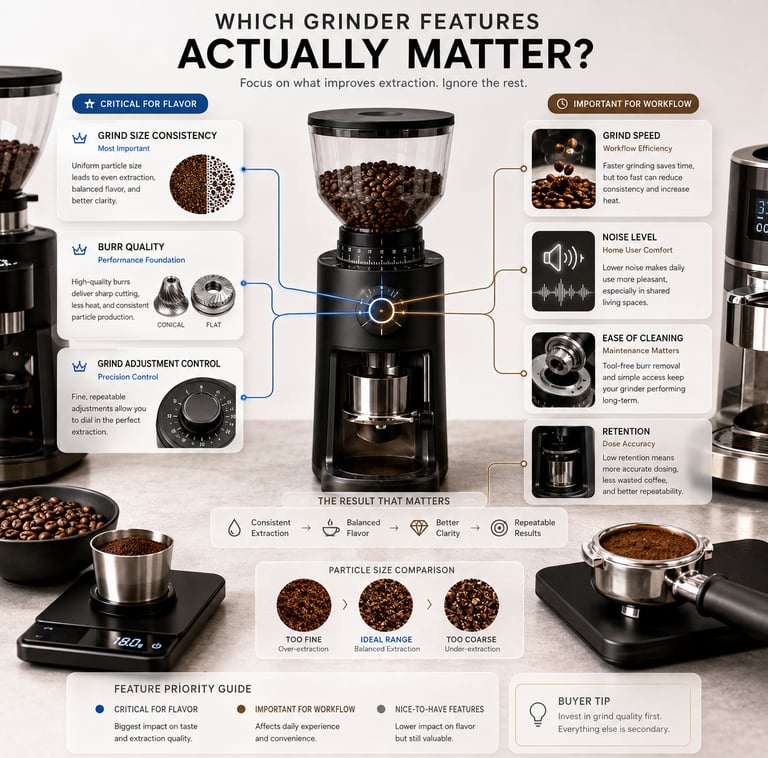
• Burr grinders deliver noticeably better grind size consistency than blade grinders, resulting in more even extraction and balanced flavor clarity.
• Grind speed affects heat buildup during grinding; slower speeds tend to preserve aroma and maintain bean integrity.
• Noise level, while often overlooked, impacts daily comfort and grinder usability—especially in home environments.
• Ease of grind size adjustment and the range of available settings determine versatility across brewing methods and user experience.
Understanding Grinder Types: Burr vs. Blade
The first variable to consider is grinder type. Burr grinders use two abrasive surfaces (flat or conical burrs) to crush beans to a targeted size, while blade grinders chop beans with spinning blades. The difference in grind size consistency between these designs is marked. Burr grinders produce a more uniform particle size distribution, which stabilizes extraction time and yield. Blade grinders generate a mix of fines and coarse particles, leading to uneven extraction and unpredictable flavor profiles.
This is usually where results start to vary without people realizing why. Even if a blade grinder seems convenient or budget-friendly, the irregular grind size it produces undermines the brewing process, particularly for methods demanding precision like espresso or pour-over. Burr grinders, though often more expensive, offer a decisive upgrade in control and repeatability, directly improving cup quality. For a deeper breakdown of the advantages and tradeoffs, see our Burr vs Blade Grinder comparison.
Why Grind Size Consistency Matters
Grind size consistency is arguably the most critical coffee grinder feature for achieving a predictable brew. Each brewing method has an optimal grind size range, and deviations can push extraction too far forward or pull it back, skewing flavor balance. Uniform grind sizes facilitate an even extraction by ensuring water flows through and interacts with coffee particles consistently.
Finer grind increases resistance, which slows extraction time and intensifies flavor concentration, while coarser grind reduces resistance and speeds extraction. If grind particles vary widely, water channels through fast around coarse chunks while forcing slow extraction through fines, creating bitterness or thinness inconsistently.
When you dial in grind size, small adjustments show up clearly in taste. This is why repeatable control over grind settings establishes a reliable brewing routine. Many grinders advertise broad grind settings, but a wide range is only useful if the increments between steps are precise and consistent. Without this, the path to dialing in a method is effectively guesswork each time you brew. This is closely related to How Grind Size Affects Taste: A Guide to Perfect Coffee.
The Role of Burr Material and Design
Burr material and configuration influence durability, heat transfer, and particle size distribution. Steel burrs are common, known for sturdiness and maintaining sharp edges. Ceramic burrs, on the other hand, offer enhanced heat resistance, minimizing thermal degradation during grinding, but tend to be more brittle and prone to chipping under heavy use.
Additionally, burr shape—conical or flat—affects grinding characteristics. Conical burrs tend to operate at slower speeds and generate less heat, while flat burrs generally spin faster and offer a narrower particle size distribution. Both have merits, but preference for one over the other often comes down to specific brewing goals and grinder build quality.
Importantly, burr alignment and tolerances have a direct impact on consistency. Even well-chosen burr types will fail to produce reliable grinds if internal tolerances loosen over time. Routine calibration and maintenance support a consistent grind profile, making burr material a factor but not the sole determinant of quality.
Grind Speed and Its Effect on Flavor
Speed in grinding reflects the rate at which burrs rotate to process beans. High-speed grinders deliver faster output, but the downside lies in heat generation. Excess heat during grinding transfers to the coffee grounds, hastening the loss of volatile aromatics and subtly altering flavor profiles. Elevated temperatures can pull bitterness forward faster than expected and mask delicate notes.
Lower grind speed reduces heat buildup, preserving more of the coffee’s natural oils and aroma compounds. This is usually where coffee results start to drift unpredictably for grinders pushing fast RPMs without temperature control considerations. While grind speed matters, it’s important to balance it against user context: slower speeds may extend prep time but reward precision-focused brewers with better sensory outcomes.
Noise Levels and Home Brewing Comfort
Grinder noise is often relegated to second-tier importance, but it affects routine usability significantly. High noise levels can disrupt morning rhythms or shared living spaces, discouraging consistent use or pushing brewers toward less optimal grind methods. Noise can also be symptomatic of design compromises such as lower quality motors or burr bearings.
Quieter grinders are not inherently better for performance but improve practical experience and daily efficiency, especially for home environments. You’ll notice this more over repeated brews when noise fatigue sets in. Opting for grinders with sound-reducing features or naturally quieter burr types supports a more disciplined and sustainable brewing routine.
Adjustability and Usability Features
Grind size adjustability and ease of use govern how quickly and accurately a grinder responds to brewing demands. The range of grind sizes a grinder covers must accommodate your preferred brewing methods—fine enough for espresso, coarse enough for French press or cold brew. However, range alone is insufficient without precise control.
Smooth, incremental adjustments are preferable to detented or stepped settings that force jumps in particle size inconsistent with refinement goals. Additionally, features like clear markings, tactile feedback, and minimal retention chambers improve grind repeatability by reducing guesswork and stale grounds mixing into fresh doses.
User experience matters because grinders are tools; their interface affects workflow consistency. A grinder delivering consistent particle size with minimal fuss encourages replication of recipes and fine-tuning, underpinning long-term improvement.
Common Mistakes When Choosing a Grinder
Many home brewers fall into several traps when selecting a grinder. Overvaluing grind speed without considering heat impact often leads to degraded coffee flavors despite faster throughput. Similarly, focusing exclusively on price without prioritizing burr quality and grind consistency commonly results in subpar brewing outcomes masked by momentary convenience.
Neglecting noise levels overlooks a practical factor that can discourage daily use or disturb others. Using blade grinders for precision methods sacrifices fundamental control, often leaving brewers confused about inconsistent results. Finally, ignoring proper grinder cleaning and maintenance contributes to performance decline due to burr dulling and stale coffee retention, complicating troubleshooting and consistency.
Buyer Considerations: Matching Grinder Features to Your Brewing Style
Matching grinder features to your brewing style and budget begins with understanding essential priorities. If espresso drives your routine, burr quality and ultra-fine grind adjustment hold precedence, along with low retention designs to avoid stale grounds carryover. For pour-over or drip coffee, broad grind range with consistently calibrated increments paired with moderate speed grinders strikes a balance between control and convenience.
Multi-method brewers require versatility, seeking grinders with wide and precise grind size spans, ease of switching settings, and reliable consistency throughout. Noise and cleaning convenience gain importance if the grinder is part of a daily routine in a household.
Investing in a grinder is worth it when the chosen features support repeatable, quality results that fit your brewing goals and lifestyle. Price is a secondary consideration if core performance metrics are met, since predictable quality is built on stable control parameters rather than cost alone.
If you're currently shopping, our roundup of the Best Coffee Grinders highlights models that balance consistency, usability, and value across multiple brewing styles.
Integrating these buying criteria with considerations from the broader grinder category can be explored in detail at CoffeeTechBuzz.com’s comprehensive grinder pillar page and relevant grinder comparison guides.
Frequently Asked Questions
What type of burr grinder is best for home use?
For home brewing, conical burr grinders are often preferred for their lower heat generation and quieter operation, while flat burrs offer tighter grind particle consistency. Ultimately, the best choice depends on your brewing methods, control needs, and budget.
How important is grind size consistency for brewing methods like espresso and pour-over?
Grind size consistency is critical across brewing methods. Espresso demands extremely precise, fine grinds to avoid channeling, while pour-over benefits from even medium grind sizes to maintain balanced extraction kinetics. Inconsistency introduces flavor imbalances and unpredictability.
Does grind speed affect coffee flavor and aroma?
Yes. Faster grind speeds produce heat, which can degrade coffee oils and aromatic compounds, resulting in noticeable flavor loss or bitterness. Slower speeds reduce heat transfer, preserving freshness and subtle flavor notes.
Are quieter grinders better for home brewing?
While noise level does not directly improve grind quality, quieter grinders enhance the usability of the tool, helping build consistent routines without disturbance. For home environments, this practical consideration impacts long-term success.
How often should I clean my coffee grinder?
Regular cleaning based on usage intensity is necessary. For daily users, cleaning burrs and retention chambers weekly or biweekly prevents stale grounds buildup and burr dulling, which affect grind quality and flavor.
What grind size range should a versatile grinder cover?
A versatile grinder should cover sufficiently fine settings for espresso and coarse settings for methods like French press or cold brew. In practice, this means having a wide and smoothly adjustable grind range to accommodate various extraction times and flow rates.
Is investing in an expensive grinder worth it for home brewing?
The value of higher-end grinders lies in superior burr quality, precise adjustment capability, and durability, which collectively promote consistent results. If quality control and repeatability are priorities, investing upfront avoids frustrations associated with inconsistent grinds.
How do burr materials affect grinder performance?
Burr materials influence durability and heat resistance. Steel burrs are robust and commonly used, while ceramic burrs resist heat better but can chip. Material choice affects maintenance intervals and grinding characteristics but is only one part of the overall system’s performance.
Conclusion
Understanding what coffee grinder features actually matter directs your investment toward tools that deliver consistent, predictable results rather than occasional good cups. Burr grinder type and quality determine particle uniformity, which underpins extraction control. Speed influences thermal impact on the grounds, affecting aroma and taste nuances. Noise and adjustability affect daily usability and precision, reinforcing brewing discipline.
Avoiding common pitfalls such as equating speed with quality or ignoring maintenance further supports reliability. When selecting a grinder, align features to your brewing style and prioritize control over convenience or price alone. Fine-tuning grind size with a high-quality burr grinder creates a stable foundation for repeatable coffee excellence, elevating each cup beyond guesswork into methodical craft.
Understanding Why Grind Size Matters in Coffee Brewing can help connect grinder performance directly to extraction and flavor outcomes.
Improving grind precision and understanding grinder characteristics leads to a brewing process that is controlled, measurable, and ultimately predictable—turning coffee preparation from an inconsistent chore into an exacting, rewarding routine. To explore further on grinder comparisons and maintenance strategies, visit CoffeeTechBuzz.com’s grinder resources and tools sections.
Contact@TheBuzzHQ.com
© 2026 Coffee Tech Buzz. All rights reserved.
Coffee Tech Buzz
Smarter brewing through better gear, clearer insights, and real-world performance testing.
Built for home users who want consistency without guesswork.
We focus on how machines actually perform — not just what they claim.
Home
Coffee Equipment Guide
Coffee Makers & Machines
Coffee Grinders
Espresso Gear & Guides
Coffee Beans & Roasts
Coffee Accessories & Tools
For educational purposes only.
We may earn commissions from qualifying purchases.
General Inquiries: