
What Happens When Your Coffee Grind Is Uneven?
Uneven coffee grind disrupts extraction uniformity, causing bitterness and sourness. Learn how grind consistency impacts taste and brewing reliability.
COFFEE GRINDERS
The Coffee Tech Buzz Editorial Team - Led by AJ “Buzz” Eichman
5/31/20268 min read
Consistent grind size sits at the core of predictable coffee brewing, yet many overlook how subtle variations in particle size complicate extraction and flavor clarity. An uneven coffee grind means the grounds consist of a mix of sizes rather than a uniform distribution, setting off a chain reaction that affects flow rate, extraction uniformity, and ultimately, the final cup. Understanding why grind consistency matters is essential for anyone aiming to move beyond one-off successes toward repeatable results in their brewing routine.
Brewing consistency hinges on reducing variables, and grind size is one of the most sensitive. Uneven grounds lead to uneven extraction because smaller particles extract faster, sometimes pushing bitterness, while larger particles under-extract and contribute sour or underdeveloped notes. This fundamental imbalance is usually where results start to vary without people realizing why their coffee tastes inconsistent, even when everything else remains unchanged. Focusing carefully on grind uniformity, not just grind size alone, refines control over extraction and flavor balance.
For a broader look at grinder performance, brewing consistency, and equipment choices, start with our Coffee Grinders guide.
Understanding how grind adjustments influence extraction becomes much easier when paired with a proper Coffee Grinder Settings Guide.
Quick Verdict
Uneven coffee grind produces a mix of over-extracted bitter and under-extracted sour flavors.
Maintaining consistent particle size improves extraction uniformity and coffee clarity.
Burr grinders generally outperform blade grinders in creating uniform grinds, impacting brew consistency.
Proper grinder maintenance and tailored grind adjustments for brewing methods enhance overall performance.
What Is Uneven Coffee Grind and Why It Happens
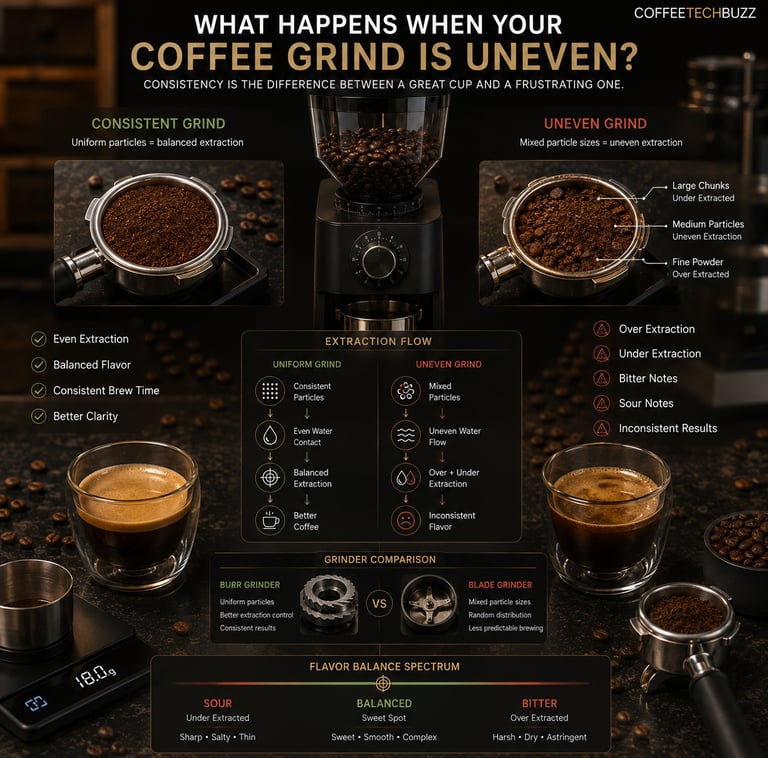
Uneven coffee grind occurs when the coffee grounds contain a broad range of particle sizes instead of a tightly controlled distribution. This inconsistency can result from several factors, starting with the grinder type. Blade grinders work by cutting beans inconsistently; beans closer to the blade are pulverized finely while others remain coarse. Burr grinders crush beans uniformly between two abrasive surfaces, producing a more consistent size range if calibrated and maintained correctly.
Beyond grinder mechanics, factors such as bean density, moisture content, and grinder cleanliness influence the particle size spread. Old or clogged burrs may produce a wider range of particles over time, and changing coffee bean characteristics without adjusting grind settings often widens the distribution unintentionally. This variance in grind size complicates flow rate and surface area exposure during extraction, fundamentally undermining consistency. It’s a process that, if left unchecked, unpredictably shifts flavor and brewing parameters across multiple attempts.
How Uneven Grind Affects Coffee Extraction and Taste
Extraction depends on even water contact time and temperature across all coffee particles. With uneven grind, smaller particles extract rapidly, drawing more soluble compounds quickly, often resulting in bitterness or harshness. Larger particles, in contrast, extract sluggishly and sometimes fail to reach optimal extraction levels within the brew time, contributing sourness, vegetal flavors, or a thin body. This dynamic creates competing flavor elements within a single cup — the hallmark sign of uneven extraction.
This imbalance also influences brew time. Finer particles add resistance, slowing water flow, and coarser particles reduce resistance, speeding it up. When both exist in the same puck or filter bed, channeling emerges: water favors paths of least resistance, over-extracting some grounds while barely touching others. You’ll see this phenomenon more over repeated brews if grind uniformity is not addressed, leading to inconsistent flavor profiles that frustrate attempts to dial in your method.
Because extraction percentage correlates strongly with particle size uniformity, the range of resulting flavors broadens unpredictably with uneven grind. This is usually where coffee taste issues appear that cannot be resolved by changing other brewing variables alone. In short, grind consistency directly dictates extraction quality and repeatable flavor balance. For a deeper look at extraction science, see How Grind Size Affects Extraction in Coffee Brewing.
Comparing Grinder Types: Blade vs Burr
Blade grinders remain common for entry-level use due to low cost and simplicity but they produce uneven coffee grind more often than burr grinders. Their chopping action randomly slices beans into particles of various sizes and shapes, resulting in a broad distribution that undermines brewing consistency. This characteristic makes blade grinders less suited for brewing methods requiring precise control, such as espresso or pour-over.
Burr grinders offer superior grind size control by crushing beans evenly between two burrs with adjustable settings. By maintaining a tighter particle size distribution, burr grinders reduce channeling and irregular extraction, leading to clearer and more balanced flavor profiles. However, burr grinders require regular calibration and maintenance to sustain this performance. Over time burr alignment, burr sharpness, and cleanliness influence particle uniformity just as much as grinder type.
While burr grinders are generally recommended to achieve grinding consistency, some consumer models may vary in effectiveness. Newer designs attempt to mitigate unevenness, but understanding your grinder’s impact on grind particle size distribution plays a pivotal role in improving brewing reliability. Evaluating grinders with a focus on consistent grind output rather than price or hype aligns better with performance-driven home coffee systems. For a full comparison, see our Burr vs Blade Grinder guide.
Identifying Common Grind-Related Brewing Problems
Bitterness, sourness, inconsistency in brew time, and uneven flow often trace back to uneven coffee grind. For example, brew time that fluctuates noticeably even with fixed technique typically hints at grind size distribution issues. Bitter flavors indicate over-extraction of fines while sour or thin flavors suggest under-extraction of coarser particles.
One recurring issue is channeling during espresso preparation, where water bypasses parts of the puck, extracting unevenly due to grind particle size variations. Similarly, in pour-over or drip brewing, uneven grounds hinder saturation uniformity, leading to unpredictable taste results and difficulty dialing in recipes.
Another subtle problem is overlooking grinder maintenance, which impacts grinding performance and grind size repeatability over time. Clogged burrs or accumulated oils increase particle size inconsistency, a factor many brewers miss when troubleshooting. Identifying these grind-related brewing problems requires measured assessment of grind uniformity alongside other brewing variables.
Tips to Achieve and Maintain Consistent Grind Size
Focus on one variable first: grind size uniformity. Start by investing in a quality burr grinder designed for your preferred brewing method and learn its calibration nuances. Adjust grind size in small increments to observe how those changes manifest in extraction and flavor — a small change here tends to show up more than expected in the final cup.
Regular cleaning of your grinder is essential. Removing buildup of coffee oils and stale grounds prevents drift in particle size distribution. This maintenance step is often overlooked yet has a direct impact on grind consistency. For a detailed maintenance schedule, see How Often Should You Clean a Grinder? Essential Guide for Coffee Lovers.
Additionally, avoid switching grind settings drastically between different beans or brewing methods without testing extraction outcomes. Grind size setting alone does not guarantee uniformity; constant evaluation ensures you maintain control over what matters most. Remember, uniformity is key to delivering balanced extraction regardless of brewing style.
Practical Grinder Maintenance for Consistent Performance
Grinder performance deteriorates gradually, often without overt signs until coffee quality noticeably declines. Taking scheduled maintenance actions preserves grind consistency over long-term use.
Cleaning the burrs and hopper prevents old coffee residues from skewing particle size. Burr alignment and sharpening contribute to maintaining the precise grind profile originally intended. Pay attention to manufacturer recommendations for maintenance intervals and procedures. Consistency improves when grinder components operate smoothly and remain free of obstruction.
A routine workflow includes disassembling grinder burrs for cleaning, inspecting parts for wear, and reassembling with care. Documenting grind settings post-maintenance helps recalibrate your grinder fine-tuning. This disciplined approach supports maintaining extraction quality and reliable brewing workflows.
Adjusting Grind Size for Different Brewing Methods
Each brewing method demands a specific grind size range to optimize its extraction environment. Espresso requires a fine, nearly powdery grind to create sufficient puck resistance and contact time, whereas immersion methods like French press utilize coarser grounds for slower extraction.
Even in making these adjustments, maintaining uniformity within the selected grind size is critical. Shifting grind size indiscriminately without attention to consistency often worsens uneven extraction problems. Similarly, switching between brewing devices or coffee origins should prompt precise recalibration rather than guesswork.
If you focus systematically on adjusting grind size while preserving uniformity, your brewing consistency will improve. Instead of chasing every minor adjustment, invest effort into understanding how these changes influence extraction quality. This methodical control paves the way for predictable coffee outcomes. If you're looking to upgrade your equipment, our roundup of the Best Coffee Grinders is a good place to start.
Common Mistakes
One common mistake is relying on blade grinders for brew methods requiring consistent particle sizes, which often leads to uneven extraction and frustrating flavor issues. Another error is failing to adjust grind size when changing brewing techniques or coffee beans, obscuring the role of grind settings in repeatability.
Ignoring grinder maintenance is a significant oversight, contributing silently to increased grind inconsistency over time. Assuming that grind size setting guarantees consistency without testing and observing extraction results frequently leads to missed opportunities for control. Finally, many overlook how uneven grind affects brew time and flow dynamics, mistakenly attributing taste problems solely to other variables.
Avoiding these missteps involves awareness of grind uniformity’s central role in brewing performance and consistent testing of outcomes with purposeful adjustments. Understanding Why Your Coffee Tastes Bitter or Sour can also help identify symptoms caused by uneven extraction.
Frequently Asked Questions About Coffee Grind Consistency
What causes uneven coffee grind?
Uneven grind results primarily from grinder type, specifically blade versus burr designs, along with factors such as burr wear, grinder cleanliness, and bean properties. Blade grinders tend to produce a broader particle size distribution, while properly maintained burr grinders generate more uniform grounds.
How does uneven grind affect coffee taste?
It creates a combination of over-extracted bitter flavors from fines and under-extracted sour notes from coarser particles. This imbalance leads to inconsistent and muddled coffee taste, lacking clarity and balance.
Which grinders produce the most consistent grind size?
Burr grinders consistently outperform blade grinders in producing uniform grind size, provided they are well-maintained and correctly calibrated for the desired brewing method.
Can uneven grind be fixed without a new grinder?
Improving grinder maintenance, cleaning burrs, and recalibrating settings can reduce unevenness. However, fundamental limitations of certain grinder designs may require upgrading to better equipment for significant improvements.
How does grind size impact different brewing methods?
Grind size controls extraction rate and brew time: finer grinds increase resistance and extraction speed (necessary for espresso), while coarser grinds allow longer contact time (used in immersion methods). Consistent size within each range remains critical.
What are signs of over-extraction and under-extraction due to uneven grind?
Over-extraction manifests as bitterness, harshness, or a dry finish, often linked to fines. Under-extraction produces sourness, acidity, or thin body associated with coarse particles remaining under-extracted.
Is grind consistency more important than grind size?
While appropriate grind size for the brewing method matters, consistency within that size is equally essential — inconsistent particles create uneven extraction regardless of average grind size.
How often should I clean my grinder to maintain consistency?
Regular cleaning every few weeks or monthly, depending on usage and grinder type, helps preserve grind uniformity. Cleaning frequency increases with heavier use or oily coffee beans.
Conclusion
Mastering the interplay between grind consistency and coffee extraction is less about trends and more about disciplined control. An uneven coffee grind introduces unpredictable variables across extraction, affecting flavor balance and brewing reliability. While grinder choice influences particle uniformity, ongoing maintenance and precise, systematic adjustments form the foundation of repeatable results.
True brewing consistency emerges from attention to detail: calibrating grind size, cleaning equipment regularly, and constantly observing the effects of small changes on extraction quality. Within the scope of home coffee preparation, these steps demystify the variability caused by uneven grind and empower brewers to make coffee predictable — not by chance, but by deliberate control.
For further guidance on refining your brewing technique and equipment choices, exploring additional resources on coffee-makers and grinder maintenance can enhance your workflow and coffee quality over time. When selecting equipment, comparing burr grinders with a focus on grind uniformity can be a decisive factor for upgrading your home brew setup.
Contact@TheBuzzHQ.com
© 2026 Coffee Tech Buzz. All rights reserved.
Coffee Tech Buzz
Smarter brewing through better gear, clearer insights, and real-world performance testing.
Built for home users who want consistency without guesswork.
We focus on how machines actually perform — not just what they claim.
Home
Coffee Equipment Guide
Coffee Makers & Machines
Coffee Grinders
Espresso Gear & Guides
Coffee Beans & Roasts
Coffee Accessories & Tools
For educational purposes only.
We may earn commissions from qualifying purchases.
General Inquiries: