
When Should You Replace Coffee Grinder Burrs?
Learn when to replace coffee grinder burrs to maintain grind consistency, flavor clarity, and optimize your coffee brewing process effectively.
COFFEE GRINDERS
The Coffee Tech Buzz Editorial Team - Led by AJ “Buzz” Eichman
5/31/20268 min read
Coffee grinder burrs represent the foundational component responsible for producing the consistent particle size critical to balanced extraction and flavor clarity. Understanding when to replace coffee grinder burrs is essential, especially for those aiming to maintain repeatability and control in their brewing process. Burr wear generally reveals itself subtly, impacting grind uniformity before the decline becomes undeniable. Assessing burr condition based on consistent signs and maintenance habits prevents flavor degradation and grinding inefficiencies. For a broader look at grinder performance, brewing consistency, and equipment choices, start with our Coffee Grinders guide. Understanding how grinder adjustments affect extraction becomes much easier when paired with a proper Complete Espresso Grinder Guide.
Quick Verdict
Coffee grinder burr wear reduces grind consistency, directly influencing extraction balance and beverage quality.
Typical grinder burr lifespan ranges from 300 to 800 pounds of coffee ground but depends heavily on material, usage, and grind settings.
Key signs of worn burrs include uneven grind size, longer grinding times, and increased static build-up.
Routine cleaning and calibration extend burr life, while timely replacement restores consistent particle distribution and flavor.
What Are Coffee Grinder Burrs and How Do They Work?
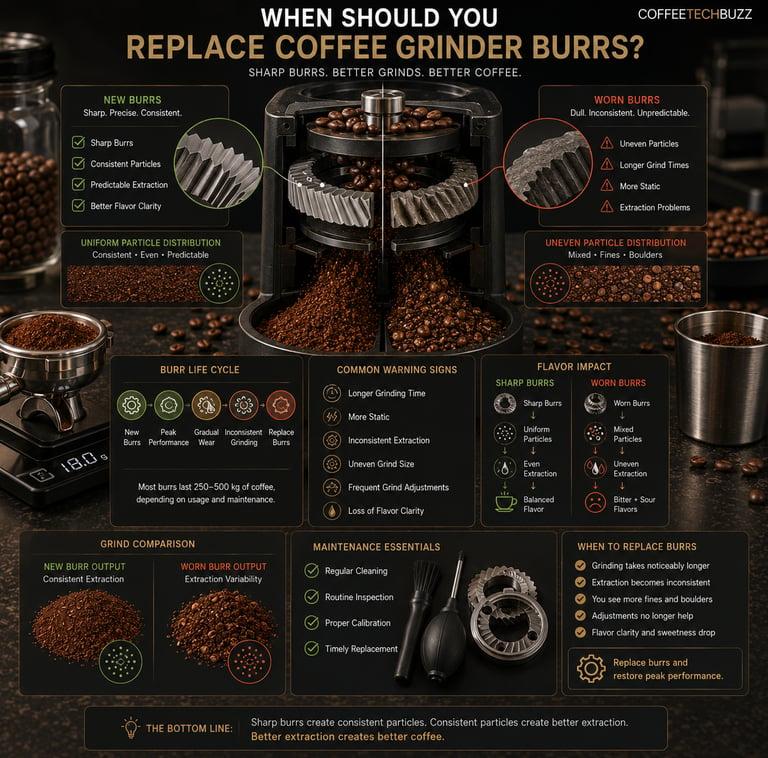
Coffee grinder burrs consist of two abrasive surfaces—typically flat or conical—that crush and shear whole coffee beans into smaller, more consistent particles. Unlike blade grinders that chop irregularly, burr grinders rely on the precision and sharpness of these burrs to provide uniform grind size tailored to brewing methods. The burrs' design defines particle distribution by controlling resistance during bean passage; sharper burrs produce cleaner breaks with a narrow size spread whereas worn burrs result in a broader particle range and visible inconsistencies.
In practical terms, burr condition governs grind repeatability. As burrs wear down, their edges dull and distances between surfaces change, altering grind size at set adjustments. Maintaining burr integrity is therefore crucial for consistent dose preparation and, ultimately, cup quality. From extraction analysis to recipe tuning, knowing the burrs are sharpening and consistent reduces guesswork. Understanding How Grinder Burrs Affect Coffee Flavor helps connect burr condition directly to extraction quality.
Signs That Indicate It's Time to Replace Grinder Burrs
Burr wear rarely becomes abrupt. Instead, coffee enthusiasts often experience a gradual loss of grind uniformity and a change in grinder behavior. One initial symptom is an increase in grind particle size variance despite unchanged grind settings. This manifests as uneven extraction, where some grounds over-extract while others under-extract, resulting in muddled or muted flavors.
Another indication involves the grinding process itself: if grinding takes noticeably longer or produces more static cling than before, the burrs’ edges may have dulled, causing inefficient bean shearing. Additionally, if you find yourself needing to adjust grind settings coarser or finer more frequently without an expected flavor or extraction response, burr wear is likely influencing these inconsistencies. Even subtle shifts can accumulate over multiple brews, making the task of reproducing a preferred cup frustrating.
If possible, visually inspecting the burrs by disassembling the grinder can reveal rounded or chipped edges, further confirming wear. This step is more practical with burrs designed for user access and replacement. Regardless, addressing these early signals by planning burr replacement prevents extended flavor degradation.
Factors Affecting Burr Lifespan and Wear Rates
The longevity of coffee grinder burrs depends on several interrelated factors. Primarily, burr material greatly impacts wear resistance. Steel burrs provide solid performance and durability, suitable for most home applications, while ceramic burrs offer enhanced hardness and resistance but tend to be more brittle. Hardened alloys can push this further in commercial settings, balancing longevity and consistent grind quality.
Design differences between flat and conical burrs also influence wear patterns. Flat burrs engage a larger contact surface simultaneously, which may lead to gradual wear distributed evenly, whereas conical burrs emphasize point contact that can wear unevenly depending on grind size settings.
User behavior affects lifespan significantly. Grinding very fine increases abrasion and accelerates burr dulling due to increased friction. Grinding larger doses or incorporating beans with varied hardness and moisture content compounds wear. Frequent grind size adjustments introduce subtle pressure changes, and, over time, all these variables contribute to inconsistent burr contact and faster deterioration.
Maintenance routines and cleaning frequency moderate wear effects. Accrued coffee oils and fragments can act like abrasive compounds between the burr surfaces, hastening edge dullness and reducing sharpness. Proper preventive care preserves burr integrity and prolongs service intervals.
How to Maintain and Clean Burrs to Extend Their Life
Consistent burr maintenance is a prerequisite to extend burr lifespan and uphold grind consistency. The process begins with regular cleaning tailored to your grinder type and usage. Removing residual coffee particles and oils that trap static and invite accelerated wear can be done by brushing the burrs and surrounding mechanisms frequently.
Periodic, more thorough cleaning detaches the burr set (following manufacturer guidelines) for a deep cleanse, ensuring no fine dust or buildup disturbs the burr interface. Avoid using water unless explicitly safe for your grinder, as moisture can cause corrosion, especially on steel components.
Depending on grinder design, recalibrating adjustments after cleaning or burr replacement restores accuracy in grind settings. This step prevents unintentional coarsening or fining that muddles brewing precision.
Understanding that burr maintenance is not an isolated task but part of an overall consistency workflow helps home baristas maintain control without chasing variables unnecessarily. Cleaning intervals depend on usage volume and coffee types but typically span from every few weeks to monthly for moderate home use. For a complete maintenance routine, see How Often Should You Clean a Grinder? Essential Guide for Coffee Lovers.
Step-by-Step Guide to Replacing Coffee Grinder Burrs
Replacing burrs requires deliberate process control to avoid introducing elements that cause inconsistency. Begin by sourcing burrs matching your grinder’s make and model closely since design tolerances influence final grind performance. Installation of incorrect burrs risks damage or unpredictable grind outcomes.
Once replacement burrs arrive, disconnect and clean the grinder thoroughly. Consult the manual for removal steps; commonly this involves unscrewing retaining nuts or sliding burr carriers out without force. Handle components gently to prevent damage.
After removal, inspect the mounting point for wear or buildup and clean as needed. Install the new burr set carefully, aligning according to manufacturer instructions typically marked with alignment pins or slots.
Once assembled, recalibrate the grind settings. This may include resetting zero points or dialing in initial grind sizes depending on whether burr dimensions or spacing slightly differ from the previous set.
Test grinding small amounts to observe uniformity, adjusting settings incrementally. Tracking flavor outcomes linked to these adjustments informs when your replacement burrs have restored optimum consistency.
Impact of Burr Wear on Brew Consistency and Flavor
Grind particle size distribution heavily dictates extraction rates and flavor balance. Burr wear erodes the precision necessary to produce the targeted grind profile, which causes uneven extraction. This unevenness manifests as less clarity, diminished sweetness, heightened bitterness, or sourness—depending on which particle fractions dominate.
Moreover, worn burrs often increase fines (tiny particles), which accelerate over-extraction, and coarse particles that under-extract, compounding negative flavor attributes. These inconsistent grounds also alter coffee bed permeability in brewing devices, resulting in unpredictable flow rates.
Beyond flavor, extraction inconsistency can skew espresso shot timing or pour-over flow, disrupting established brewing protocols. This sensitivity explains why small burr wear changes may evade casual notice initially but accumulate to reduce cup quality over repeated brews.
Choosing the Right Replacement Burrs for Your Grinder
Selecting replacement burrs demands attention to material compatibility, size, and design. Using burrs specified by the manufacturer ensures preservation of grind uniformity and prevents mechanical issues. Substituting burrs with different dimensions, materials, or mounting configurations risks misalignment and inconsistent grinding forces.
Investing in higher-grade replacement burrs, such as those with hardened steel or ceramic finishes, can yield improved wear resistance and longer service life, although this depends on grinder compatibility.
Additionally, consider the ease of burr replacement in your grinder model. Home grinders designed with straightforward burr access allow regular inspection and swaps, facilitating ongoing control over grinding precision.
If you're evaluating grinder upgrades while replacing burrs, our roundup of the Best Coffee Grinders Under $300 highlights several models with user-friendly maintenance and burr replacement systems.
Internal references to coffee grinder pillar articles on grinder burr maintenance provide in-depth technical explanations on burr materials and design choices, assisting in informed decisions before purchase or replacement.
Common Mistakes
One frequent error is delaying burr replacement until grind quality noticeably suffers. By then, flavor profiles have degraded, and extraction timing may have drifted, requiring complex recalibrations.
Neglecting proper burr cleaning accelerates wear through retained oils and residual grounds. This oversight shortens burr service life despite infrequent replacement intentions.
Another mistake involves assuming all burrs wear out at uniform rates. Factors like burr material, grind settings, and usage volume cause significant variability, so expectations should reflect individual circumstances rather than generalized norms.
Using incorrect replacement burrs due to convenience or cost savings compromises grinder performance and often leads to additional repair costs or inconsistent brewing results.
Some overlook subtle early warning signs, such as increased particle size spread or minor flavor inconsistencies, which typically precede full burr dullness. Attuning sensitivity to these early indicators can prevent extensive decline.
Understanding Why Your Grinder Isn’t Consistent can also help identify symptoms that are often caused by burr wear rather than brewing technique.
FAQ About Coffee Grinder Burr Replacement
How often should I replace coffee grinder burrs?
Replacement frequency varies with usage and burr type but typically falls between 300 and 800 pounds of coffee ground. For home enthusiasts grinding small daily doses, this translates to roughly one to two years. Monitoring grind consistency and visual inspections remain the best practices.
What are the signs my grinder burrs are worn?
Uneven grind size distribution at a stable grind setting, longer grinding times, increased static buildup, and frequent need to adjust grind settings without expected extraction responses usually signal wear.
Can I sharpen coffee grinder burrs instead of replacing them?
While theoretically possible, sharpening burrs is generally impractical for most home grinders due to precise angles and small tolerances. Replacement burrs offer restored sharpness and predictable results without the complexity of sharpening.
Does burr material affect lifespan and replacement frequency?
Yes. Ceramic burrs usually last longer due to hardness but are more brittle, while steel burrs wear faster but withstand impact better. Hardened alloys offer balance but depend on application specifics.
How does burr wear impact coffee brewing flavor?
Worn burrs lead to inconsistent grind sizes causing uneven extraction. This results in muted, bitter, sour, or muddled flavors and overall decline in cup clarity and balance.
What maintenance steps help prolong burr life?
Regular cleaning to remove coffee oils and fragments, periodic deep cleans, and calibrations combined with gentle handling during grind size adjustments extend burr longevity.
Are replacement burrs easy to install on home grinders?
Installation difficulty varies by model. Some home grinders provide user-friendly burr access and replacement, while others require professional servicing. Confirm ease of replacement when selecting grinders.
Is it better to replace burrs or buy a new grinder?
If grinder mechanics remain sound, replacing burrs is cost-effective and restores performance. However, very old or low-quality grinders may not justify burr replacement costs, making new grinder investment more sensible.
Practical Conclusion
Maintaining coffee grinder burrs within an optimal condition window is essential for brewing consistency and flavor fidelity. Rather than relying on guesswork, assessing burr wear through observable signs and regular maintenance establishes a foundation for controlled brewing outcomes. Recognizing that burrs are precision tools subject to gradual dulling allows home baristas to plan ahead, minimizing flavor inconsistencies and workflow disruption.
Replacing burrs at appropriate intervals, matched to your grinder and usage patterns, reinstates sharpness and grind uniformity vital for predictable extraction. Integrating this practice into an overall coffee preparation system creates a reliable baseline from which further recipe refinement and brewing precision become practical.
For those serious about repeatability rather than experimentation, understanding the relationship between burr wear, maintenance, and flavor control is non-negotiable. Consistent replacement and care ensure that the grinder remains a dependable partner, not an unpredictable variable, in crafting the perfect cup.
Contact@TheBuzzHQ.com
© 2026 Coffee Tech Buzz. All rights reserved.
Coffee Tech Buzz
Smarter brewing through better gear, clearer insights, and real-world performance testing.
Built for home users who want consistency without guesswork.
We focus on how machines actually perform — not just what they claim.
Home
Coffee Equipment Guide
Coffee Makers & Machines
Coffee Grinders
Espresso Gear & Guides
Coffee Beans & Roasts
Coffee Accessories & Tools
For educational purposes only.
We may earn commissions from qualifying purchases.
General Inquiries: