
How Grinder Burrs Affect Coffee Flavor
Explore how grinder burrs influence coffee flavor by controlling grind consistency, heat generation, and extraction for balanced and predictable brews.
COFFEE GRINDERS
The Coffee Tech Buzz Editorial Team - Led by AJ “Buzz” Eichman
5/31/20268 min read
Grinder burrs are the foundation of any coffee grinding process, and their influence extends well beyond merely turning whole beans into grounds. The geometry, size, and condition of these burrs dictate grind consistency, which in turn controls how evenly coffee extracts during brewing. This extraction uniformity is essential for achieving balanced coffee flavor and aroma, making grinder burrs a critical variable in the pursuit of predictable, repeatable results. Understanding how different burr types and sizes affect grind quality provides the clarity needed to tailor your equipment for optimal coffee flavor. For a broader look at grinder performance, brewing consistency, and equipment choices, start with our Coffee Grinders guide. Understanding how grinder adjustments affect extraction becomes much easier when paired with a proper Complete Espresso Grinder Guide.
Quick Verdict
Grinder burrs determine particle size distribution, directly influencing extraction and coffee flavor.
Flat burrs generally yield narrower grind particle ranges but tend to generate more heat compared to conical burrs.
Larger burr diameters facilitate faster grinding with reduced heat buildup, especially beneficial for fine grind settings.
Burr condition and sharpness critically sustain grind consistency; regular maintenance and timely replacement are necessary.
Matching burr type and size with your brewing method and workflow ensures better flavor control.

What Are Grinder Burrs and How They Work
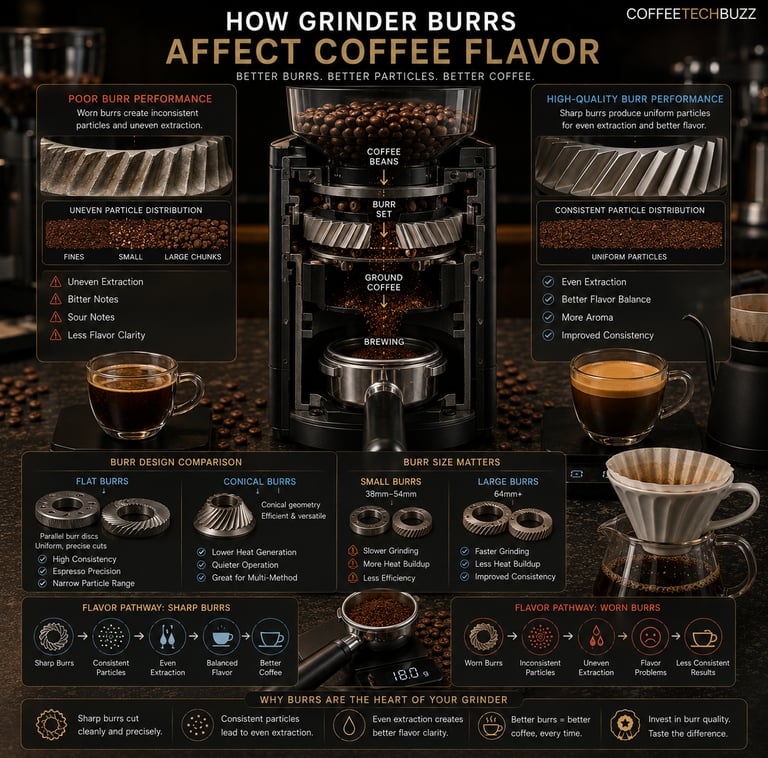
Grinding coffee does not just reduce beans to smaller particles; it is a precise mechanical process shaped by the burrs at the heart of the grinder. Burrs are hard, abrasive discs or cones that crush the coffee beans between them, slicing rather than pulverizing. The space between the burrs governs the resulting grind size, while their sharpness and alignment maintain the uniformity of particle size.
The importance of this uniformity is often underestimated. A consistent grind produces coffee particles that extract at relatively the same rate. This controlled extraction prevents certain grounds from over-extracting into bitterness while others under-extract into sourness or thinness. Grind inconsistency leads to unpredictable extraction, which invariably shows up in the cup as imbalance or flatness.
As burrs grind beans, they can also produce frictional heat. Excess heat risks premature and uneven extraction by drying particles or degrading aromatic compounds before brewing even begins. Burr design and size influence this heat generation, a factor often overlooked yet significant for preserving coffee flavor integrity. Understanding How Grind Size Affects Taste: A Guide to Perfect Coffee helps connect burr performance directly to flavor outcomes.
Types of Burrs: Flat vs Conical
Understanding the two primary burr types—flat and conical—reveals how their distinct geometries impact grind quality and flavor outcomes.
Flat burrs consist of two parallel discs that rotate against each other. This arrangement offers close tolerances and tends to produce a more uniform particle size distribution. Such consistency favors precise brewing methods like espresso, where particle size control is paramount. However, the close contact between flat burrs can generate more heat during grinding, which, in high-volume or prolonged use, risks affecting coffee aroma retention.
Conical burrs have a conical outer burr working against a ring-shaped inner burr; this design produces slightly less frictional heat because of reduced surface contact and slower rotation speeds. Conical burrs tend to generate coarser grind distributions with a few fines, which actually benefit some brewing styles like drip and immersion, where a certain range of particle sizes facilitates balanced extraction. Additionally, conical burrs often operate more quietly and require less cleaning, factors relevant for workflow and daily use.
The choice between flat and conical burrs is not about superiority but suitability. Flat burr grinders offer enhanced grind uniformity and work well for users prioritizing espresso or fine, precise grind control. Conical burr grinders excel when preserving aroma and handling larger batches at moderate grind sizes, making them ideal for drip or French press in many home setups. For a deeper comparison, see Flat Burr vs Conical Burr Grinders for Espresso: Which Is Better?
Impact of Burr Size on Grinding Performance
Burr size, typically measured by diameter, affects grinding speed, heat generation, and ultimately, flavor consistency. Larger burrs allow beans to enter and exit grinding surfaces more quickly, reducing the time particles spend exposed to frictional heat. This speed helps maintain bean integrity by minimizing thermal degradation of volatile oils that contribute to coffee aroma and flavor.
Additionally, larger burrs provide higher capacity for fine grinding without slowing the process excessively. This aspect is crucial for espresso enthusiasts who need fine consistency but benefit from efficient grinding to avoid overheating or flavor loss. Conversely, smaller burrs must rotate faster to maintain throughput, which often increases heat and accelerates burr wear.
It's important to recognize that burr size must align with your brewing method and household volume. Larger burrs facilitate quick grinding for multiple cups with consistent particle size, while smaller burrs can suit low-volume users prioritizing compact form or specific grind ranges. Neglecting burr size considerations can result in suboptimal heat buildup or inconsistent grind speeds, complicating repeatable extraction and flavor control.
How Burr Condition Affects Grind Consistency
Burrs are not permanent fixtures; their grinding edges dull with use, and this deterioration profoundly impacts grind uniformity. Worn burrs produce broader particle size distributions, introducing an increased proportion of fines and boulders. Such inconsistent particle size causes uneven extraction, amplifying bitterness or under-extraction based on which particles dominate.
Wear also diminishes the burrs' ability to crush beans cleanly, sometimes forcing grinders to operate at higher speeds or extra passes for desired fineness, which increases heat further. If burrs become misaligned or develop cracks, grinding inefficiency escalates, making consistent flavor control unreliable.
Routine burr maintenance—cleaning, inspection, and timely replacement—is key to maintaining a consistent grind profile. Many grinders specify replacement intervals based on usage, ranging from several hundred to a few thousand pounds of coffee processed. Ignoring burr wear is often the unseen cause behind sudden shifts in coffee taste and extraction behavior, especially for home users who expect steady performance across brews.
Burr Material and Its Influence on Flavor
Materials used in burr manufacturing—usually hardened steel or ceramic—also have subtle impacts on grind quality and durability. Steel burrs are prevalent for their sharp edge retention and toughness, but they can warm up more quickly during extended grinding due to heat conduction. Ceramic burrs, while harder and often slower to wear, tend to generate less frictional heat and preserve aromatic compounds better, albeit sometimes at the expense of increased brittleness and risk of chipping.
Neither material choice inherently guarantees superior flavor; maintenance, burr geometry, and grinder design matter more. Still, the thermal properties and sharpness retention of the material will influence how long grinders deliver consistent results before tedious replacements are necessary.
Brewing Methods and Suitable Burr Choices
The relationship between burr type, size, and brewing method is conditional on how grind size influences extraction dynamics. Espresso demands extremely fine and consistent grounds to ensure uniform extraction within a brief contact time under pressure. Flat burrs with larger diameters excel here by providing narrow particle distributions and faster grinding while managing heat buildup.
For drip brewing or immersion methods like French press, a broader particle size can actually promote more nuanced flavor development, as extraction unfolds over longer times at lower temperatures. Conical burrs’ tendency toward a wider particle size range can complement these methods by fostering balanced extraction and preserving aroma, especially when paired with medium to coarse grind sizes.
Users looking to switch between multiple brewing methods should either seek burr grinders with adaptable burr sets or consider grinders designed to perform well across a range of grind profiles. Assessing your favorite brewing styles should guide burr selection more than brand marketing or price. If you're shopping for one, our roundup of the Best Coffee Grinders for Espresso includes several grinders known for burr quality and consistency.
Common Grinding Mistakes to Avoid
Several pitfalls with burr grinders undermine flavor consistency, often without immediate notice. Neglecting burr wear is paramount among these, as dull burrs degrade grind uniformity and cause unpredictable extraction. Overlooking this factor creates repeated flavor inconsistencies that users mistakenly attribute to bean freshness or brewing technique.
Another common error involves confusing burr types without regard for intended grind size and brewing method. For example, using a grinder with small flat burrs aimed at espresso exclusively may not provide the coarser grind necessary for a balanced French press extraction.
Ignoring the effects of burr size on grinding speed and heat transfer also undermines flavor control. Some users unintentionally push grinders to fine settings beyond their burrs’ optimal capacity, resulting in excessive heat generation that dulls taste clarity.
Finally, many fail to recalibrate grind size after burr replacements or adjustments. Such recalibration is necessary because new burrs may differ slightly in geometry and sharpness compared to worn ones. Skipping this step risks inconsistent particle size and extraction imbalance.
Maintaining and Replacing Burrs for Best Results
To preserve consistent coffee flavor, routine maintenance of burrs is non-negotiable. This includes regular cleaning to remove residual oils and fines that clog burrs and reduce cutting efficiency. Using manufacturer-approved brushes or compressed air without disassembling the grinder ensures burr surfaces remain sharp and aligned.
Monitoring grinder performance over time—a subtle increase in grind time or variation in particle size—signals when burrs may require replacement. Keeping track of coffee quantity processed assists in estimating burr lifespan. Choosing grinders with easy burr access and replacement enhances sustainable, long-term consistency.
Replacing burrs does not simply restore original performance; it also necessitates recalibrating grind settings. The new burrs’ slight geometric differences mean previous grind adjustments may no longer yield the same particle size. Fine-tuning after replacement ensures the repeatability of extraction profiles essential for flavor control. For guidance on timing, see When Should You Replace Coffee Grinder Burrs?
Internal Linking
For deeper insight into grinder performance, readers may consult our pillar article on grinders which breaks down the mechanics of various grinder models and their suitability for different brewing needs. Exploring brewing methods more broadly, including immersion and pressure techniques, can clarify why grind particle size uniformity matters; resources on brewing methods and techniques provide this context. Lastly, for those evaluating equipment upgrades, comparisons between conical and flat burr grinders provide practical information on balancing speed, noise, and flavor precision.
Frequently Asked Questions
How do grinder burr types affect coffee taste?
Grinder burr type influences particle size distribution and heat generation during grinding, which together impact extraction uniformity and aroma preservation. Flat burrs produce more uniform grinds suitable for espresso precision, while conical burrs offer slightly broader distributions that benefit drip and immersion methods by enhancing flavor complexity.
What is the ideal burr size for home espresso vs drip coffee?
Larger burrs (around 50mm+) are desirable for home espresso grinders due to their ability to grind finer with less heat and faster speed. Drip coffee can accommodate smaller burrs because it requires coarser grinds and is less sensitive to slight inconsistencies, allowing more flexibility in burr size.
How often should coffee grinder burrs be replaced?
Replacement intervals vary based on grinder use and burr material but typically range from 500 to 1500 pounds of coffee ground. Signs such as increased grind time, inconsistent particle size, or diminished flavor clarity indicate it’s time to replace burrs.
Does burr material influence coffee aroma retention?
Yes, burr material affects heat conduction during grinding. Ceramic burrs tend to heat less than steel, preserving delicate aromatic compounds better, though this effect is subtle and depends heavily on grinder design and usage patterns.
What grinding mistakes impact extraction the most?
Neglecting burr wear, using inappropriate burr types for the brewing method, grinding too fine or coarse without recalibration, and failing to maintain burr sharpness consistently produce uneven extraction and off-flavors.
Can burrs cause overheating of coffee beans?
Excessive friction between burrs, especially smaller or dull ones, can elevate grinding temperature, risking premature aroma degradation. Proper burr size, sharpness, and grinding technique help minimize heat buildup.
What are the benefits of flat vs conical burrs?
Flat burrs provide tighter grind particle uniformity ideal for espresso and fine control, while conical burrs generate less heat and noise with more forgiving particle distributions suited to drip and immersion brewing.
How does grind consistency affect coffee flavor?
Grind consistency ensures even extraction, preventing over-extraction bitterness and under-extraction sourness, thus producing more balanced, predictable coffee flavor and aroma.
Conclusion
Grinder burrs, though small components within the coffee-making workflow, exert a profound effect on the resulting coffee flavor through precise control of grind consistency and heat management. Selecting the appropriate burr type and size aligned with your brewing method and usage habits forms the basis for a repeatable and balanced extraction. Maintaining burr sharpness and replacing them at suitable intervals prevent silent deterioration of grind quality that undermines flavor clarity. Recognizing these variables and acting deliberately rather than impulsively empowers you to make coffee that meets exacting standards cup after cup. In this way, grinder burrs are not just parts of a machine but critical tools in mastering coffee’s complexity.
Contact@TheBuzzHQ.com
© 2026 Coffee Tech Buzz. All rights reserved.
Coffee Tech Buzz
Smarter brewing through better gear, clearer insights, and real-world performance testing.
Built for home users who want consistency without guesswork.
We focus on how machines actually perform — not just what they claim.
Home
Coffee Equipment Guide
Coffee Makers & Machines
Coffee Grinders
Espresso Gear & Guides
Coffee Beans & Roasts
Coffee Accessories & Tools
For educational purposes only.
We may earn commissions from qualifying purchases.
General Inquiries: