
Do You Need a Grinder for Espresso? Essential Insight for Coffee Lovers
Discover why an espresso grinder is essential for precision brewing, consistency, and rich flavor in every shot of espresso.
ESPRESSO
The Coffee Tech Buzz Editorial Team - Led by AJ “Buzz” Eichman
4/14/20268 min read
Espresso brewing hinges on precision—a control of variables that influences every milliliter pulled from the portafilter. Among these variables, grind size stands as one of the most critical elements in the pursuit of consistency and quality. The question “Do you need a grinder for espresso?” is not about convenience but about ensuring predictable extraction and authentic flavor clarity. While it might seem possible to rely on pre-ground coffee or multipurpose grinders, the nuances of espresso demand a dedicated approach. Understanding why a specialized espresso grinder matters requires examining how grind size directly affects extraction dynamics and how this links to the performance of espresso-specific brewing equipment. For a full system overview, see the Espresso pillar.
Quick Verdict
Consistent espresso extraction demands a finely tuned, uniform grind size, achievable only through a dedicated espresso grinder.
Regular coffee grinders lack the micro-adjustment capability and particle uniformity to reliably produce espresso-standard grind profiles.
A precision espresso grinder supports control over key variables such as dose, particle size distribution, and freshness, all impacting crema, flavor clarity, and body.
Investing in a dedicated espresso grinder optimizes repeatability and makes it easier to maintain steady shot times, enabling real control rather than guesswork.
Why Grind Size Matters in Espresso Brewing
Espresso requires a relatively fine grind, typically in the range of 200 to 400 microns, substantially finer than the medium or coarse settings used for methods like drip or French press. The grind size regulates flow rate through the puck, controlling extraction time and intensity. Finer grinds increase resistance and slow water flow, which extends contact time and results in a richer extraction. Conversely, a coarser grind allows water to pass too quickly, producing under-extracted, thin espresso with muted aromatics and weak crema.
Moreover, consistency in particle size—achieved through a quality burr grinder—is as important as the grind itself. Irregular particles lead to channeling, where water takes the path of least resistance, causing uneven extraction and flavor imbalance. These inconsistencies frequently manifest as bitterness or sourness, as different particle sizes extract unevenly under pressure. This is usually where results start to vary without people realizing why, especially when grinding methods or tools lack precision. These issues are often easier to diagnose when comparing Why Espresso Tastes Sour and Why Espresso Tastes Bitter.
Can You Use a Regular Grinder for Espresso?
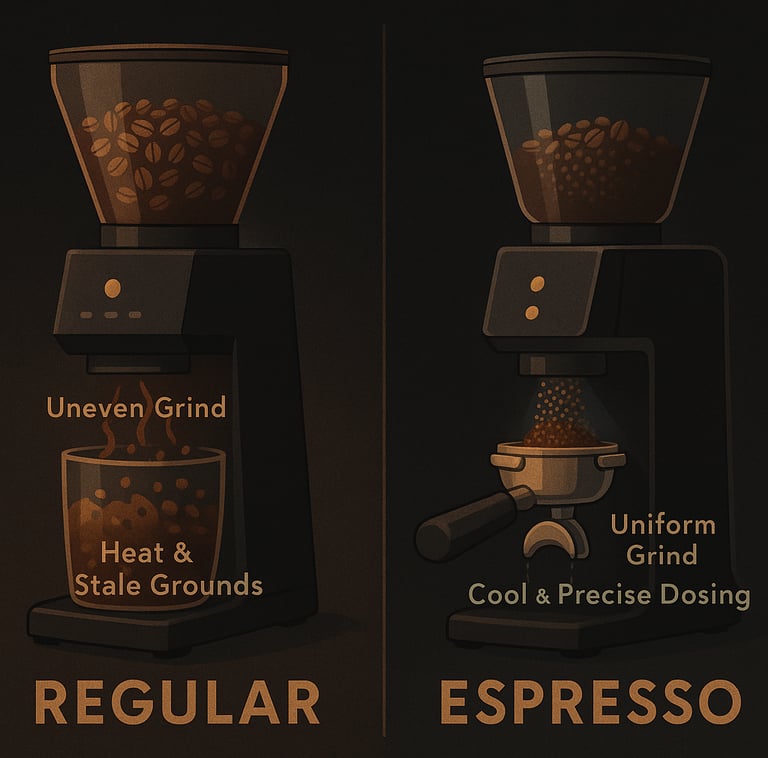
It is technically possible to attempt espresso extraction using a regular coffee grinder, particularly burr grinders designed primarily for drip or pour-over. However, this approach almost always compromises quality and consistency. Standard grinders typically do not offer the stepless or micro-adjustable settings required to dial in the grind precisely for espresso. These coarser grinders often produce broader particle distributions, with a mix of fine and larger particles, which destabilizes flow and extraction.
Another concern lies in grinder heat and retention. Regular grinders may generate more heat during operation, negatively affecting bean oils and freshness. Excessive grind retention means stale grounds mix with fresh, which dilutes flavor clarity shot after shot. These equipment limitations contribute to inconsistent extraction times and trouble maintaining stable shot profiles over repeated brews—something that dedicated espresso grinders mitigate by design. For a complete dialing workflow, see How to Dial in Espresso.
Features That Make an Espresso Grinder Special
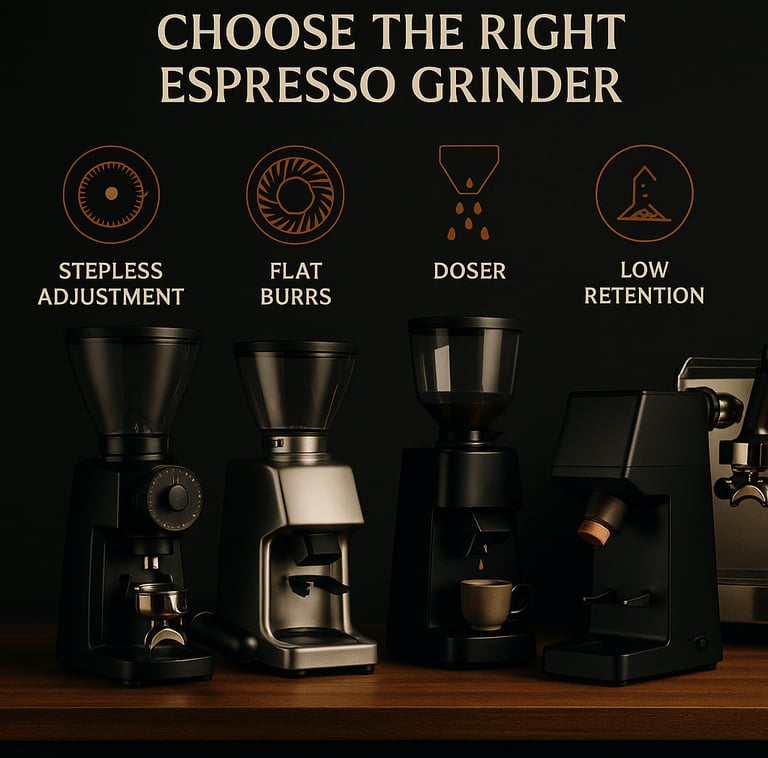
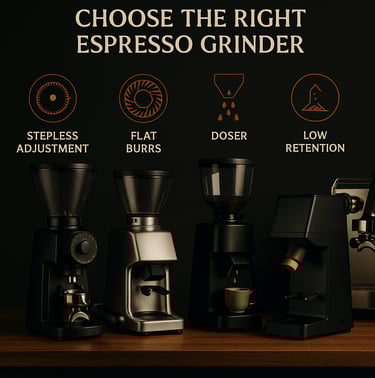
Dedicated espresso grinders provide several features that support repeatability and control critical to espresso brewing. First is stepless grind adjustment, which allows for very fine micro-tuning of particle size. This precise control is necessary because small adjustments in grind often yield significant changes in flow and extraction quality.
High-quality burrs—either flat or conical—constructed from steel or ceramic enhance consistency and durability. Flat burrs generally produce a more uniform particle size distribution, while conical burrs operate with less heat generation. Espresso grinders also often incorporate low retention designs or single-dosing capabilities, reducing stale grounds and ensuring freshness.
User-friendly dosing systems, including doser chambers or timed electronic doses, streamline grinding workflow and contribute to dose consistency. This uniformity matters because slight variations in dose combined with inconsistent grind size are sources of unpredictable extractions.
How to Choose the Right Grinder for Your Espresso Setup
Selecting an espresso grinder should begin with the intended use case and level of control desired. For home use, a grinder featuring stepless or very fine gradation adjustment, durable burrs, and low grind retention typically offers the best performance. Understanding that grind size affects not only extraction time but also taste profile encourages a focus on quality over price.
Budget considerations are valid but must be balanced against long-term repeatability. The trajectory from simpler to more advanced grinders is usually driven by experience and a desire for finer control. Choosing grinders capable of upgradeable components or easy maintenance ensures longevity. Comparing options like Best Coffee Grinders for Espresso helps narrow down reliable choices.
Additionally, consider the integration with your espresso brewing equipment: grind size range, dosing volume, and grind consistency all influence workflow efficiency. This holistic view supports achieving predictable results, not just an arbitrary equipment purchase.
Common Mistakes in Grinding for Espresso
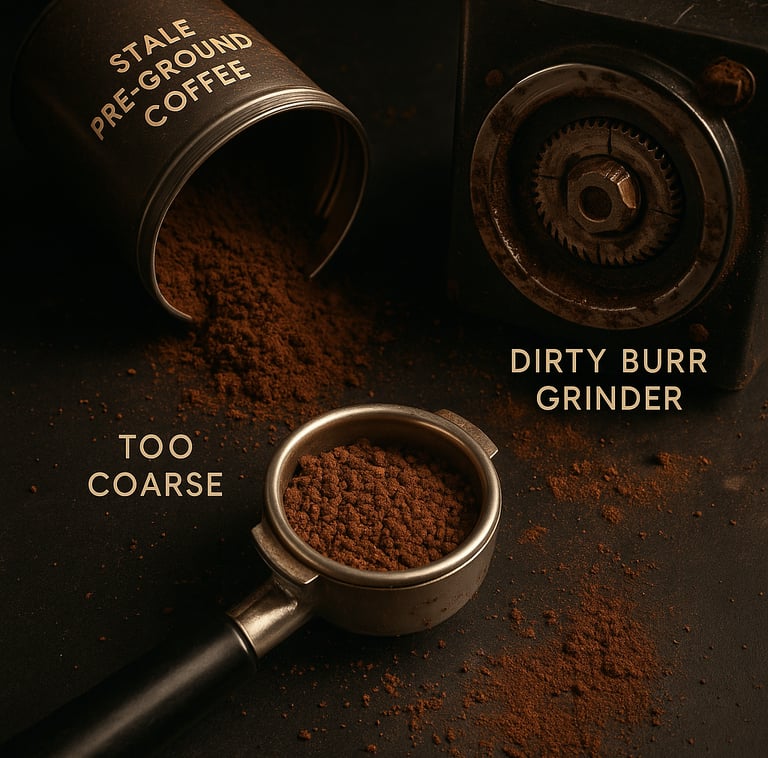
Using pre-ground coffee or stale grounds is the most common error that reduces espresso vibrancy and crema quality. Ground coffee begins to lose volatile aromatics and oils within minutes, so freshness directly impacts flavor clarity.
Another frequent mistake is attempting to grind espresso with a setting suitable only for coarser brews. Neglecting to adjust grind size when changing beans, roast levels, or environmental conditions (such as humidity) results in inconsistent extraction times and uneven flavor profiles.
Ignoring burr maintenance also affects performance. Dull or misaligned burrs produce uneven particles, making repeatable extraction difficult. Similarly, overlooking dosing consistency—such as using variable scoops instead of scales or disregarding grind retention—adds further unpredictability to shots.
Technical Insights: Burr Types and Grind Adjustment
Burr grinders come mainly in two varieties for espresso: flat burrs and conical burrs. Flat burrs often yield greater particle uniformity, which supports cleaner extraction and balanced crema. Conical burrs, on the other hand, are quieter, generate less heat, and typically require less maintenance, though they may produce slightly broader grind distributions.
Stepless grind adjustment is a particularly valuable feature for espresso. It allows almost infinite changes in grind size, making it possible to compensate for slight variations in beans or machine performance. Unlike stepped grinders, where adjustment increments are fixed, stepless grinders support fine-tuning essential for espresso’s tight extraction window.
When adjusting the grind, even a small change tends to show up more than expected in the final cup. A finer grind increases resistance, slowing extraction and producing heavier body and sweetness; a coarser grind reduces resistance, accelerating water flow and exposing undesirable acidity or under-extraction.
Real-World Espresso Grinding Scenarios and Tips
A home barista aiming for consistent results will benefit most by focusing first on controlling grind size. Begin with a baseline setting established through timed shots and taste evaluation. From there, keep records of grind adjustments alongside changes in dose, tamp pressure, and yield ratio to isolate variables systematically. For deeper ratio control, see Espresso Ratio Explained.
Routine maintenance—cleaning burrs and calibrating grinder settings—should be part of your workflow rather than an afterthought. Neglecting this is usually where results start to drift over time.
If you brew espresso alongside other methods, consider multi-purpose grinders with espresso options, but remain aware that compromises in grind precision occur. In such cases, single dosing or dedicated espresso grinders become tools for refining shots.
Maintenance and Accessories for Consistent Espresso Grinding
Maintaining burrs by regularly cleaning and replacing them as needed prevents degradation in grind quality. This is crucial because burr wear alters grind particle distribution subtly but significantly. Employing a quality grinder brush and cleaning schedule is standard practice among experienced baristas.
Accessories such as precision scales for dosing, tampers with consistent pressure, and grinding chambers designed to minimize retention improve overall repeatability. Single dosing grinders reduce stale coffee issues, allowing for immediate grinding before extraction—which has a direct influence on flavor freshness. Tools from Best Espresso Scales and Best Espresso Tampers are key here.
Consider also the workflow impact of features like timed dosing, dose catchers, or grind bins designed for easy transfer to portafilters. These elements reduce variables and speed up consistency during preparation.
Common Mistakes When Grinding for Espresso
The pitfalls in espresso grinding often stem from assuming that one setting fits all situations. Pre-ground coffee neglects grind freshness entirely, resulting in flat and dull espresso. Using coarse settings designed for other brew methods leads to under-extracted shots. Furthermore, failing to recalibrate grind size with changes in bean roast level or environmental humidity introduces instability in extraction.
Burr neglect—such as not cleaning or replacing worn burrs—degrades grind consistency, while inconsistent dosing methods add another layer of unpredictability. These issues cumulatively undermine espresso quality in ways many overlook until patterns are established.
FAQ
Do I really need a grinder specifically for espresso?
Yes, because espresso requires a finely tuned and uniform grind that general coffee grinders typically cannot provide consistently. A dedicated espresso grinder allows for precise adjustments critical to achieving the optimal extraction balance.
Can I use a regular coffee grinder to make espresso?
While possible, using a typical coffee grinder designed for drip or other methods often results in uneven particle size distribution and inconsistent extraction times, diminishing espresso quality and flavor clarity.
What grind size is best for espresso?
Espresso grind size usually ranges from 200 to 400 microns, significantly finer than other brew methods. The exact setting varies with the machine, beans, and environment but must be uniform and adjustable to suit these factors.
How often should I adjust grind size for espresso brewing?
Adjustments should be routine whenever you change beans, roast levels, or notice shifts in extraction time or taste profile. Environmental factors like humidity also prompt changes. Tracking adjustments precisely helps maintain consistency.
What is the difference between burr types in espresso grinders?
Flat burrs generally provide more uniform particle sizes beneficial for espresso, while conical burrs tend to run cooler and quieter with less maintenance. Each burr type affects grind texture slightly differently and suits personal preferences and grinder models.
How important is grind freshness for espresso quality?
Extremely important. Coffee begins to lose flavor and aromatic compounds moments after grinding. Grinding immediately before brewing preserves the essential oils and aromatics that define espresso’s rich character.
Are there affordable options for a good espresso grinder?
Yes, several budget-friendly grinders offer stepless adjustments and quality burrs sufficient for home espresso. However, one should weigh durability and upgrade potential alongside price to ensure satisfactory long-term performance.
What accessories improve espresso grinding consistency?
Precision scales, high-quality tampers, grinder cleaning kits, and single-dosing tools improve control over dose, tamp pressure, burr maintenance, and freshness—all contributing to repeatable espresso shots.
Conclusion
Grinding plays a foundational role in espresso brewing that directly influences every other aspect of the process. While it is tempting to bypass a dedicated espresso grinder, the lack of precise control over particle size and consistency almost invariably compromises extraction quality. A grinder designed specifically for espresso supports the delicate balance of flow rate, extraction time, and flavor clarity. Treating coffee preparation as a methodical process—not just a casual routine—means recognizing the importance of freshness, uniformity, and repeatability. For those serious about making espresso predictable rather than a hit-or-miss effort, investing in a dedicated espresso grinder aligned with your setup and skill level is essential. The predictability born from precise grind control ultimately defines the difference between a mediocre shot and one worthy of the term espresso.
For equipment upgrades that support grinder precision, exploring options like Best Espresso Machines helps align your full setup for consistency.
Contact@TheBuzzHQ.com
© 2026 Coffee Tech Buzz. All rights reserved.
Coffee Tech Buzz
Smarter brewing through better gear, clearer insights, and real-world performance testing.
Built for home users who want consistency without guesswork.
We focus on how machines actually perform — not just what they claim.
Home
Coffee Equipment Guide
Coffee Makers & Machines
Coffee Grinders
Espresso Gear & Guides
Coffee Beans & Roasts
Coffee Accessories & Tools
For educational purposes only.
We may earn commissions from qualifying purchases.
General Inquiries: