

What Is Backflushing?
Discover the importance of backflushing for espresso machines, how it works, and how to do it right to maintain consistent coffee quality.
ESPRESSO
The Coffee Tech Buzz Editorial Team - Led by AJ “Buzz” Eichman
6/11/20267 min read
Maintaining consistent espresso quality requires attention not only to coffee beans, grind size, and extraction time, but also to the condition of the espresso machine itself. Among the essential maintenance procedures, backflushing stands out as a targeted cleaning method designed to clear coffee oils, solids, and residues that accumulate inside the group head and internal components.
Neglecting this process often leads to subtle but persistent changes in flavor and machine performance that are otherwise difficult to diagnose. Understanding what backflushing is, how it works, and the correct technique for performing it can help home baristas and professionals alike preserve the precision of their espresso extraction.
As part of Espresso Gear & Guides, backflushing plays a major role in the maintenance routines covered throughout the Espresso Machine Cleaning & Maintenance Guide.
Quick Verdict
Backflushing is a cleaning process that pushes water and detergent backward through the espresso machine’s group head to remove oil buildup and coffee residues.
Performing backflushing regularly prevents clogging, maintains consistent water flow, and supports espresso flavor stability.
Not every espresso machine supports backflushing; confirming your machine’s design is critical before attempting this procedure.
Backflushing complements but does not replace full descaling, which addresses mineral deposits elsewhere in the machine.
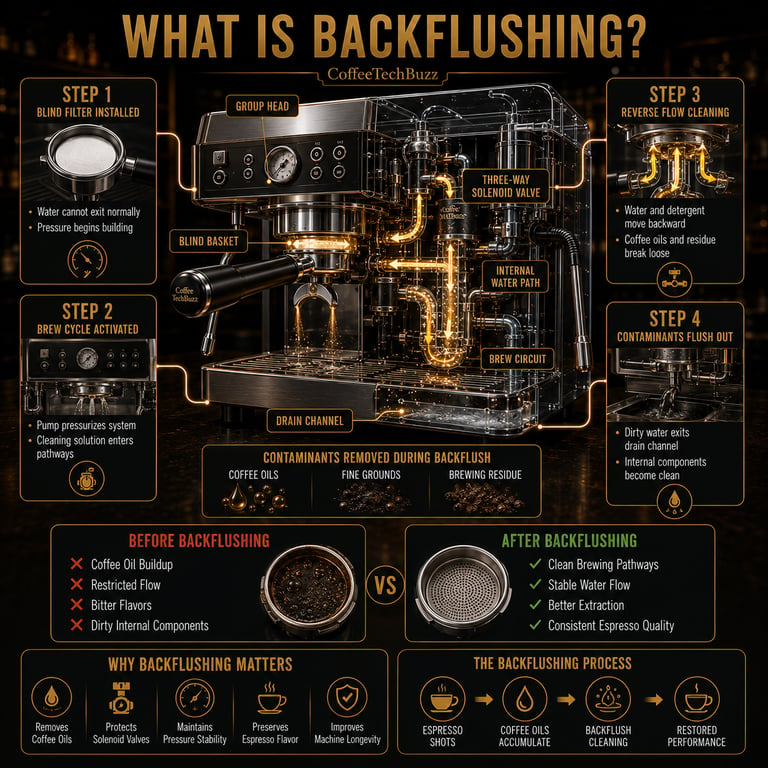
What Is Backflushing? The Basics
At its core, backflushing reverses the normal flow of water through an espresso machine’s brewing circuit by introducing water and cleaning detergents from the portafilter side, rather than forcing water from the boiler through the coffee grounds to the cup.
This reversal is accomplished using a blind or blank filter basket that lacks any openings. When the machine pumps water with a blind basket attached, the liquid cannot exit through the portafilter spouts. Instead, pressure builds up and causes water to flow backward through internal passages, reaching the group head, solenoid valve, and other critical components that routinely encounter oily coffee residues.
The purpose of this process is to dislodge and flush out accumulated coffee oils, fine grounds, and other organic matter that gradually build up during normal espresso preparation. These deposits affect extraction by obstructing water flow, altering pressure dynamics, and introducing stale flavors.
Unlike surface cleaning or group head brushing, backflushing targets internal elements that cannot be manually accessed. Its effectiveness depends on the use of appropriate cleaning agents that emulsify oils without leaving lingering residues. For product recommendations, see Best Espresso Machine Cleaning Tablets.
How Does Backflushing Work in Espresso Machines?
Successful backflushing relies heavily on specific machine design features, primarily the existence of a three-way solenoid valve. This valve regulates pressure release and flow direction during both brewing and cleaning cycles.
During the cycle, water is forced into the group head under pressure while the blind filter prevents forward flow. Detergent introduced into the filter basket suspends oils and fine particles. The repeated pressurization and release intervals agitate and loosen deposits without excessive stress on machine components.
Each backflush typically lasts 10 to 15 seconds and is repeated multiple times within a session to enhance cleaning efficacy and ensure thorough rinsing.
Many users don't realize that neglected coffee oils are one of the biggest contributors to the problems discussed in Why Espresso Machines Taste Worse Over Time.
Step-by-Step Guide: How to Backflush Your Espresso Machine
Proper execution of backflushing depends on careful adherence to cycle timings, detergent amounts, and manufacturer recommendations.
Begin by ensuring your espresso machine supports backflushing—consult your manual or manufacturer’s resources before proceeding. Use detergents specifically designed for espresso machine backflushing, as general cleaning agents may leave damaging residues or fail to emulsify coffee oils appropriately.
Insert the blind filter into your portafilter and dose it as you would for a normal brew, or leave it empty depending on the instructions.
Add the manufacturer-recommended amount of cleaning detergent to the blind filter.
Lock the portafilter into the group head securely.
Start the brew cycle to run water through the system. The machine’s pump will force water backward due to the blind filter.
Run the pump for about 10–15 seconds, then stop to allow detergent and water to loosen deposits.
Repeat the cycle 4–5 times, following the recommended total number of flushes.
Remove the detergent by running several rinse cycles without the detergent, using plain water each time.
Remove the blind filter and resume normal espresso preparation.
Some home machines include automatic backflushing programs, while others require manual operation. It is best to stick to cycle durations and detergent quantities precisely, as overuse or short cycles may either leave residues or fail to adequately clean.
For a complete walkthrough of the process, see How to Backflush an Espresso Machine.
Benefits of Regular Backflushing
The consistent practice of backflushing delivers several key benefits that extend beyond simply cleaning the machine.
First and foremost, it ensures more predictable espresso extraction by maintaining stable water flow paths within the group head and minimizing resistance variations caused by buildup.
Over time, accumulated oils become rancid and introduce off-flavors to espresso shots. Removing these residues preserves the intended flavor profile of fresh coffee.
Another benefit lies in protecting machine components. Solenoid valves, group heads, and gaskets exposed to coffee oil deposits can degrade prematurely without regular cleaning.
Backflushing also helps prevent clogging issues that reduce pump efficiency and water pressure consistency — both of which become noticeable almost immediately in shot quality.
Staying current with backflushing routines usually avoids unscheduled maintenance or costly service calls. Most users incorporate it into the schedules outlined in How Often Should You Clean an Espresso Machine?
Common Mistakes to Avoid During Backflushing
Several errors frequently undermine the effectiveness of backflushing or even cause damage when performed incorrectly.
Using detergents with excessive frequency or without proper rinsing leads to residue accumulation that dulls espresso flavors more than coffee oils do. It is important to reserve detergent use for an appropriate interval—often weekly or biweekly in home settings—and rinse sufficiently between sessions.
Attempting to backflush machines not designed for the process can damage seals, valves, and other parts due to incompatible hydraulic layouts. Verify machine compatibility before using blind filters or detergents.
Likewise, using an incorrect blind filter that does not fully seal the group head may cause water to leak forward, negating backflushing effects.
Another common mistake is confusing backflushing with descaling. Descaling targets mineral buildup in boilers and pipes, whereas backflushing focuses on organic residues in the brew group. To understand the differences, see Espresso Cleaning Tablets vs Descaling Solutions.
Insufficient cleaning cycle duration or detergent dosing often leads to partial cleaning. This incomplete process can result in buildup persisting unnoticed, which eventually affects espresso quality.
Backflushing vs Descaling: What’s the Difference?
Backflushing and descaling are two distinct maintenance practices targeting different internal issues within espresso machines.
Backflushing removes coffee oils and grounds from the group head and solenoid valve area using a blind filter and detergent designed to break down organic residues.
Descaling uses acidic solutions to dissolve mineral scale deposits—such as calcium and magnesium—that accumulate from hard water inside boilers, pipes, and heating elements.
For descaling product recommendations, see Best Espresso Machine Descaling Solutions.
While both procedures influence machine performance and coffee quality, they are not interchangeable. Skipping one or the other increases the risk of unpredictable extraction changes or component failures.
Regular backflushing keeps coffee pathways clear, whereas descaling preserves heating efficiency and water flow. In practice, backflushing should be done weekly or biweekly depending on usage, and descaling usually scheduled quarterly or biannually based on water quality and manufacturer recommendations.
How Often Should You Backflush?
Frequency is directly linked to machine usage and environment.
In commercial or busy home setups pulling multiple shots daily, backflushing is typically performed every 1–2 days to maintain cleanliness and consistent pressure characteristics.
For casual home users, weekly or biweekly backflushing is generally sufficient.
It is important to observe taste and flow characteristics to judge timing. Signs that your machine requires backflushing include slower flow rates, altered pressure profiles, or flavor imbalances such as increased bitterness or dullness appearing over multiple shots.
Manufacturer instructions provide the best baseline for frequency, but personal use patterns and water quality might necessitate adjustments.
Troubleshooting Backflushing Issues
If you notice diminished cleaning results or problems arising during backflushing, a closer look at technique and equipment compatibility is necessary.
Incomplete cleaning cycles often manifest as persistent off-flavors or recurring flow blockages. Ensure that you are running adequate flush times as specified and that the detergent used is meant for backflushing, not generic dish soap or detergents.
Leaks or water flow continuing through the portafilter spouts during backflushing could indicate a poor seal on the blind filter, requiring a replacement or checking for debris on filter edges.
Additionally, if the machine lacks a three-way solenoid valve, backflushing will not work and attempting it risks mechanical failure.
If machine performance deteriorates despite regular backflushing, evaluate the need for descaling and consider professional servicing to inspect valves and seals.
Frequently Asked Questions
What exactly is backflushing and why is it necessary?
Backflushing is a cleaning procedure that reverses water flow through the espresso machine’s group head using a blind filter and detergent to remove oil and coffee residue buildups that degrade espresso quality and machine function.
How often should I backflush my espresso machine at home?
Generally, backflushing once a week or every two weeks is appropriate for most home espresso machines, but frequency depends on shot volume and taste observations.
Can I backflush any espresso machine?
No. Only machines with a three-way solenoid valve and compatibility with blind filters should be backflushed. Check your machine manual or manufacturer resources before proceeding.
What cleaning agent should I use for backflushing?
Use detergents specifically formulated for espresso machine backflushing, which emulsify coffee oils effectively without leaving harmful residues.
What is the difference between backflushing and descaling?
Backflushing removes coffee oils and grounds from the group head, while descaling dissolves mineral scale deposits inside boilers and plumbing components. Both are necessary but address different maintenance needs.
Can backflushing damage my espresso machine?
If done correctly following manufacturer guidelines, backflushing does not damage your machine. However, improper technique, wrong detergent use, or backflushing incompatible machines carries risk.
How do I know if my machine supports backflushing?
Check your machine’s manual or official documentation for mention of backflush procedures, blind filter compatibility, and the presence of a three-way solenoid valve.
What are signs that my machine needs backflushing?
Slowing water flow, inconsistent extraction pressure, off-flavors shifting toward bitterness or stale notes, and visible residue on group heads are indicators that backflushing is due.
Conclusion
Backflushing remains a keystone maintenance practice for achieving consistent espresso quality and preserving machine longevity. Its precise technique targets internal residues that fundamentally alter flow dynamics and taste profiles over time.
While requiring attention to machine design and cycle procedures, backflushing is not optional for serious espresso enthusiasts who demand repeatability rather than guesswork. Incorporating backflushing alongside complementary tasks such as group head brushing and descaling establishes a routine that keeps performance predictable and coffee flavors pure.
For anyone invested in their espresso’s consistency, mastering backflushing offers control over an otherwise invisible but powerful variable.
Given the technical nature of backflushing, investing in compatible accessories like recommended blind filters and cleaning detergents is worthwhile. Additionally, understanding your espresso machine’s engineering—especially the role of the solenoid valve—clarifies why the process works and how minor neglect can cascade into bigger problems.
Treat your machine as a precision tool; backflushing is one of the calibrated adjustments that ensure it stays that way.

Contact@TheBuzzHQ.com
© 2026 Coffee Tech Buzz. All rights reserved.
Coffee Tech Buzz
Smarter brewing through better gear, clearer insights, and real-world performance testing.
Built for home users who want consistency without guesswork.
We focus on how machines actually perform — not just what they claim.
Home
Coffee Equipment Guide
Coffee Makers & Machines
Coffee Grinders
Espresso Gear & Guides
Coffee Beans & Roasts
Coffee Accessories & Tools
For educational purposes only.
We may earn commissions from qualifying purchases.
General Inquiries: